“Neptune’s disappearing clouds linked to solar cycle | CNN”


Neptune


Astronomers have been puzzling over a mystery on Neptune, and now they think they have unlocked its secret.

The ice giant’s ghostly, cirrus-like clouds largely disappeared four years ago. Today, just a patch hovers over the planet’s south pole.

Thanks to an analysis of nearly three decades’ worth of Neptune observations captured by three space telescopes, scientists have determined the ice giant’s diminished clouds may indicate that shifts in their abundance are in sync with the solar cycle, according to a recent study published in the journal Icarus.

Read the full article here.

Link contributed by Gene Savoy, Jr.


“Bizarre ‘failed star’ the size of Jupiter is 2,000 degrees hotter than the sun”


white dwarf star


A newly discovered star system is breaking records — and helping scientists unravel the mysteries of an extreme type of planet known as hot Jupiters. In a paper published Aug. 14 in the journal Nature Astronomy, researchers describe how the system could help further our understanding of worlds beyond our solar system.

The binary system, located 1,400 light-years away, consists of a “white dwarf” and a “brown dwarf.” White dwarfs are the crystalline cores of large stars that ran out of fuel and collapsed under their own gravity.

Read the full article here.


“Black holes may be hurtling around at 10 percent the speed of light”


black holes merging


Black holes have a speed limit. When two black holes collide, the larger black hole created in the merger can be blasted off by the energy of the collision, and now we know the highest speed possible from this recoil process.

Read the full article here.


“Black Hole Theory Finally Explains How Galaxies Form”


galaxy


One of the great mysteries in astronomy is how galaxies form. At issue is why stars gather into “island universes” rather than spreading out evenly through the universe.

One clue comes from the observation that most galaxies contain massive black holes at their centers. That has led to the proposal that galaxies form around black holes which act as seeds for this process.

Read the full article here.


“When two stars orbit each other, gravity gets weird”


binary star


The idea of gravity as we know it has been around for a long time. More than 300 years ago, Isaac Newton first shared his theory of gravitation, describing how massive objects are attracted to each other. Then, around a hundred years ago, Albert Einstein refined and expanded upon Newton’s ideas to create the theory of relativity—explaining gravity as the way objects, especially at the extremes across the universe, warp the fabric of space around them.

Read the full article here.


“Hubble telescope captures a ‘ghostly’ galaxy glowing in distant space (photo)”


lenticular galaxy


A new image from the Hubble Space Telescope captures a distant galaxy cloaked in a ghostly haze. The recent image was taken using Hubble’s Advanced Camera for Surveys.

Known as NGC 6684, this lenticular galaxy — a cross between a spiral and an elliptical galaxy — is located roughly 44 million light-years from Earth in the constellation Pavo. Lenticular, or lens-shaped, galaxies have a central bulge and disk, but lack distinct arms like those found in spiral galaxies such as the Milky Way.

Read the full article here.


“ Solar Cycle 25 more active and powerful than predicted”


sun


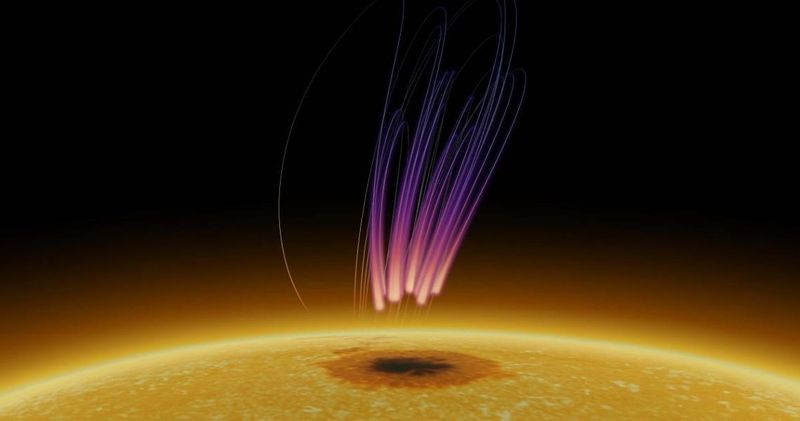
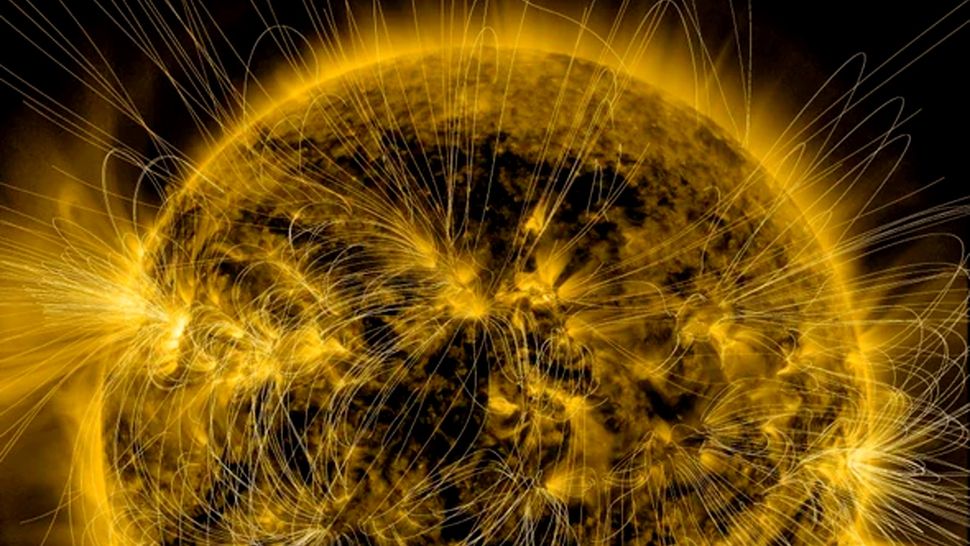
Sun activity has been low in recent days. But we’re currently heading toward another peak in the sun’s 11-year cycle of activity. And Solar Cycle 25 has already proven surprising. The maximum activity was predicted to occur in 2025. But solar activity has already exceeded that predicted maximum. So we’ve been seeing more geomagnetic storms, more auroral displays, and more potentially hazardous conditions for satellites in low-Earth orbit.

Read the full article here.


“The centuries-long effects of Saturn storms”


Saturn with mega-storm


Saturn is the 2nd-largest gas giant in our solar system. It’s the 6th planet outward from the sun. It’s a step beyond from Jupiter, the largest planet. And, like Jupiter with its iconic Great Red Spot – Saturn also has mega storms. They look like great white ovals on Saturn that can grow to stretch partway around the planet! On August 11, 2023, researchers said the aftereffects of the Saturn mega storms can last hundreds of years.

Read the complete story here.


“Scientists at Fermilab close in on fifth force of nature”


Fermilab


Scientists near Chicago say they may be getting closer to discovering the existence of a new force of nature.

They have found more evidence that sub-atomic particles, called muons, are not behaving in the way predicted by the current theory of sub-atomic physics.

Scientists believe that an unknown force could be acting on the muons.

More data will be needed to confirm these results, but if they are verified, it could mark the beginning of a revolution in physics.

Read the complete story here.

Link contributed by Gene Savoy, Jr.


“Scientists Find Record-Breaking Planet-Like Object Hotter Than The Sun”


brown dwarf


An object orbiting a star 1,400 light-years away is seriously confronting our notions of what’s possible in the Universe.

It’s a brown dwarf, the curious category of objects that straddle the gap between planets and stars, but it’s on such a close orbit with its very hot host star that its temperature exceeds a blistering 8,000 Kelvin (7,727 degrees Celsius, or 13,940 Fahrenheit) – hot enough to snap apart the molecules in its atmosphere into their composite atoms.

Read the complete story here.