“Astronomers Have Discovered A Mysterious Object, Which Is 570 Billion Times Brighter Than The Sun”


bright supernova


Billions of light years away, there is a giant ball of hot gas that is brighter than hundreds of billions of suns. It is hard to imagine something so bright. So what is it? Astronomers are not really sure, but they have a couple theories.

They think it may be a very rare type of supernova — called a magnetar — but one so powerful that it pushes the energy limits of physics, or in other words, the most powerful supernova ever seen as of today.

Click here to read the complete article.


“A new Earthlike planet in the distant Kuiper Belt?”


Kuiper belt and Oort cloud


Japanese researchers said this month (September 7, 2023) that a possible Earthlike planet – with a mass some 1.5 to 3 times that of our home world – is lurking in the far, frozen reaches of our own solar system. And its presence could explain the unexpected behaviors of some of the strangest objects orbiting our star.

Astronomers Takashi Ito and Patryk Sofia Lykawa probed this realm of space using a special computer program – called an N-body simulation – that simulates the gravitational interactions of solar system bodies.

Read the entire article here.


“Star blows giant exoplanet’s atmosphere away, leaving massive tail in its wake”


star blasting exoplanet


A planet located 950 light years from Earth is explosively losing its atmosphere and creating a tail that is around 18 times the size of Jupiter in the process. This makes the gaseous tail one of the largest planetary structures seen outside the solar system.

The extra-solar planet, or exoplanet, known as HAT-P-32 b has a mass around 68% that of Jupiter but is twice as wide as the solar system’s largest planet. HAT-P-32 exists just 3.2 million miles from its parent star, or about 3% of the distance between Earth and the sun, and completes an orbit every 2.2 days. This proximity means the gas giant is roasted by radiation from its parent star, classifying HAT-P-32 b as a “hot Jupiter” planet.

Read the entire article here.


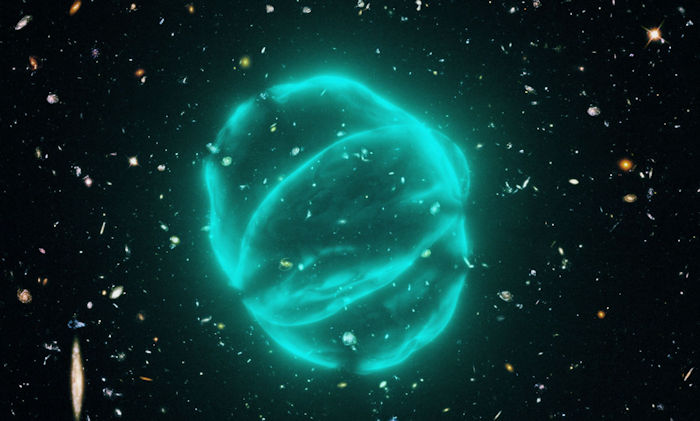
“A billion-light-years-wide bubble of galaxies found!”


bubble of galaxies


Astronomers in Hawaii said this week (September 5, 2023) that they’ve discovered an immense bubble 820 million light-years from Earth. They called it:

… a fossil-like remnant of the birth of the universe.

And they said its size – a billion-light-years in diameter – is:

… beyond theoretical expectations.

Read the full article here


“’Cosmic cannonballs’ exploding out of dead star could explain mysterious flicker in the night sky”


Pulsar and companion star


Astronomers have solved the decade-long mystery of how a bizarre cosmic object toggles rapidly between “high” and “low” energy states: by launching plasma cannonballs from its orbit.

The object in question is a pulsar — a type of extremely magnetic neutron star. Like other neutron stars — the remnants of massive stars that have collapsed — pulsars are extremely dense and tend to spin quickly around their axes. But unlike other neutron stars, a pulsar emits bright beams of electromagnetic radiation from its poles. This gives it the appearance of “pulsing” in space, like a lighthouse beacon viewed from a distance.

Read the full article here


“University of Michigan scientists study giant black hole that destroyed a massive star”


Black hole tidal disruption event


A research team used NASA’s Chandra X-ray Observatory and ESA’s XMM-Newton to study the amount of nitrogen and carbon near a black hole that was known to have torn a star apart. Astronomers believe the nitrogen and carbon were created inside the star as it neared the black hole before it was ripped apart.

“We are seeing the guts of what used to be a star,” said Jon Miller, U-M professor of astronomy who led the study. “The elements left behind are clues we can follow to figure out what sort of star met its demise.”

Read the full article here.


“Wandering Stars Pass Near Our Solar System Surprisingly Often”


Scholz's Star


Every 50,000 years or so, a nomadic star passes near our solar system. Most brush by without incident. But, every once in a while, one comes so close that it gains a prominent place in Earth’s night sky, as well as knocks distant comets loose from their orbits. 

The most famous of these stellar interlopers is called Scholz’s Star. This small binary star system was discovered in 2013. Its orbital path indicated that, about 70,000 years ago, it passed through the Oort Cloud, the extended sphere of icy bodies that surrounds the fringes of our solar system.

Read the full article here.


“How far back in time can we see?”


Earendel


The Hubble and James Webb Space Telescopes have observed the most distant star ever seen – Earendel – whose name means morning star. Even though Earendel is 50 times the mass of our sun, and millions of times brighter, we would not normally be able to see it. We can only see it due to an alignment of the star with a large galaxy cluster in front of it whose gravity bends the light from the star to make it brighter and more focused. The galaxy cluster essentially acts as a lens.

Read the full article here.


“NASA’s Webb Telescope captures the dying star ‘Ring Nebula’ in new detail”


Ring Nebula


NASA released new images Monday taken by the James Webb Space Telescope of the Ring Nebula – one of the first known examples of cosmic gas and dust formed by a dying star discovered by humans.

The Ring Nebula is an early example of a planetary nebula – when gases and emissions produced by a dying star emit a glowing, colorful shell.

Read the full article here.


“Solar Orbiter observes jets of material escaping the sun | CNN”


Solar mosaic


The Solar Orbiter mission has discovered jets of material rapidly releasing from the sun’s outer atmosphere.

Astronomers believe these jets could be the source of the solar wind, a stream of charged particles that continuously flows from the sun across the solar system. The jets of charged particles, called plasma, last between 20 and 100 seconds each and move at about 223,694 miles per hour (360,000 kilometers per hour).

Read the full article here.

Link contributed by Gene Savoy, Jr.