By Rafael Montoro Sep 10, 2024, 08:24 pm PST
The American carried out several expeditions in the Peruvian jungle and the Andes, obtaining good results. Among his most notable discoveries are Vilcabamba, the last Inca refuge from the Spanish invasion, and Gran Pajatén.
In 1957, the American received an invitation to join an archaeological excavation in Peru, but the project did not materialize.
In the vast lands of Peru, a man whose figure evoked that of ancient heroes, launched himself into adventure with immeasurable determination. His name remained in the shadows for a time, but his exploits expanded with the strength of someone who challenges the unexplored. From 1957 to 1984, this explorer crossed mountains, jungles and rivers with an almost supernatural energy, as if nature itself had chosen him to reveal its best kept secrets.
With his imposing appearance and a fame that extended beyond the borders, this adventurer could well have been the personification of ‘Indiana Jones’, the iconic character of Hollywood cinematography. Like the famous archaeologist, he combined an insatiable curiosity with indescribable courage, facing the dangers of Peru with audacity. His figure rose like a fictional hero made real.
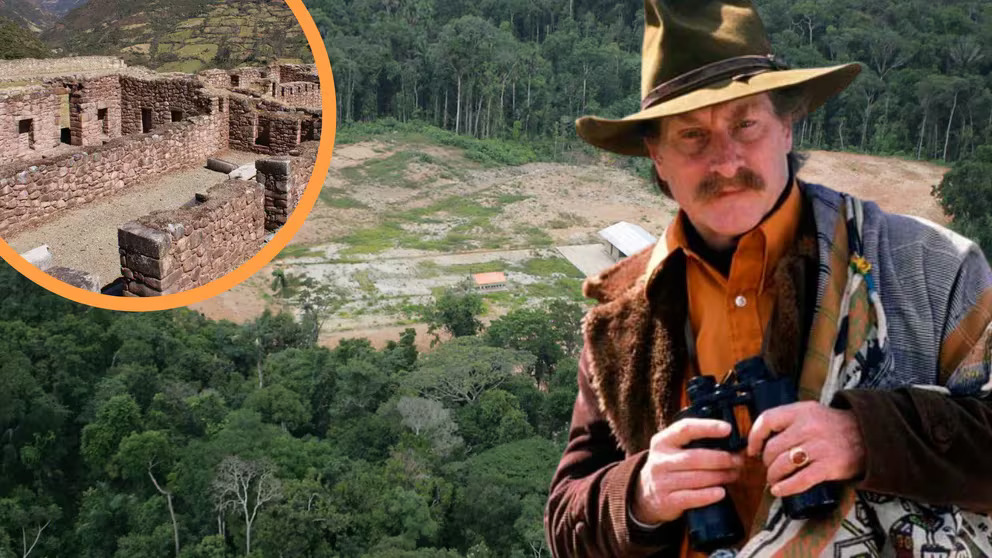
Douglas Eugene Savoy (1927-2007) is the name of the explorer described in the previous paragraphs. The man who first saw the light in Bellingham, Washington, was never destined for an ordinary existence. From the vastness of the north, something greater than himself led him to distant lands, where adventure awaited him with open arms, as if his essence was predestined to conquer the unknown.
His restless spirit led him to transcend the borders of his native country, becoming an explorer of legendary proportions, a man who, far from being contained by the known world, set out to discover the hidden mysteries in the vast lands of Peru and beyond.
Eugene Savoy began his academic training at the Jesuit University of Portland, initially attracted by a religious vocation. However, his passion for ancient cultures and indigenous peoples soon led him to abandon these studies to devote himself to folklore, archaeology, mythology, religion and the ethnography of American civilizations.
In 1957, the American received an invitation to join an archaeological dig in Peru , but the project did not materialize. Despite this, his visit to the Andean country became a turning point. He decided to settle in Peru and embark on an exploration mission that would last until 1984. During this extensive period, he discovered more than 40 lost cities of various pre-Columbian cultures . His work offered Peruvians a new understanding of their historical heritage.

In 1965, upon arriving at Gran Pajatén, Savoy discovered sculptures depicting condors and figures adorned with halos. (El País)
In the 1960s, Douglas Eugene Savoy carried out several expeditions in the Peruvian jungle, the Andes and the Amazon, obtaining good results. Among his most notable discoveries were Vilcabamba , the last Inca refuge from the Spanish invasion, and Gran Pajatén . For the explorer, these sites were tangible proof of his theory on the origin of Andean cultures.
In his view, the roots of these civilizations were not in the Andean valleys, but in the jungle regions. With these discoveries, he challenged traditional conceptions about the origin of Andean cultures
The adventurer shared his experiences about the places he explored in a conversation with Discovery Networks , whose channel broadcast his statements through a documentary. “I explored all of Ecuador, Colombia, Venezuela, (as well as) all the tributaries of the Amazon (…) I found nothing. Honestly, if there were ruins there, I would have found them. They are not there, they are in Peru ,” he said.
For decades, Savoy devoted himself to exploring the most remote regions of Peru. His search for pre-Columbian ruins took him through the vast Peruvian jungle and valleys, discovering ancient cities and villages that had remained hidden. His tireless and meticulous work allowed him to document more than 40 collections of ruins, which are located throughout the country.
Regarding his findings, the explorer said the following: “We found about 40 sites located in 40 different places. (They were) linked by stone paths and each one included between 400 and 500 buildings,” he said in the documentary by the international media.
In 1965, upon arriving at Gran Pajatén, Savoy discovered sculptures depicting condors and figures adorned with halos. Throughout his life full of adventures and explorations, he followed his dreams with determination and managed to obtain these remarkable discoveries.
Historian Santiago Tácunan Bonifacio, in his article “An explorer passionate about Peru,” pointed out the other places that the American discovered. “His history is little known among Peruvians, despite being the discoverer of important archaeological remains such as Vilcabamba (the last refuge of the Incas, in Cusco), the Gran Pajatén (an ancient pre-Incan stone city in the San Martín region), the Gran Vilaya (an intricate stone structure that covers more than 250 square kilometers of dense jungle, in Chachapoyas), among other architectural evidence located in eastern Peru,” he said.
Ultimately, the explorer was not only dedicated to adventure , but also to an intense work of dissemination. Over the years, he produced a wide range of books, articles and essays that shared his discoveries and knowledge with the world. In addition, he contributed to television documentaries that brought his findings and his passion for ancient cultures to a global audience.