“Stunning New Image Shows Black Hole’s Immensely Powerful Magnetic Field”


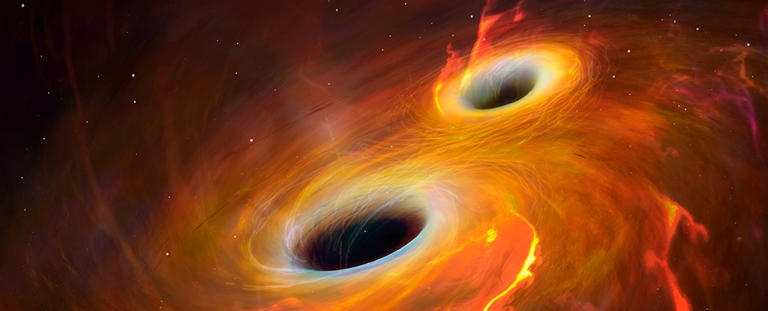
The clear, swirling lines give some hint at the supermassive black hole’s power: a spiraling magnetic field helping haul in just about anything that sits nearby. It’s the first time scientists have captured an image of the magnetic fields coiling around Sagittarius A*, or Sgr A*, a giant black hole at the center of the Milky Way with a mass four million times that of the sun.

Read the entire article here.


“Physicists Think The Infinite Size of The Multiverse Could Be Infinitely Bigger”


Not only does God play dice, that great big casino of quantum physics could have far more rooms than we ever imagined. An infinite number more, in fact.

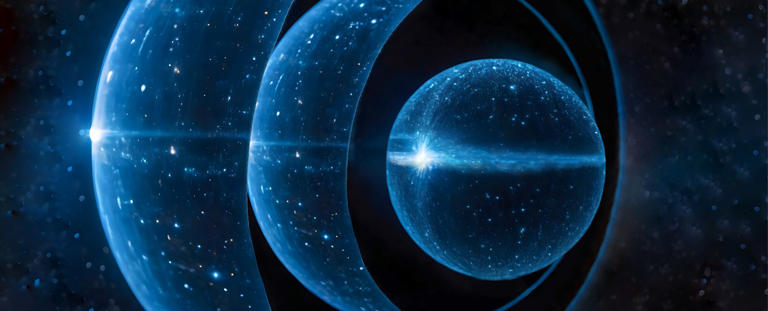
Physicists from the University of California, Davis (UCD), the Los Alamos National Laboratory in the US, and the Swiss Federal Institute of Technology Lausanne have redrawn the map of fundamental reality to demonstrate the way we relate objects in physics could be holding us back from seeing a bigger picture.

Click here to read the complete article.


“One of Life’s Most Important Ingredients Could Have Formed in The Hearts of Comets”


While details are understandably slim today, life on Earth is thought to have arisen about 4 billion years ago from a fateful blend of organic compounds popularly known as primordial soup.

Just how – and where – the ingredients for this proto-biological entree were generated is still a field of debate, given the timeline and surface conditions on a cooling baby Earth.

Click here to read the complete article.


“Extremely rare ‘stellar explosion’ will be visible to naked eye, will last for a week”


As if the recent total solar eclipse wasn’t enough, stargazers will now have another massive space event to look forward to.

According to astronomers, the stars of T Coronae Borealis (T CrB), which is a binary system roughly 3,000 light years away, will be visible during an extremely rare cosmic event later in 2024, according to Space.

A rare nova explosion is expected to be visible for an entire week. NASA currently says that the event could happen anytime between now and September.

Click here to read the complete article.


“𝐓𝐡𝐞 𝐒𝐮𝐧 𝐢𝐧 𝐗-𝐫𝐚𝐲𝐬 𝐟𝐫𝐨𝐦 𝐍𝐮𝐒𝐓𝐀𝐑”


Why are the regions above sunspots so hot? Sunspots themselves are a bit cooler than the surrounding solar surface because the magnetic fields that create them reduce convective heating. It is therefore unusual that regions overhead — even much higher up in the Sun’s corona — can be hundreds of times hotter.

Read the entire article here.


“Two ancient star streams that built early Milky Way galaxy found | CNN”


Astronomers have used the Gaia space telescope to spy some of the first building blocks of the Milky Way galaxy: two ancient streams of stars named Shakti and Shiva that helped our home galaxy grow and evolve more than 12 billion years ago.

Named after Hindu deities, the star streams appear to be the remnants of two galaxies that merged with an early version of the Milky Way between 12 billion and 13 billion years ago when the first galaxies were forming across the cosmos. The structures are so old that they formed well before the most ancient parts of the Milky Way’s iconic spiral arms and central disk.

Read the full article here

Link contributed by Gene Savoy, Jr.


“Jupiter’s stormy weather on display in new Hubble images”


  • New images of Jupiter from the Hubble Space Telescope as the whole gas giant rotates. These images provide insights into Jupiter’s stormy weather patterns.
  • Jupiter’s weather is intense, due to the fact that its atmosphere is tens of thousands of miles/ kilometers deep with no solid surface beneath. The thick Jovian atmosphere hosts big and little storms, including cyclones and anticyclones, some larger than Earth.
  • The new images show Jupiter’s famous Great Red Spot, plus what scientists call Red Spot Jr., a smaller anticyclone that brushes past the Great Red Spot about every two years.

Read the full article here.


“Possible Hycean world found by Webb telescope”


Meet TOI-270 d, a possible hycean world

  • Recent research suggests that exoplanet TOI-270 d is likely a hycean planet – a world with a global ocean beneath a thick hydrogen atmosphere – located 70 light-years from Earth.
  • But another research team thinks the planet is too hot to be considered hycean. Temperatures on its sunlit side might be as high as 7,200 degrees Fahrenheit (4,000 degrees Celsius).

Read the full article here.


“A Mysterious Wave-Like Structure in Our Galaxy Found to Be Slowly Slithering”


Gazing out upon the apparently unchanging sea of stars around us, it’s tempting to think of the Milky Way galaxy as static and everything within it as fixed and immutable.

While the timescales on which our galaxy moves often defy human experience, move it does indeed.

Not all of these dynamic processes are easy to see. Just a few years ago, scientists discovered a huge, wave-shaped structure extending some 9,000 light-years in length snaking along a spiral arm of the Milky Way, just 500 light-years from the Solar System at its closest point.

Read the full article here.


“Giant ‘bubble’ in space could be source of powerful cosmic rays”


space bubble


Astronomers have detected an enormous gamma-ray bubble that could be a source of the Milky Way’s most powerful cosmic rays — high-energy particles that rain down on Earth from space.

The turbocharged galactic accelerator — dubbed a ‘super PeVatron’ — is capable of blasting out cosmic rays at energies of at least 10 petaelectronvolts (PeV; 1016 electronvolts), pushing the upper limits of the energies such particles are thought to reach in the Milky Way.

Read the full article here.