“Extraordinary ‘Trinary’ Black Hole System Is The First of Its Kind Ever Found”


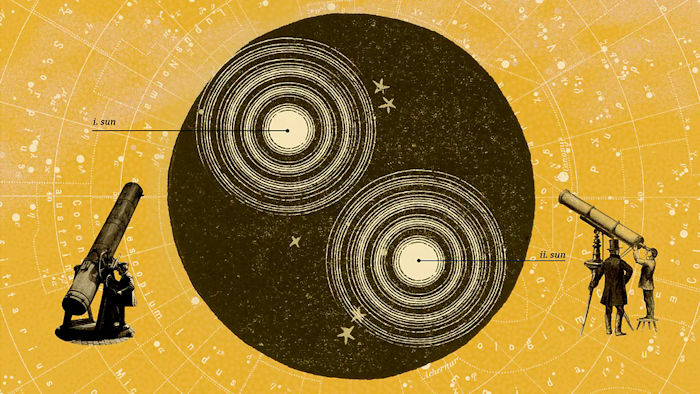
In the constellation of Cygnus, some 7,800 light-years from Earth, lurks a real space oddity. There, a black hole in a system named V404 Cygni repeatedly engages in behavior that has simultaneously baffled and delighted scientists.

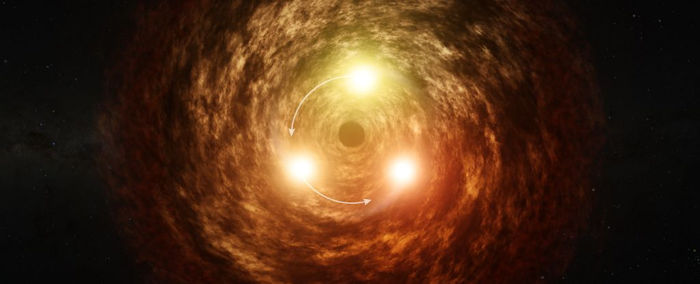
Now it’s whipped a brand new trick out of its seemingly endless arsenal: an unseen binary companion, a star on a wide orbit of around 70,000 years.

Since V404 Cygni already has a companion – a star on a close, 6.5-day orbit, on which the central black hole is leisurely feasting – the newly discovered third object makes the system a trinary.

Click here to read the full article.


“Astronomers Discover Complex Carbon Molecules in Interstellar Space”


A team led by researchers at MIT in the United States has discovered large molecules containing carbon in a distant interstellar cloud of gas and dust.

This is exciting for those of us who keep lists of known interstellar molecules in the hope that we might work out how life arose in the Universe.

But it’s more than just another molecule for the collection. The result, reported today in the journal Science, shows that complex organic molecules (with carbon and hydrogen) likely existed in the cold, dark gas cloud that gave rise to our Solar System.

Click here to read the full article.


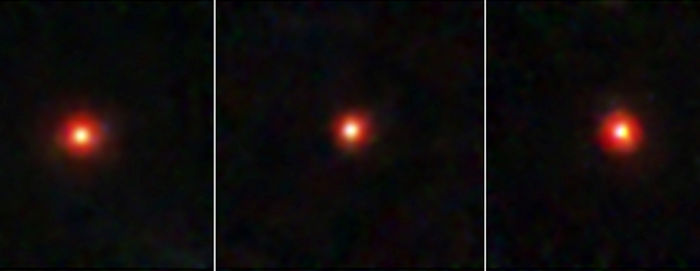
“After 29 years, first-known brown dwarf revealed as twins”


  • Brown dwarfs are ‘failed stars’ with masses greater than planets but less than stars. The first confirmed brown dwarf was Gliese 229 B in 1995.
  • But Gliese 229 B’s brightness is puzzling. Based on its mass, it should be much brighter, said astronomers.
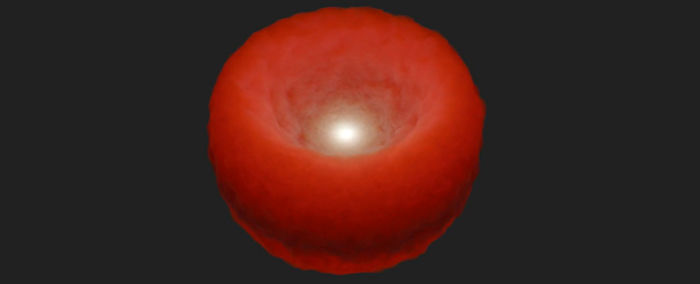
  • Now, astronomers say Gliese 229 B is two brown dwarfs, not one, as they originally thought. The researchers said the two brown dwarfs orbit extremely close together.

Click here to read the full article.


“12 breathtaking images from the 2024 Astrophotography Prize Photographer of the Year awards”


Striking. Vibrant. Dazzling. The adjectives to describe our universe are nearly infinite. And nowhere is that on display more than in the images from this year’s Astrophotography Prize Photographer of the Year awards.

Australian photographer Phil Hart took the top honors for his incredible image of the 2023 solar eclipse over Exmouth, Western Australia. Hart’s photo is one of the highest-resolution (white light) images of the solar corona ever documented, and its details are staggering. He created the image using multiple telescopes, video frames, and RAW exposures.

Click here to read the full article.


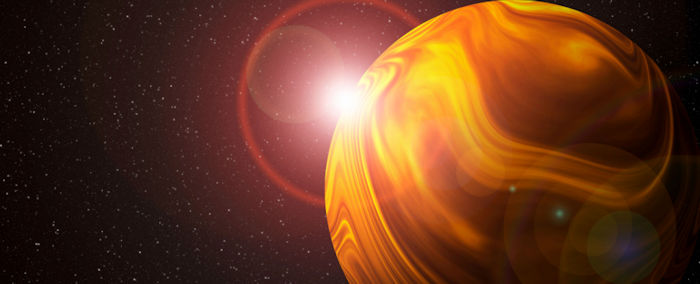
“A steam world exoplanet with an earthlike atmosphere?”


  • GJ 9827 d is an exoplanet orbiting a red dwarf star, some 98 light-years away. It’s about twice the size of Earth and searing hot.
  • It’s the smallest exoplanet so far where water vapor has been detected. But does it have a hydrogen atmosphere, or a more earthlike atmosphere?
  • New results from the Webb space telescope suggest an atmosphere dense with heavy molecules. This includes even more water vapor than first thought, suggesting the hot planet is a “steam world.”

Click here to read the full article.


“Fumes of Fiery Volcanic Moon Detected Outside The Solar System”


Around a neighboring star just 635 light-years away, astronomers have found even more evidence of a moon absolutely livid with volcanoes.

There is a giant cloud of sodium consistent with volcanic activity, orbiting an exoplanet named WASP-49b, orbiting in turn a yellow dwarf star named WASP-49.

And how do we know that the sodium is from an exomoon? The exoplanet is a gas giant, unlikely to host volcanoes – and the sodium cloud is out of sync with the exoplanet’s orbit, but exactly what we might expect if WASP-49b had a rocky volcanic moon.

Click here to read the full article.


“Earth’s core has a huge, hidden donut shape”


  • Earth’s core is in two parts, an inner solid core and a liquid outer core.
  • Scientists just discovered a large donut-shaped region within the outer core. They used a new method of measuring seismic waves to find it.
  • Earth’s magnetic field is powered by the liquid outer core. The discovery provides new clues about the dynamics of the magnetic field.

Click here to read the full article.


“Another one! New comet could get SUPER-bright”


We’ve been eagerly waiting for bright Comet A3 to grace our skies. And now there’s another comet! On Friday, the ATLAS survey discovered a comet that could appear even brighter than Comet A3, and even brighter than the brightest planet, Venus. Comets are notoriously unpredictable, but early observations suggest it might be bright enough to be seen even in the daytime.

The comet is so new it’s still waiting for its name. But for now it has the designation of A11bP7I. Predictions for the comet have it reaching as bright as magnitude -5 to -7 when it comes closest to the sun, at perihelion, on October 28.

Click here to read the full article.


“Nikola Tesla & The Electric Universe | Thunderbolts”


It’s not easy to categorize Tesla—engineer, inventor, futurist, humanist, and visionary—although his ideas about the universe resonate with the EU Model—electrical energy is a force in nature and a living, connected cosmos. David Drew examines the legacy of Tesla (1856–1943).

View the video here.


“What is the heliosphere and how can we measure it?”


The sun warms the Earth, making it habitable for people and animals. But that’s not all it does, and it affects a much larger area of space. The heliosphere, the area of space influenced by the sun, is over a hundred times larger than the distance from the sun to the Earth.

The sun is a star that constantly emits a steady stream of plasma – highly energized ionized gas – called the solar wind. In addition to the constant solar wind, the sun also occasionally releases eruptions of plasma called coronal mass ejections, or CMEs.

Click here to read the full article.