“Solar Orbiter captures the highest-resolution images of the sun’s surface yet | CNN”


New images of the sun captured by the Solar Orbiter mission showcase the highest-resolution views of our star’s visible surface ever seen, revealing sunspots and continuously moving charged gas called plasma. The images could provide heliophysicists with new clues to help unlock the secrets of the sun like never before.

Click here to read the full article.

Link submitted by Gene Savoy, Jr.


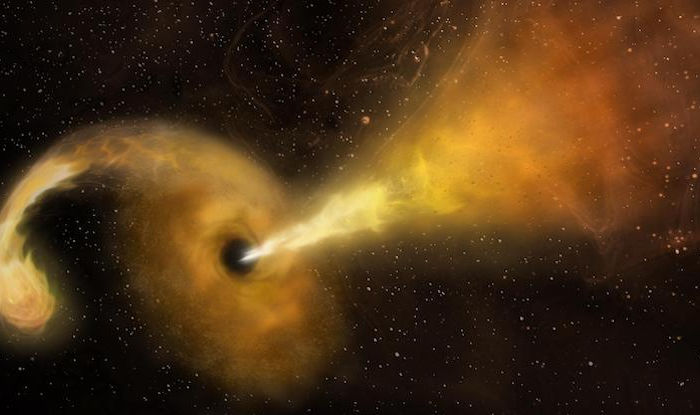
“Scientists Reveal The Shape of a Black Hole’s Corona For The Very First Time”


If you were lucky enough to observe a total eclipse, you are certain to remember the halo of brilliant light around the Moon during totality.

It’s known as the corona, and it is the diffuse outer atmosphere of the Sun. Although it is so thin we’d consider it a vacuum on Earth, it has a temperature of millions of degrees, which is why it’s visible during a total eclipse.

Click here to read the full article.


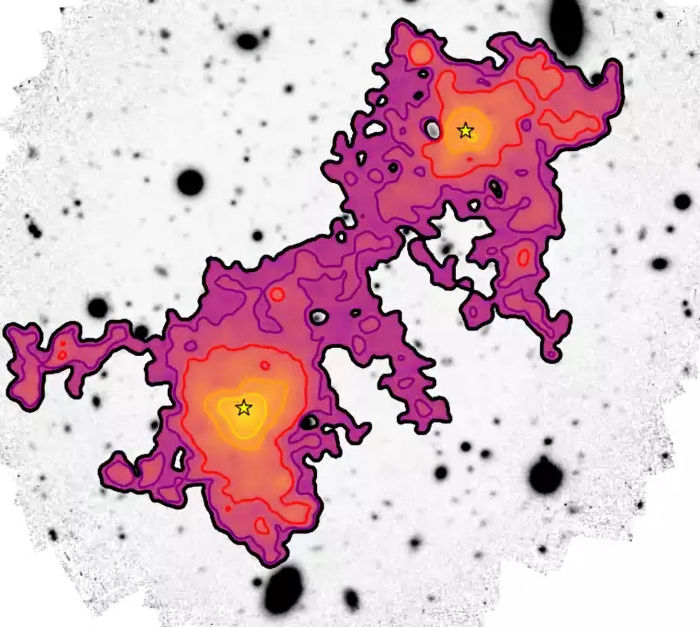
“Astronomers discover two galaxies aligned in a way where their gravity acts as a compound lens”


An international team of astronomers has discovered an instance of two galaxies aligned in a way where their gravity acts as a compound lens. The group has written a paper describing the findings and posted it on the arXiv preprint server.

Prior research has led to many findings of galaxies, or clusters of them, bending light in ways that were predicted by Einstein’s theory of general relativity. Astronomers have noted that some of them work as imperfect lenses, distorting the light behind them in interesting ways.

Click here to read the full article.


“Discovery of three galactic ‘red monsters’ in early universe challenges current models of galaxy formation”


An international team led by the University of Geneva (UNIGE) has identified three ultra-massive galaxies—nearly as massive as the Milky Way—already in place within the first billion years after the Big Bang.

This surprising discovery was made possible by the James Webb Space Telescope’s FRESCO program, which uses the NIRCam/grism spectrograph to measure accurate distances and stellar masses of galaxies. The results indicate that the formation of stars in the early universe was far more efficient than previously thought, challenging existing galaxy formation models.

Click here to read the full article.


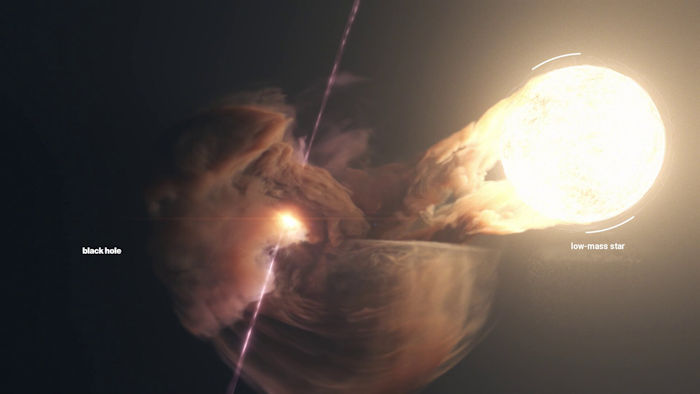
“Mysterious Flashes Traced to Cosmic Cloud’s Encounter With Merging Black Holes”


In March 2021, astronomers observed a high-energy burst of light from a distant galaxy. Assigned the name AT 2021hdr, it was thought to be a supernova.

However, there were enough interesting features that flagged as potentially interesting by the Automatic Learning for the Rapid Classification of Events (ALeRCE).

Click here to read the full article.


“Open star clusters are loose groups of stars”


Open star clusters

Open star clusters are young, loosely bound gatherings of stars. The stars in these clusters were born together. They’re still sometimes moving within the nebula, or cosmic cloud, of their creation. They’re occasionally called galactic clusters. Scientists have discovered more than 1,100 open clusters around us in space. They may contain a handful of stars or thousands of stars. Most likely won’t survive more than several orbits around our galaxy’s center before being disrupted and dispersed. You can see many open star clusters with the eye alone! Or you can aim binoculars or telescopes their way …

Click here to read the full article.


“Supermassive black hole a feature of most galaxies”


The Event Horizon Telescope – the same group that, in 2019, obtained the first-ever image of a supermassive black hole, in the galaxy M87 – says it will make a groundbreaking announcement on Thursday, May 12, 2022. The press conference will be held at ESO’s headquarters in Garching, Germany, beginning at 15 CEST (13 UTC, or 8 a.m. CDT). The press conference is focused on Sagittarius A*, the supermassive black hole at the center of our own Milky Way galaxy. Could it be the first-ever image of our galaxy’s supermassive black hole?

Click here to read the full article.


“First 3D view of globular cluster formation and evolution”


Globular clusters are giant balls of millions of stars held together by gravity and orbiting in the halo of our Milky Way galaxy. On November 5, 2024, scientists from the National Institute for Astrophysics (INAF), the University of Bologna and Indiana University said they’ve conducted the first 3D analysis of how stars move within 16 globular clusters. Their study adds to the understanding of the formation and evolution of these massive stellar groups.

Click here to read the full article.


“Wild Star Discovered Spinning an Incredible 716 Times Per Second”


A dead star 27,400 light-years away appears to be having one of the most epic stellar discos we’ve ever seen.

In the binary system 4U 1820-30, a neutron star is spinning so fast around its center axis that it completes a breathtaking 716 rotations per second. No stars have been discovered spinning faster, and only the famous pulsar PSR J1748-2446ad has been found spinning at that speed.

Click here to read the full article.


“Mission to study the ‘dark side’ of the universe just revealed the first piece of unprecedented map”


The powerful Euclid telescope has captured millions of stars and galaxies in a dazzling new mosaic — and it represents just the first piece of a massive puzzle the observatory has been designed to solve.

The European Space Agency mission, launched in July 2023, will create the largest and most accurate 3D map of the cosmos yet to help answer enduring questions about the “dark side” of the universe.

Click here to read the full article.