“JWST Reveals Actively Forming Early Galaxy, Lightweight as a Baby Milky Way”


A galaxy lurking in the far reaches of the Universe, a mere 600 million years after the Big Bang, is giving us our best glimpse yet at what our own infant Milky Way might have looked like.

Bursting with star formation, it’s been given the nickname Firefly Sparkle. Yet having traveled 13.2 billion years to reach us, the galaxy’s ‘sparkly’ light can only be seen thanks to a combination of the most powerful space telescope ever built and a quirk of gravity that bends space-time into a magnifying glass.

Click here to read the full article.


“Astronomers map giant starspots on distant XX Trianguli”


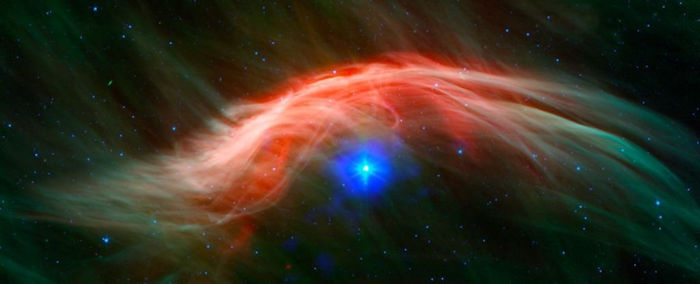
  • Astronomers mapped starspots on the red giant star XX Trianguli using Doppler imaging over 16 years.
  • Some of these distant starspots are big, bigger than our entire sun!
  • XX Trianguli’s starspot activity is chaotic and non-periodic, in contrast to our sun’s regular 11-year cycle of activity.

Click here to read the full article.


“Odd, slowly repeating radio bursts traced to red dwarf star”


  • Slowly repeating radio bursts are natural radio signals from space that are similar to signals from pulsars, but these repeat much more slowly. Astronomers discovered the first one in 2022, which repeated every 18 minutes. Their sources and causes have remained a mystery.
  • Now, for the first time, astronomers have pinpointed the origin of a slowly repeating radio burst. It comes from a red dwarf star.
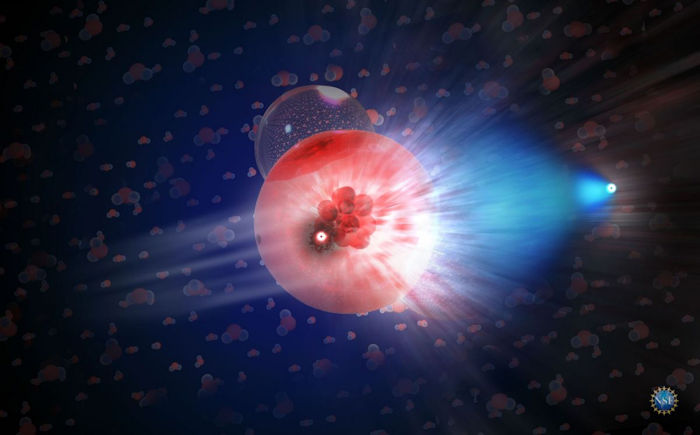
  • A white dwarf star might be orbiting the red dwarf. A stream of charged particles from the red dwarf, like our sun’s solar wind, could hit the white dwarf, producing the radio waves.

Click here to read the full article.


“Scientists Find Galaxies Colliding at Millions of Kilometers an Hour”


In a corner of space 290 million light-years from Earth, we’re getting to see something truly epic in action.

There, four galaxies are closely interacting, the region filled with the detritus of past collisions, so vast and energetic that their interaction is lighting up the space between them with an X-ray shock-front.

Click here to read the full article.


“Record-Breaking Super-Earth Has The Density of Lead, Scientists Say”


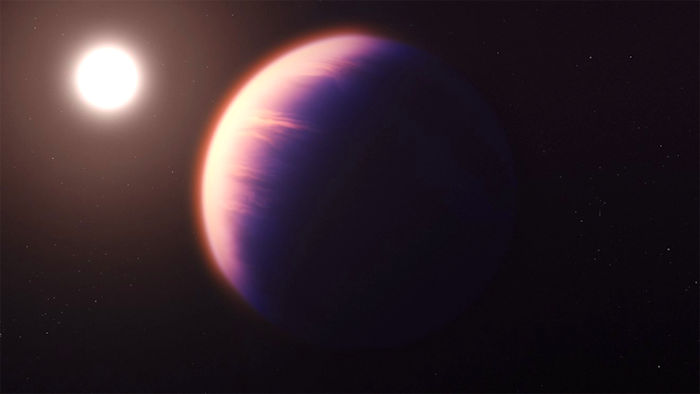
Astronomers have discovered a hefty new Super-Earth that’s as dense as lead. This rocky world might just be the leftover core of a gas giant that flew too close to its sun.

Meet K2-360 b, an exoplanet that packs 7.7 Earths-worth of mass into a ball that’s just 1.6 times the size of our home world. That shakes out to a density of about 11 grams per cubic centimeter, on par with that of lead.

Click here to read the full article.


“A galaxy named for its resemblance to a sombrero looks distinctly different in new image | CNN”


The James Webb Space Telescope has captured a surprising new view of a long-studied galactic neighbor, the Sombrero galaxy, revealing a perspective that looks quite different from the wide-brimmed Mexican hat for which it was named.

Taken with the space observatory’s Mid-Infrared Instrument, or MIRI, the image showcases the galaxy’s smooth inner disk, rather than the glowing core that usually shines in visible light images taken with the Hubble Space Telescope. Webb’s view makes the “crown” of the sombrero invisible, changing the appearance of the galaxy to resemble a bull’s-eye. Meanwhile, distant galaxies glimmer in the background of the image.

Click here to read the full article.

Link submitted by Gene Savoy, Jr.


“The universe is vibrating, mounting evidence shows”


  • More evidence indicates our universe is vibrating. Scientists announced their discovery on December 3, 2024.
  • Astronomers looked at pulsars located across the galaxy and measured the time these pulses should arrive at Earth. They noticed an interference in the arrival time due to ripples from the gravitational wave background.
  • The ripples from the gravitational wave background are likely due to interactions between black holes.

Click here to read the full article.


“New odd radio circle discovered with MeerKAT telescope”


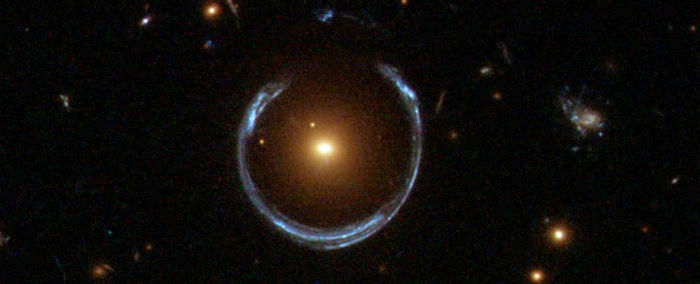
Using the MeerKAT telescope, astronomers have discovered a new odd radio circle that appears to be associated with an elliptical galaxy known as WISEA J021912.43–050501.8. The finding, which could help us better understand the nature of this mysterious radio emission phenomenon, is reported in a paper published Nov. 26 on the arXiv preprint server.

Click here to read the full article.


“Webb finds new galaxies in Spiderweb protocluster field”


Using the NASA/ESA/CSA James Webb Space Telescope, an international team of astronomers have found new galaxies in the Spiderweb protocluster. Their characteristics shed light on the growth of galaxies in these large cosmic cities, with the finding that gravitational interactions in these dense regions are not as important as previously thought.

Click here to read the full article.


“Star outside the Milky Way seen about to blow in closeup image”


  • Astronomers have captured the first closeup image of a star outside the Milky Way. The star, WOH G64, is located in the Large Magellanic Cloud.
  • It is a red supergiant 1,500 times the size of our sun. It has been undergoing significant changes.
  • It will eventually explode as a supernova, as the image suggests it’s nearing its final stages.

Click here to read the full article.