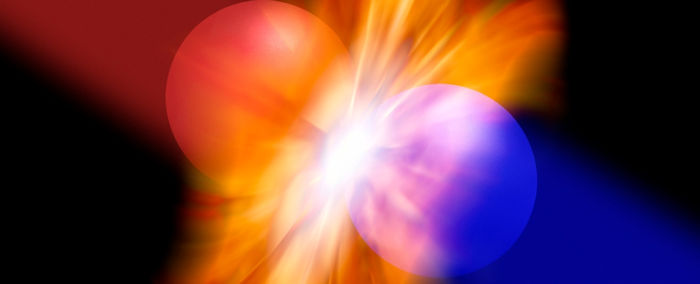
“Our Sun may once have had a twin. What happened to this stellar sibling?”


Many stars in our galaxy exist in pairs, but our Sun is a notable exception. Now scientists are finding clues that it may once have had a companion of its own. The question is, where did it go?

Our Sun is a bit of an isolated nomad. Orbiting in one of the Milky Way’s spiral arms, it takes us on a journey around the galaxy roughly once every 230 million years on our lonesome. The nearest star to our Sun, Proxima Centauri, is 4.2 light-years away, so remote that it would take even the fastest spacecraft ever built more than 7,000 years to reach.

Click here to read the full article.

Link submitted by Gene Savoy, Jr.


“Swarm of Black Holes Found Lurking in The Heart of a Giant Star Cluster”


The plot has just thickened in the mystery tale about the unseen mass skulking inside the largest cluster of stars in the Milky Way galaxy.

In the heart of Omega Centauri, a huge glob of gravitationally bound stars over 17,000 light-years away, astronomers have just uncovered evidence of an entire swarm of stellar-mass black holes.

Click here to read the full article.


“Quantum Physicists Just Found Evidence of ‘Negative Time'”


Scientists have long known that light can sometimes appear to exit a material before entering it – an effect dismissed as an illusion caused by how waves are distorted by matter.

Now, researchers at the University of Toronto, through innovative quantum experiments, say they have demonstrated that “negative time” isn’t just a theoretical idea – it exists in a tangible, physical sense, deserving closer scrutiny.

Click here to read the full article.


“NASA Probe About to Make History With Record-Blazing Sun Approach”


NASA’s Parker Solar Probe is about to make history, once again.

On Christmas Eve, the spacecraft is going to get closer to the Sun than any human-made object ever has, traveling at speeds faster than any human-made object has traveled.

In its 22nd close flyby, the probe will skim just 6.1 million kilometers (3.8 million miles) from the surface of the Sun, speeding by at around 192 km per second.

Click here to read the full article.


“Mystery Signals May Be Coming From One of The Rarest Stars in The Galaxy”


A few years ago, a radio telescope operating out of the desert of Western Australia observed something very weird.

Just 4,000 light-years from Earth, something was emitting a bright radio signal like nothing we’d ever seen before: flashing like a pulsar, but with a super long period between pulses, and a super long pulse itself. The nature of the source was impossible, at that point, to discern.

Click here to read the full article.


“Are We Wrong About the Start of the Universe? New Webb Data Explained in 5 Minutes”


Click the image to view the video.


“Hubble Gets its Best Look At the First Quasar”


The term quasar comes from quasi-stellar objects, a name that reflected our uncertainty about their nature. The first quasars were discovered solely because of their radio emissions, with no corresponding visual objects. This is surprising since quasars blaze with the light of trillions of stars.

In recent observations, the Hubble examined a historical quasar named 3C 273, the first quasar to be linked with a visual object.

Click here to read the full article.


“Our Sun Could Be Overdue For a Violent Superflare, Study Warns”


Our Sun is not a peaceful place. It roils with convection; its magnetic field snaps, finds a connection, snaps again. It unleashes eruptions of energy in the form of violent flares, and plasma in the form of coronal mass ejections.

Most of this activity lacks sufficient punch to harm us… but every now and then, the Sun erupts with a flare powerful enough to do serious damage. And we don’t know how often such events occur. Previous estimates have the range between once a century and once a millennium.

Click here to read the full article.


“NASA Captures Black Hole Jet Blasting a Mysterious Object”


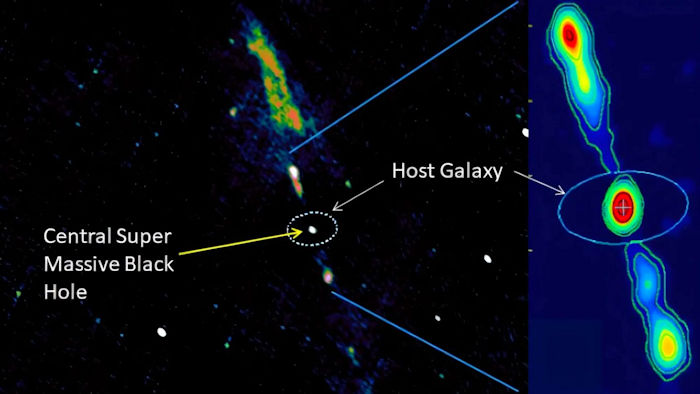
One of the strangest galaxies in the neighborhood of the Milky Way has just presented astronomers with a fascinating mystery.

It’s called Centaurus A, and huge jets of plasma shooting from its central supermassive black hole have slammed into something as they travel into intergalactic space.

Click here to read the full article.


“The Science of Color”


Here is a link to an interesting video on the science of color by Jacob Liberman. Dr. Liberman is a long-time friend of the Community and has spoken at our “Spiritual State of the World” conferences.

Click here to watch the video.