“There could be a supermassive black hole in the Large Magellanic Cloud hurling stars at the Milky Way”


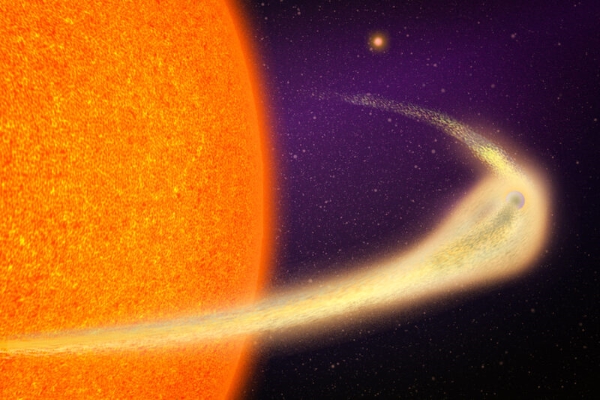
Hypervelocity stars (HVSs) were first theorized to exist in the late 1980s. In 2005, the first discoveries were confirmed. HVSs travel much faster than normal stars, and sometimes, they can exceed the galactic escape velocity. Astronomers estimate that the Milky Way contains about 1,000 HVSs, and new research shows that some of these originate in the Milky Way’s satellite galaxy, the Large Magellanic Cloud (LMC).

Click here to read the full article.


“Billions of Hidden Black Holes Could Be Lurking in Space”


Don’t let the name fool you. Black holes might all have hearts of pure darkness, but many cloak themselves in rings of fire that blaze like little else in the cosmos.

That doesn’t mean all are detectable. An analysis of galaxies surveyed by a large international consortium of researchers suggests the glow surrounding a third of all supermassive black holes might be hidden by a thick pall of dust and gas.

Click here to read the full article.


“Boom! Galaxy with 9 rings nicknamed the Bullseye”


Galaxy with 9 rings following collision

The galaxy formerly known as LEDA 1313424 – now nicknamed the Bullseye – is a monster. It’s 2 1/2 times larger than our home galaxy, the Milky Way. A team of researchers said on February 4, 2025, that they discovered nine rings around this galaxy – the most yet observed for any galaxy – and that the rings are the result of a collision with a smaller galaxy.

Click here to read the full article.


“Amazing new Milky Way galaxy animation”


The European Space Agency’s Gaia spacecraft launched in 2013 and spent more than a decade measuring and mapping our home galaxy, the Milky Way. And ESA said last week (January 15, 2025) that Gaia has now ended its operations. It has taken its final measurements of our galaxy. So Gaia is no longer in a data-gathering mode. But loads of Gaia data remain to be analyzed, and scientists expect to find more mind-bending insights from Gaia about our galaxy and its immediate environment. For now, scientists have released a short animation giving a quick overview of a few of the new insights Gaia helped make possible. Gaia data was used to put together this animation of our galaxy.

Click here to read the full article.


“Supermassive Black Hole Caught Doing Something Never Seen Before”


As far as supermassive black holes go, the one at the center of the Milky Way is relatively sedate.

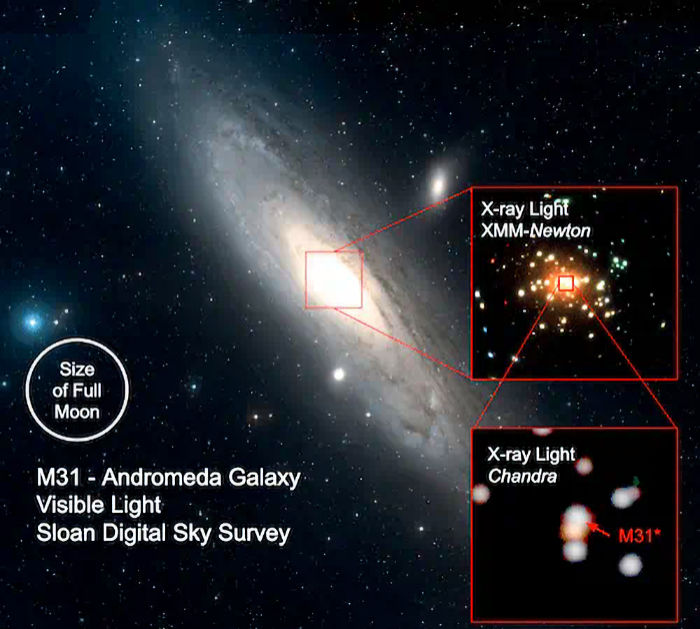
But, even in its supposed quiescent state, Sagittarius A* is prone to the occasional belch or rupture – and now, using JWST, astronomers have recorded it doing something we’ve never seen before.

On 6 April 2024, the black hole let out a flare observed in mid-infrared wavelengths, followed by a radio flare counterpart.

Click here to read the full article.


“A Giant Object May Have Warped Our Solar System, Study Says”


If you were to perfectly follow the steps in An Idiot’s Guide to Making a Solar System, you should eventually find yourself with a star surrounded by a flat disc of planetary material orbiting in relatively neat, circular paths.

But our own Solar System’s disc is relatively warped, with the orbits of its planets slightly tilted and more oval than circular. What happened to it?

Click here to read the full article.


“MOND and more. Does the universe need a rethink?”


Our current cosmology says cold dark matter helped small galaxies form in the early universe. But recent data from the James Webb Space Telescope are challenging that idea. Astronomers, like Stacy McGaugh of Case Western Reserve University, think that since our theories don’t match the observations, it might be time to rethink our story of how the universe formed in its extreme youth. According to McGaugh and his team, new research supports the MOND theory. EarthSky’s Dave Adalian down with Stacy McGaugh to talk about his team’s discoveries, what they means for cosmology and where we go from here on Monday, November 18. A transcript of that interview is below. It’s fascinating stuff!

Click here to read the full article.


“Little Red Dots might indicate ancient, growing black holes”


In December 2022, less than six months after commencing science operations, NASA’s James Webb Space Telescope revealed something never seen before. It discovered an abundance of tiny red objects scattered across the sky. Scientists dubbed them ‘Little Red Dots.’ Since then, researchers have been perplexed by their nature, the reason for their color and what they convey about the early universe.

Click here to read the full article.


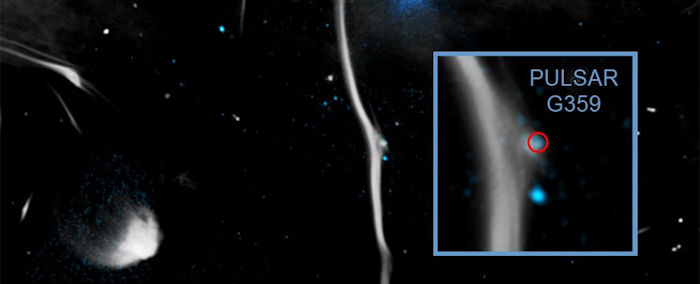
“Astronomers Discover Slow-Spinning Radio Source That ‘Shouldn’t Exist'”


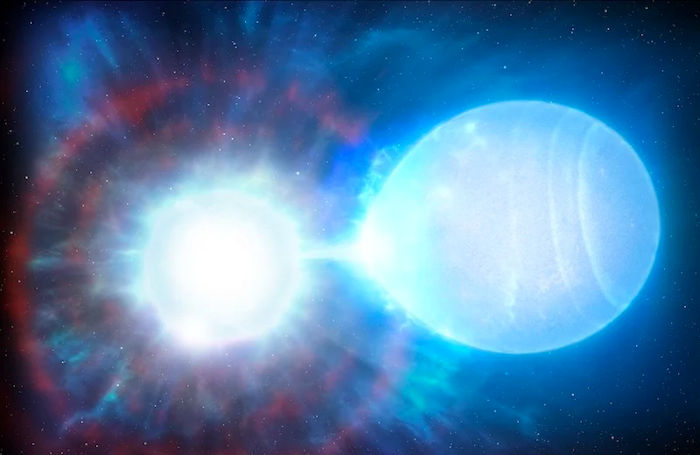
When some of the biggest stars reach the end of their lives, they explode in spectacular supernovas and leave behind incredibly dense cores called neutron stars. Some of these remnants emit powerful radio beams from their magnetic poles.

As the star spins, these beams sweep past Earth and produce periodic pulses of radio waves, much like a cosmic lighthouse. This behaviour has earned them the name ” pulsars”.

Click here to read the full article.


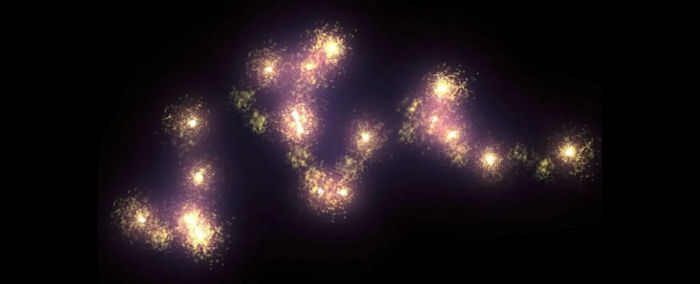
“Record-Breaking Trove of Stars Seen Billions of Light-Years Away in Cosmic Dragon”


There are limits to what we can see across the gulf of space and time separating us from the early Universe. Light that travels across billions of light-years emanates from sources so distant it can be challenging even to see something even as luminous as a galaxy glowing in the darkness.

Human endeavor has now smashed through those limits using JWST – resolving more than 40 individual stars on the outskirts of a galaxy whose light has spent almost 6.5 billion years traversing space-time to reach us.

Click here to read the full article.