“Hubble Captures a Starry Spiral Cosmic Neighbor”


You’re looking at an incredible image of the spiral galaxy NGC 3137, captured by the Hubble Space Telescope. This galaxy is 53 million light-years away in the constellation Antilia, and gives astronomers an opportunity to study the life cycle of stars in a galaxy that’s similar to the Milky Way. You can see countless stellar clusters in the galaxy, places where new stars are forming inside collapsing clouds of gas and dust.


“How Super-Quasars Shaped Early Galaxies and Confounded the JWST”


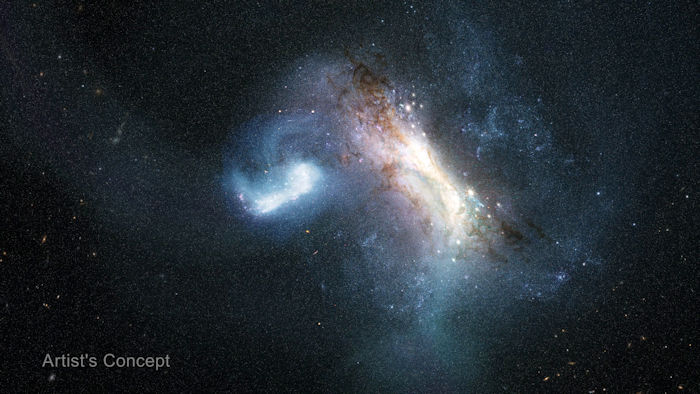
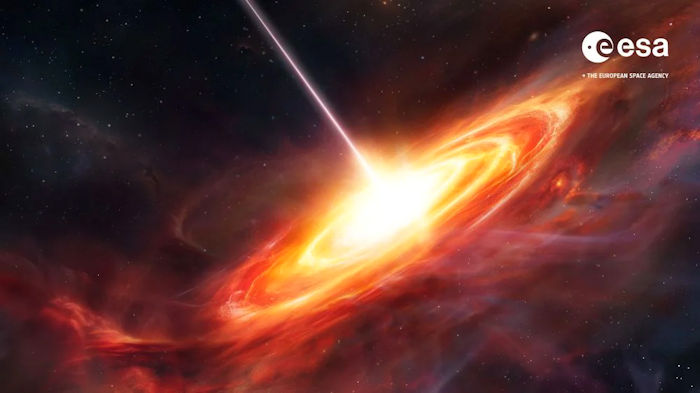
Webb has shown us that there were extremely powerful quasars, even early on in the history of the Universe. These actively feeding supermassive black holes can have powerful outflows similar to stellar winds, but much more powerful. New research shows there’s a clear link to these stellar outflows and the evolution of the galaxies that surround them. This might explain why some galaxies have stopped forming stars as early as only two billion years after the Big Bang.


“Strange ripples in space may point to dark matter near merging black holes”


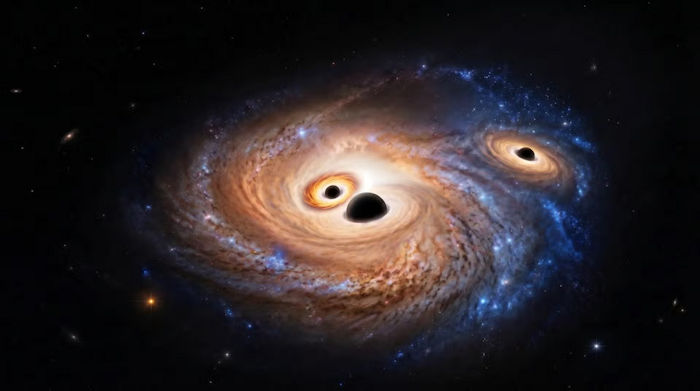
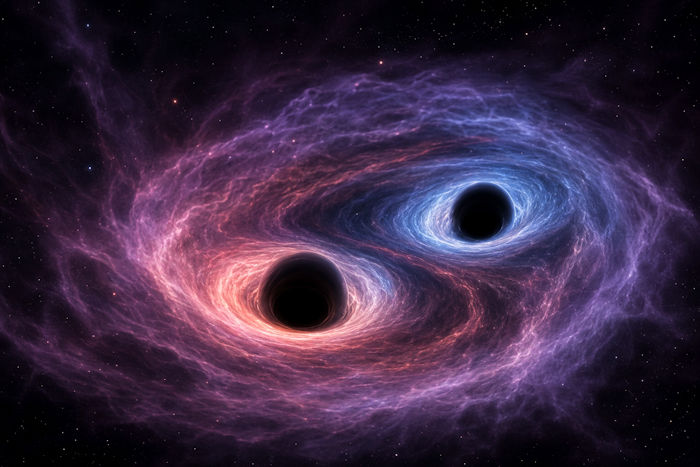
Dark matter is thought to make up most of the matter in the cosmos, yet it has never been directly observed. It does not emit, absorb, or reflect light. So far, the clearest signs of it come from gravity. For example, galaxies bend light and move as though they contain far more mass than astronomers can see.


“The Universe may have begun inside a black hole, not a Big Bang”


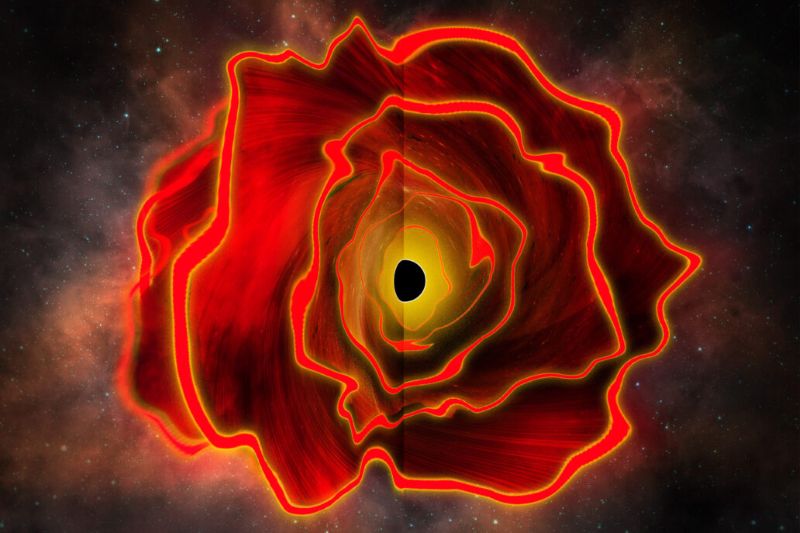
For nearly a century, modern cosmology has treated the Big Bang as the opening moment of everything, the instant when space, time, and energy burst into existence from an infinitely dense point. That picture has explained a great deal, from the cosmic microwave background to the large-scale distribution of galaxies. It has also left behind some stubborn problems, including the question of what happened at the singularity itself, where the known laws of physics break down.


“Physicists rewrite Einstein’s equations to define spacetime evolution”


Spacetime is often described as the stage on which the universe unfolds, a four-dimensional blend of space and time that bends, stretches and shifts as matter and energy move through it. However, despite more than a century of work since Einstein introduced general relativity, physicists still struggle to describe how that stage evolves when gravity becomes violent, nonlinear and hard to predict.


“Young Sun-like Stars Are Not As Menacing As Thought”


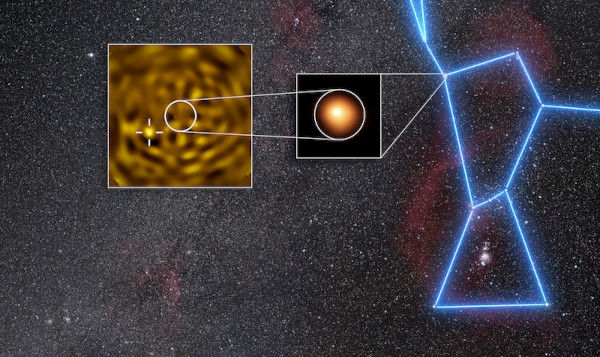
The Sun is relatively calm and steady today, but it’s believed that it was much more problematic in its youth, regularly releasing powerful flares that could have bombarded the Earth. Observations of star clusters with several telescopes have shown that sunlike stars might not be as bombastic in their youth as previously believed. When it comes to X-rays, anyway. The research showed that yellow dwarfs in young clusters emit only one-third as much X-rays as models had predicted.


“DECam’s New Image of the Sombrero Galaxy: A Portrait of Ancient Mergers”


Here is the famous Sombrero Galaxy, captured by the Dark Energy Camera (DECam) on the Victor M. Blanco 4-meter Telescope. Before Vera Rubin, this was the world’s largest camera, containing 570 megapixels. The Sombrero Galaxy is 31 million light-years away and part of the Virgo II Group. It contains one of the largest supermassive black holes that we know of, with at least a billion solar masses. The galaxy’s central bulge is surrounded by 2,000 globular star clusters, ten times as many as the Milky Way has.


“The Universe Builds Stars by the Book”


Stars form out of nebulae in a range of sizes from giants to tiny dwarfs with a fraction of the mass of the Sun. What decides how massive a star will be? New research shows that the total mass of the star cluster sets the rules, stamping out stars according to a mathematical model. Star formation always follows the most ordered, efficient path available, with the total mass of the cluster being the biggest predictor for the mass distribution of the stars inside it.


“Astronomers Find the Edge of the Milky Way’s Star-Forming Disc”


Where does the Milky Way begin and end? It’s not a simple question because it contains stars, a halo of field stars and gas, and then an even larger halo of dark matter that stretches almost to Andromeda. A new paper suggests that the Milky Way’s star-forming regions define an important boundary, and they’ve traced this edge to about 40,000 light-years from the galaxy’s core. Beyond this region, the stars probably migrated out through gravitational interactions, but didn’t form there.


“Is the Earliest Supermassive Black Hole Mystery Solved?”


Astronomers continue to find supermassive black holes at earlier and earlier times in the Universe, challenging theories about how they might form. In a new paper, researchers studied the role that dark matter played in the early Universe, suggesting that the decay of dark matter could have influenced the birth and growth of those early supermassive black holes. Dark matter particles could send very small amounts of energy into a gas cloud, which could kick-start the black hole formation process.