“Huge nearby space cloud was invisible … until now”


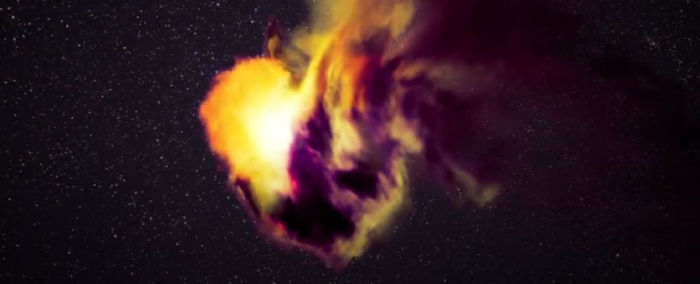
Dotted throughout our Milky Way galaxy and beyond are vast structures known as molecular clouds. Made up mostly of hydrogen gas and dust, these clouds are often regions of intense star formation. And astronomers have just identified one of the closest molecular clouds ever seen, which has long remained undetected on Earth’s doorstep.

The cloud, now named Eos, is only some 300 light-years away. It’s located on the edge of the Local Bubble, a huge low-density “cavity” in space that encases our solar system. And Eos is one of the largest single structures ever seen in space. If you could see it with the unaided eye, it would span 40 full moons across the sky.

Click here to read the full article.


“This Galactic ‘Bone’ Was Smashed by a Pulsar Clocking Up to 2 Million MPH”


The culprit in a cosmic hit-and-run that resulted in a broken ‘bone’ has been found out.

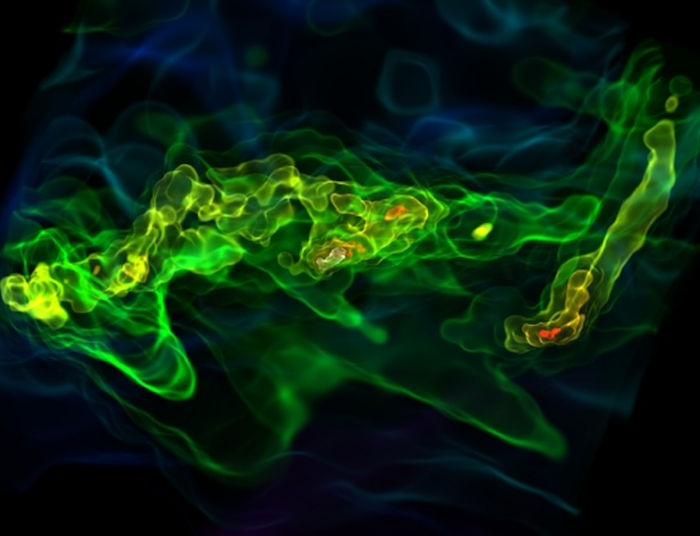
Of course, it’s not actually a bone at all, but a mind-blowingly huge filament in the center of the Milky Way galaxy, known as the Snake, extending for a length of 230 light-years. One of the interesting things about this filament is that it’s relatively smooth – except for two prominent kinks, or “breaks”.

Click here to read the full article.


“Stuart Talbott: Galactic Plasmoid Stuns Astronomers | Thunderbolts”


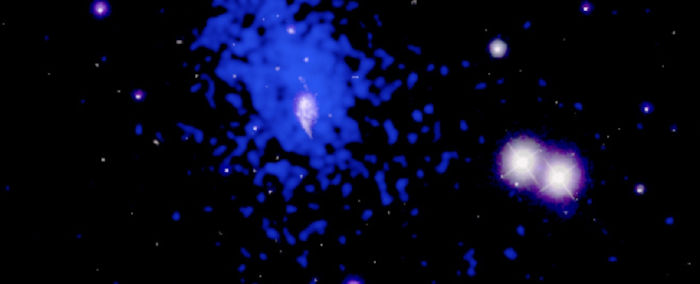
The plasmoid at the center of a galaxy 300 million light-years away has astronomers stumped. Its behavior is perplexing to space scientists for exactly one reason—they simply do not recognize that it exists. For many decades the space sciences have accepted that at the center of most galaxies is a super massive black hole—a hypothetical object believed to be billions of times more dense than our own Sun, and whose gravitational field is so intense that nothing, not even light, can escape. The term plasmoid was coined in 1956 by the renowned MIT physicist Winston H. Bostick to describe a concentration of electromagnetic energy caused by electric currents. At the center of galaxies, where the Standard Model claims is a super massive black hole, the plasmoid concentrates and stores energy, and is connected to a larger galactic electrical circuitry. Independent researcher Stuart Talbott describes what advocates of the EU Model and plasma cosmology have always known—it’s the physics of the plasmoid that makes the stupendous energies and mass at the center of a galaxy explicable.

Click here to view the video.


“Largest Structure in The Universe May Be 50% Larger Than We Thought”


The largest known structure in the Universe may be even larger than we thought it was.

A re-examination of the distribution of powerful space explosions suggests that the Hercules-Corona Borealis Great Wall, a cluster of galaxies previously estimated to be 10 billion light-years long, could actually be as large as 15 billion light-years in size.

Click here to read the full article.


“A Hidden Supermassive Black Hole Has Just Revealed Itself in Deep Space”


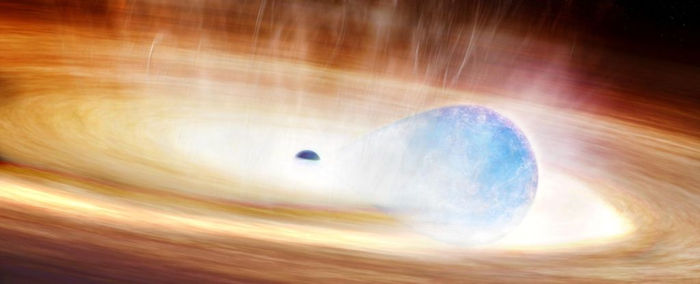
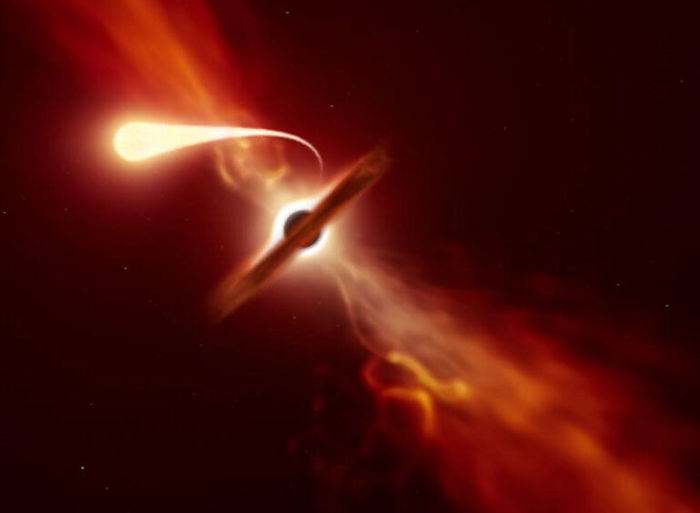
A supermassive black hole around a million times the mass of the Sun just gave away its position in spectacular fashion.

When a passing star veered a little too close, it was torn apart in the black hole’s gravitational field, releasing an enormous flare of light.

That flare of light, a tidal disruption event recorded by telescopes on Earth, was named AT2024tvd, and its detection revealed something very peculiar about the galaxy 600 million light-years away in which the event took place.

Click here to read the full article.


“Astronomers spot disintegrating planet with a comet-like tail”


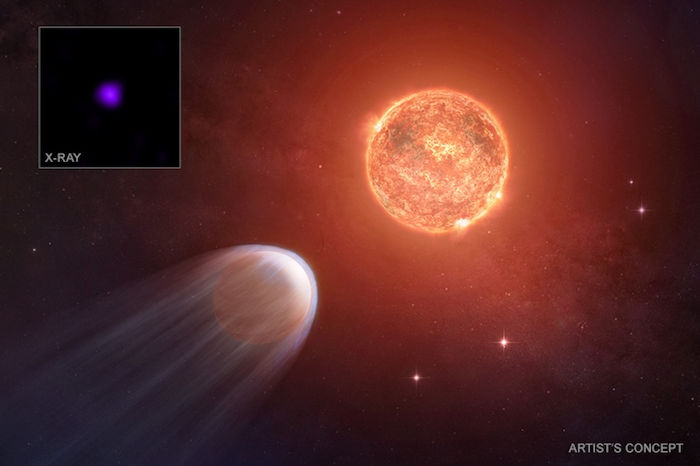
Astronomers announced yesterday they’ve spotted an exoplanet crumbling to pieces. The doomed planet – located some 140 light-years from Earth – loses a Mount Everest’s worth of material with every 30.5-hour orbit around its star. And this material is trailing behind the planet, forming a comet-like tail that stretches some 9 million kilometers (5.6 million miles).

The disintegrating world is about the mass of Mercury, but it circles about 20 times closer to its star than Mercury does. That means it’s likely roasting at around 1,600 degrees Celsius (3,000 F), and covered in magma that’s boiling off into space. And as it loses mass, the planet’s gravity weakens, allowing more and more material to fall away. This runaway process is expected to continue until the planet is completely disintegrated, some 1 or 2 million years in the future.

Click here to read the full article.


“Is our whole universe spinning? A new study suggests it is”


spinning galaxy


Our Earth is spinning, the sun is spinning, the solar system is spinning and our galaxy is spinning. So it would make sense to think that our entire universe is spinning as well. Yet that’s not what current models suggest. Instead, the general consensus is that the universe is expanding with no signs of rotation. But on April 14, 2025, scientists from the University of Hawaii said the universe might be rotating … just extremely slowly.

Click here to read the full article.


“There’s a Type 1a Supernova in the Making, Just 150 Light-Years Away”


A Type 1a supernova represents one of the most powerful and consistent explosions in our universe. These spectacular events occur when a white dwarf star – the dense, carbon-rich core left behind after a medium-sized star exhausts its nuclear fuel – reaches a critical mass threshold known as the Chandrasekhar limit (about 1.4 times the mass of our Sun.) What makes Type 1a supernovae particularly valuable is their remarkably consistent peak brightness, allowing them to serve as “standard candles” for measuring distances across the Universe.

Click here to read the full article.


“Andromeda’s Black Hole is Winking at Us”


The Andromeda Galaxy, also known as M31, is the nearest spiral galaxy to the Milky Way and the largest galaxy in our local group. It’s located 2.5 million light-years from Earth and is visible to the naked eye from the northern hemisphere on clear, dark nights. Similar in structure to the Milky Way, Andromeda contains hundreds of billions of stars, as well as a supermassive black hole at its core. Studies have revealed that Andromeda and the Milky Way are on a slow motion collision course, due to merge in about 4.5 billion years time, forming a new, larger galaxy.

Click here to read the full article.


“Surprising galaxy shines through fog of the early universe”


  • The early universe was filled with a thick fog of neutral hydrogen. Even though the first stars and galaxies emitted copious amounts of light, that light struggled to pierce this fog.
  • It took hundreds of millions of years for the neutral hydrogen to become ionized – electrons stripped from protons – so that light could travel freely through space.
  • But one galaxy in the early universe has caught astronomers by surprise. Scientists have spotted a bright emission of hydrogen from newly discovered galaxy JADES-GS-z13-1, even though the cosmic fog should have absorbed it.

Click here to read the full article.