“Jaw-Dropping Image Reveals Dying Stars Entangled Like Serpents”


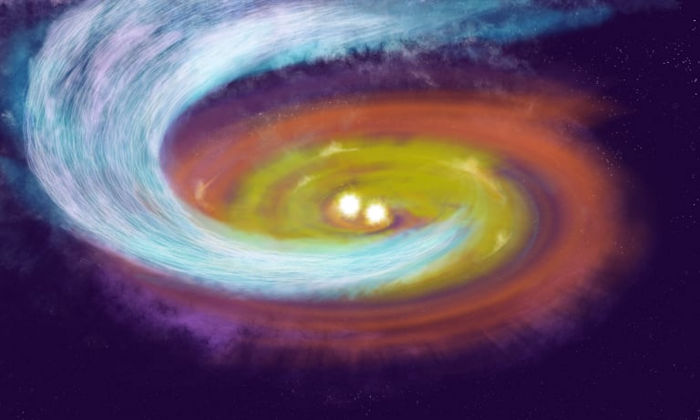
The day before my thesis examination, my friend and radio astronomer Joe Callingham showed me an image we’d been awaiting for five long years – an infrared photo of two dying stars we’d requested from the Very Large Telescope in Chile.

I gasped – the stars were wreathed in a huge spiral of dust, like a snake eating its own tail.

Click here to read the article.


“Witnessing a solar system’s dawn, for the 1st time”


Astronomers say they’ve just observed the birth of a new solar system. They caught the early signs of gases beginning to solidify around a young star, marking the very 1st spark of planet formation.

Sitting some 1,300 light-years from Earth, the star – HOPS-315 – is only around 100,000 years old. It’s a sunlike star, so it resembles how our star might have appeared some 4.6 billion years ago, when the material that went on to form Earth was just starting to come together.

Click here to view the video.


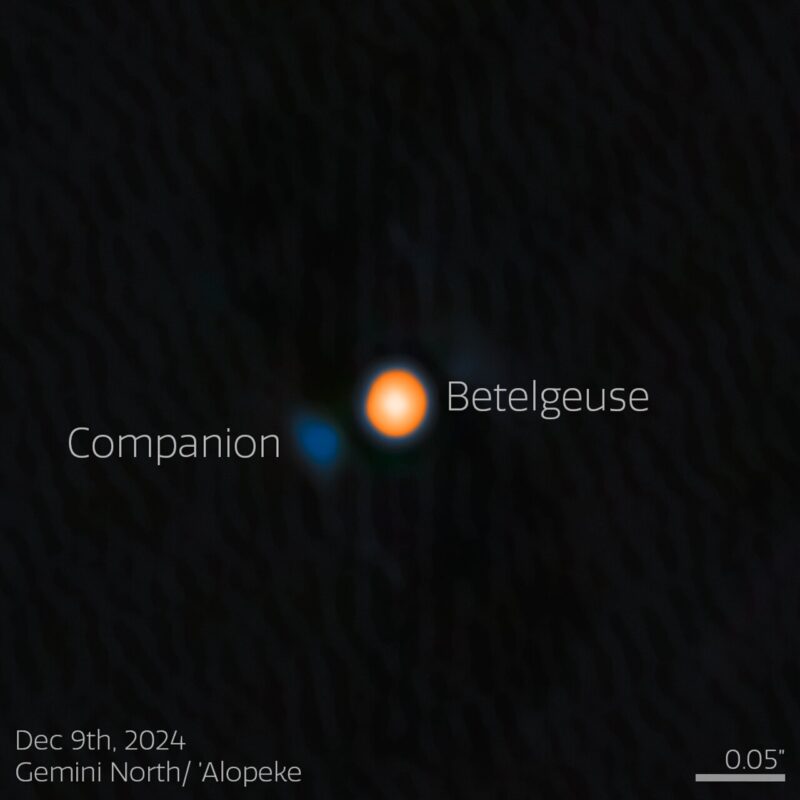
“Betelgeuse’s companion star revealed in new images”


Hidden cozied up to Betelgeuse, a bright red star in the constellation Orion, astronomers may have finally found the giant star’s long-sought companion. This close-orbiting partner, first postulated over a century ago, matches some predictions and adds another piece to the puzzle of the mysterious supergiant star.

Click here to read the article.


“A hidden molecular cloud near our Milky Way’s center”


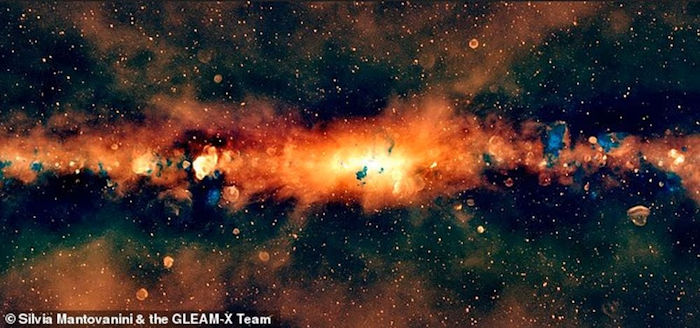
Our Milky Way galaxy consists of gas, dust and billions of stars. They trace out its spiral arms and form its central bulge, while a supermassive black hole resides at our galaxy’s center. But on July 16, 2025, astronomers from the National Science Foundation’s National Radio Astronomy Observatory said they’ve found a giant molecular cloud – a gaseous region of star birth made mostly of molecular hydrogen – that was previously hidden from our view. The molecular cloud lies at a transition zone between the quieter galactic disk and the more extreme central region.

Click here to read the full article.


“A 400-Year-Old Mystery About The Sun May Finally Be Solved”


Since Galileo first observed them through his telescope in the early 1600s, sunspots have fascinated scientists. These dark patches on the Sun’s surface can persist for days or even months, but until now, researchers couldn’t fully explain why they remained stable for such extended periods.

A study published in Astronomy & Astrophysics has finally solved this centuries-old puzzle. An international team of scientists, led by researchers from Germany’s Institute of Solar Physics, developed a revolutionary new method for analyzing sunspot stability that reveals the delicate balance keeping these solar features intact.

Click here to read the full article.


“Record-Sized Collision Between Black Holes Detected by Astronomers”


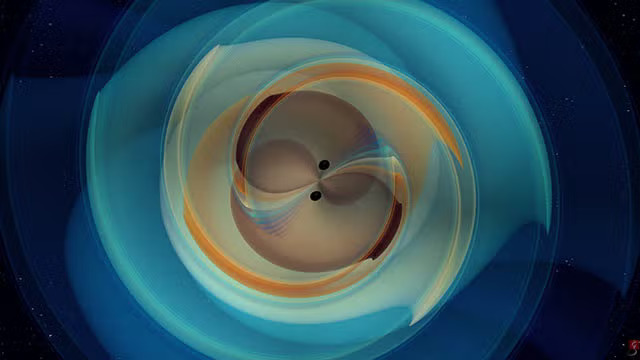
Two black holes have collided in a merger that could revolutionize our understanding of black hole growth.

Named GW 231123 after the date it was recorded on 23 November 2023, it’s the most massive black hole collision we’ve seen yet, resulting in an object heavier than 225 Suns.

Previously, the most massive black hole collision produced an object 142 times the mass of the Sun.

Click here to read the full article.


“Earth could be in a huge void, Big Bang sound waves suggest”


One of the greatest mysteries facing scientists today is the Hubble tension: the fact that our different methods of measuring the universe’s expansion produce different results. And a study announced today has an intriguing answer.

The research says that Earth might be located inside a billion-light-year-wide void of low density, encompassing many millions of galaxies. If so, the gravity of the higher-density regions around this void would pull matter outward. And that means space would appear to be expanding faster in our local area.

Click here to read the full article.


“A Supermassive White Dwarf Is Pulsating Rapidly, Revealing Details Of Its Interior”


Scientists are constantly finding new ways to look at things, and that’s especially true for objects that represent an outlier of their specific type. Adjectives like “biggest”, “brightest”, or “fastest spinning” all seem to attract scientific studies – perhaps because they’re an easier sell to funding agencies. No matter the reason, that means we typically get a lot of good science on specific objects that represent their particular class of objects well, and a new paper from Ozcan Caliskan from Istanbul University in Turkey hits that nail on the head when it comes to the most massive known white dwarf star.

Click here to read the full article.


“Double detonation supernova destroyed this star!”


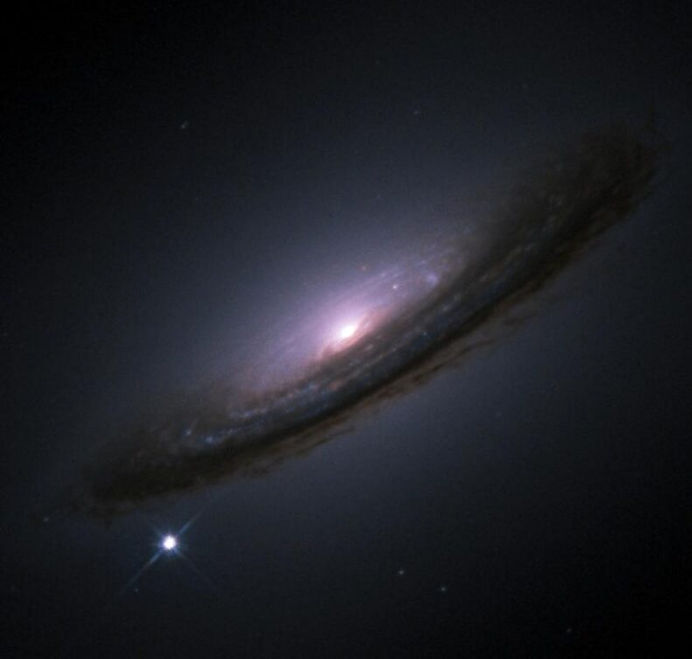
For the first time, astronomers have obtained an image of a star that met its end by detonating twice. Scientists used the European Southern Observatory’s Very Large Telescope (VLT) to image the centuries-old remains of supernova SNR 0509-67.5. They announced today (July 2, 2025) that they’ve found patterns confirming its star suffered not one but two explosive blasts. This discovery shows some of the most important explosions in the universe in a new light, the scientists said.

Click here to view the video.


“Solar Flare Photobombs The ISS in Perfectly Timed Photo”


Pictures of the International Space Station as it passes in front of the Sun or Moon are a bit of a feather in the cap of space photographers – but Arizona-based astrophotographer Andrew McCarthy bagged a real prize.

When he headed out to the Sonoran Desert and set up his equipment to attempt to capture an ISS transit, he was surprised by a medium-sized solar flare in the background. The resulting image captured not just the space station as it whisked past the surface of the Sun, but the transient appearance of a solar eruption.

Click here to read the full article.