“A Distant Star Explodes While Swallowing Its Black Hole Companion”


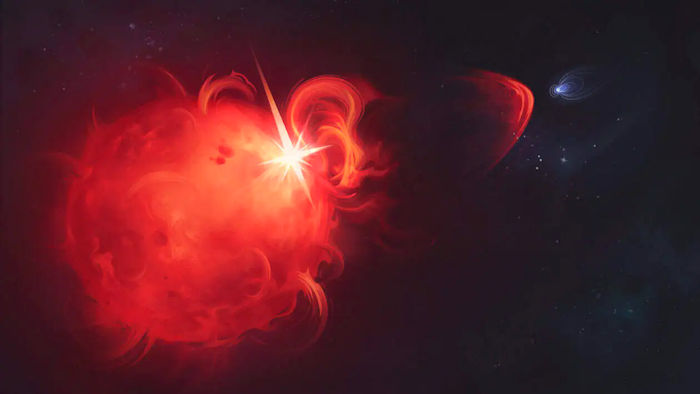
Interactions between supernovae and black holes must be exceedingly rare. But that’s the only explanation for a very strange explosion found with the Zwicky Transient Facility. In July 2023, the ZTF spotted strange light signals about 730 million light-years from Earth, and AI helped astronomers unravel what they were seeing.

The ZTF scans the skies for transient objects that change in brightness. It’s an automated survey that sends out alerts when it detects something significant. The 2023 detection was made with a new artificial intelligence algorithm, and when it was detected, the ZTF alerted astronomers.

Click here to read the article.


“Supernova Reveals What The Inside of a Star Really Looks Like”


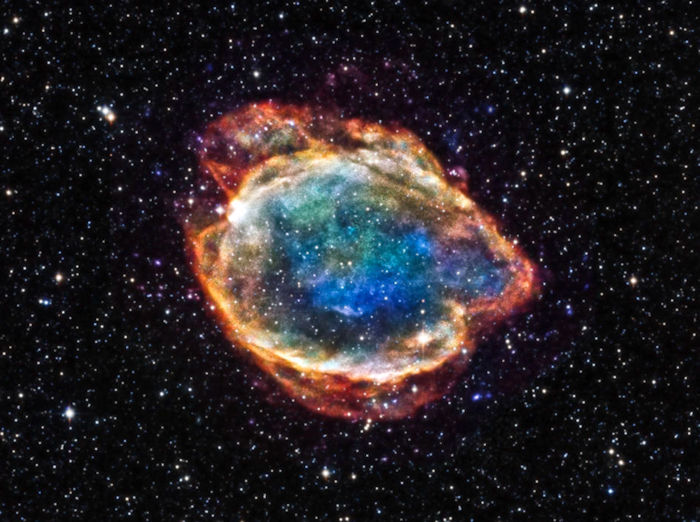
A star exploding at the end of its life has rocked the cosmos like no other that humanity has ever seen.

In 2021, astronomers watched in astonishment as a supernova 2.2 billion light-years away named SN2021yfj bloomed, rich with silicon, sulfur, and argon – something never before seen in an exploding star.

Click here to read the article.


“Star Trying to Swallow a Black Hole May Have Triggered a New Type of Supernova”


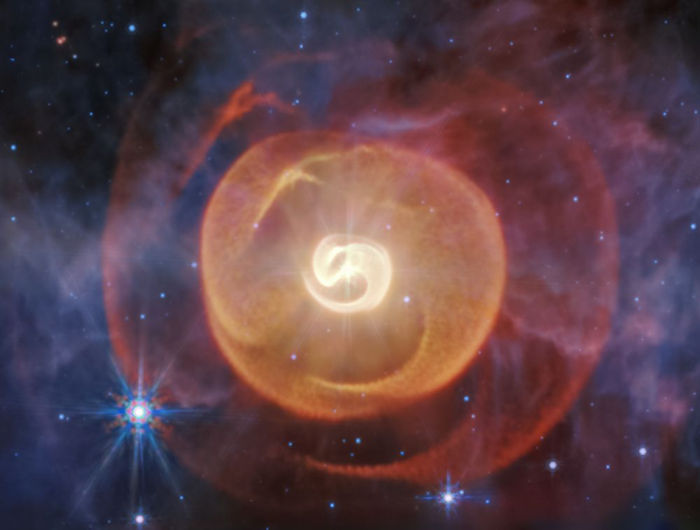
In 2023, astronomers recorded one of the most extraordinary space explosions they had ever seen.

It took place some 750 million light-years away, flaring into the detectors of the Zwicky Transient Facility on 7 July. At first, it looked just like a normal supernova – the explosive death of a star – and astronomers named it SN 2023zkd.

Click here to read the article.


“Supermassive Black Hole Caught in The Act of Switching on”


A recent discovery by a team of astronomers centres on a galaxy cluster called CHIPS 1911+4455, located an incredible 6 billion light-years from Earth.

At its heart lies a supermassive black hole that has only recently ‘turned on’, just a thousand years ago. While that might sound like a long time, it’s merely a blink of an eye in astronomical terms.

Lead researcher Francesco Ubertosi from the University of Bologna describes the phenomenon as watching a sleeping giant wake up.

Click here to read the article.


“Surprisingly chaotic early universe had supersonic turbulence”


  • What was the early universe like? Astronomers thought the first stars were gigantic and drifted in isolation in relatively calm clouds of gas.
  • But the first star-forming clouds were turbulent and clumpy, a new study from researchers in Taiwan suggests. The turbulence reached supersonic speeds. This was only a few hundred million years after the Big Bang.
  • The first stars in the universe were less massive but more numerous than previously thought, the study says.

Click here to read the article.


“Rogue Planets Can Spawn Their Own Planetary Systems”


We live in an age of exoplanet discovery, and have discovered several thousand planets orbiting distant stars. These discoveries hold important lessons about planetary formation and solar system architecture. But we’re also discovering a growing number of rogue planets, also called free-floating planets. These planets aren’t gravitationally bound to any star. What can they teach us?

Click here to read the article.


“The JWST Found Evidence Of An Exo-Gas Giant Around Alpha Centauri, Our Closest Sun-Like Neighbor”


If detecting exoplanets was easy, then we should have a complete understanding of the planetary system around our nearest stellar neighbour, Alpha Centauri. But we don’t, because it’s not easy. Alpha Centauri is a triple star system about 4.25 light-years away. The primary star is called Alpha Centauri A, a Sun-like star, and it’s in a binary relationship with Alpha Centauri B, another Sun-like star. The third star is a red dwarf named Proxima Centauri, and it’s the closest one to us.

Click here to read the article.


“This Newborn Planet Is Carving Out A Home In Its Protoplanetary Disk”


Around three decades ago, we weren’t certain that other stars had planets orbiting them. Scientists naturally thought there would be, but they had no evidence. Now, not only do we know of more than 6,000 confirmed exoplanets, but we can watch as baby planets take shape around distant stars.

When stars form, they’re surrounded by rotating disks of gas and dust called protoplanetary disks. Planets form in these disks, and in recent years, ALMA (Atacama Large Millimeter/submillimeter Array has examined many of these disks. It’s made headlines by finding telltale signs of planets forming, as they seem to clear orbital paths in the disks.

Click here to read the article.


“Star survives black hole, returns for another round”


You’d think a star wouldn’t stand a chance against a supermassive black hole. But astronomers have spotted a star that apparently did battle with one of these behemoths, and later came back for another fight.

In 2022, astronomers spotted a bright flare at the center of a galaxy some 408 million light-years away. Labeled AT 2022dbl, it was what’s known as a tidal disruption event, where a star passes too close to a supermassive black hole, which rips it to shreds.

Click here to read the article.


“This baby exoplanet is shrinking toward a sad destiny”


  • TOI 1227 b is a young, Jupiter-sized exoplanet 330 light-years away. It orbits close to its small, cool red dwarf star.
  • NASA’s Chandra X-ray Observatory observed the planet and found that intense radiation from the star is slowly destroying the planet’s deep atmosphere.
  • TOI 1227 b will completely lose its atmosphere in about a billion years, scientists say. As a result, it will shrink to about 1/10 of its current size.

Click here to read the article.