“New study says water in Venus’ clouds surprisingly abundant”


  • Venus’ clouds contain droplets that are highly acidic. Scientists thought they were mostly sulfuric acid with some water. But is that true?
  • A new analysis of data from the Pioneer Venus 2 mission in 1978 shows the droplets have less sulfuric acid and much more water than previous estimates, along with oxidized iron.
  • Venus’ clouds could therefore be potentially more habitable for microbes than scientists have long thought.

Click here to read the article.


“Webb glimpsed doomed star before it exploded”


Astronomers have captured the most detailed glimpse yet of a doomed star before its death.

The star came to our attention when we saw it explode as a supernova on June 29, 2025, in a galaxy 40 million light-years away. And this galaxy, NGC 1637, had already been imaged by the James Webb Space Telescope. So astronomers were able to study this imagery to identify the supernova’s source star, or progenitor.

It’s the 1st time Webb has identified a supernova progenitor. And it revealed the doomed star was a red supergiant, cloaked in an unexpected shroud of dust.

Click here to read the article.


“Butterfly Nebula’s Hidden Heart Reveals the Building Blocks of Planets”


At first glance, the Butterfly Nebula looks like a glowing insect pinned against the backdrop of space. Officially known as NGC 6302, it sits about 3,400 light-years away in the constellation Scorpius. Its colorful wings stretch across space, formed from the dying gas and dust of a star not unlike our Sun. For centuries, astronomers have admired its beauty. Now, with the help of the James Webb Space Telescope, you can see its hidden heart in a way never possible before.

Click here to read the article.


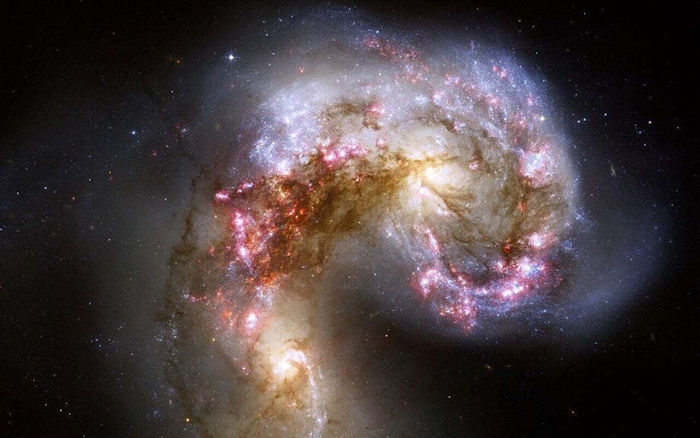
“Astronomers find huge gas bridge linking 2 galaxies”


  • Astronomers discovered a massive 185,000-light-year-long hydrogen gas bridge connecting two dwarf galaxies.
  • This bridge, along with a very long gas tail, is thought to have formed due to gravitational interactions between the dwarf galaxies and the influence of the nearby Virgo galaxy cluster.
  • The discovery, made using the ASKAP radio telescope array, helps scientists better understand galaxy evolution, star formation and gas dynamics between galaxies.

Click here to read the article.


“Brightest fast radio burst ever detected traced to nearby galaxy”


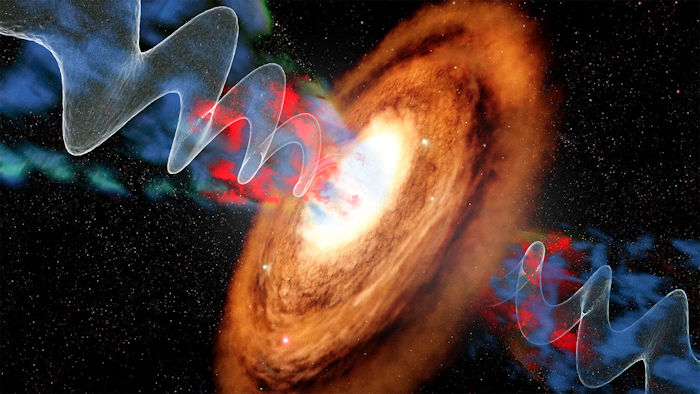
Astronomers have just caught the brightest fast radio burst (FRB) ever recorded, and it has been given a nickname worthy of its power: RBFLOAT, short for “Radio Brightest Flash Of All Time.” The extraordinary event, formally catalogued as FRB 20250316A, was spotted this past March by the Canadian Hydrogen Intensity Mapping Experiment, better known as CHIME. This massive telescope in British Columbia has made a name for itself by finding thousands of FRBs, but none quite like this one.

Click here to read the article.


“Astronomers find hidden channels of hot gas connecting our solar system to distant stars”


When people picture space, they often imagine endless black emptiness dotted with planets and stars. But new research shows that the region surrounding our solar system is far from empty. Instead, it may hold hidden channels of hot gas that connect our neighborhood of the galaxy to distant star systems.

Click here to read the article.


“The Messy Habits Of Small Black Holes”


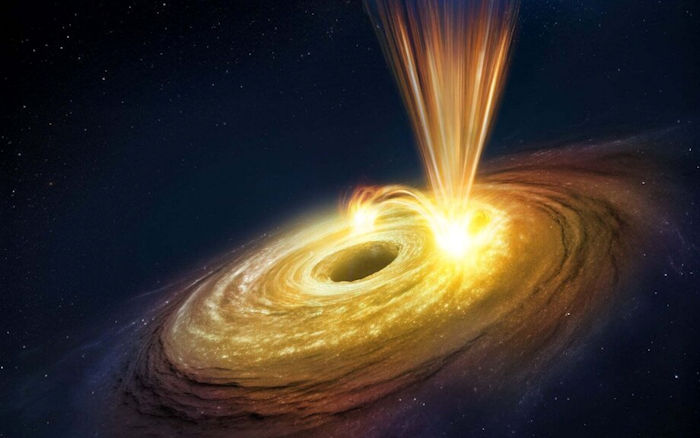
The best opportunity to study black holes is when they’re actively accreting matter. During these times, matter gathers in an accretion disk around the black hole, where it heats up and emits electromagnetic radiation. At other times, there’s simply no light.

Click here to read the article.


“Is A Young Exoplanet Warping The Disk Around Fomalhaut?”


Wh


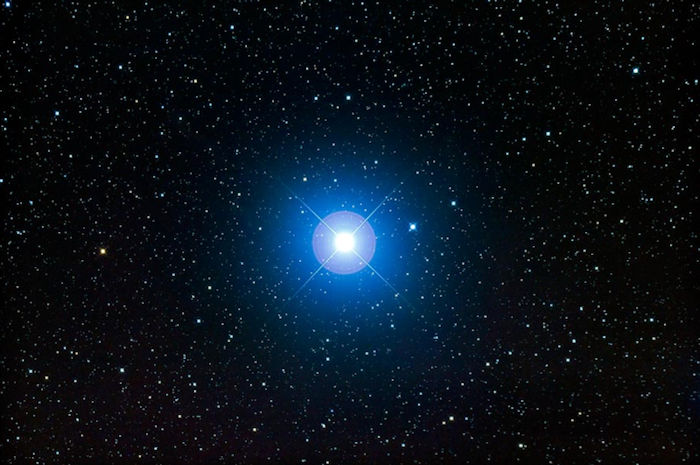
Fomalhaut is one of the brightest stars in the night sky and is about 25 light-years away, making it a galaxy amenable to detailed observations. It’s also a young star, only about 440 million years old. At that age, stars like Fomalhaut are surrounded by active debris disks made of rock and dust from collisions between planetesimals. Exoplanets form in these disks, and one of the hot topics in exoplanet science concerns how planets form in these circumstellar disks.

Click here to read the article.


“NASA’s Webb Observes Immense Stellar Jet on Outskirts of Our Milky Way”


Wh


A blowtorch of seething gasses erupting from a volcanically growing monster star has been captured by NASA’s James Webb Space Telescope. Stretching across 8 light-years, the length of the stellar eruption is approximately twice the distance between our Sun and the next nearest stars, the Alpha Centauri system. The size and strength of this particular stellar jet, located in a nebula known as Sharpless 2-284 (Sh2-284 for short), qualifies it as rare, say researchers.

Click here to read the article.


“Particles Shot Out of The Sun Reveal Distinct Patterns, Scientists Find”


Wh


Our sun can seem deceptively peaceful from Earth, but only because we have the luxury of living 150 million kilometers away. Up close, it’s a nuclear-fuelled carnival ride of terror, launching countless tiny particles at speed far into interplanetary space.

“The Sun is the most energetic particle accelerator in the Solar System,” writes a team of researchers behind a study on the energetic particles that stream forth in solar flares and coronal mass ejections (CMEs).

Click here to read the article.