“Massive black hole from the early universe has astronomers looking back to the Big Bang”


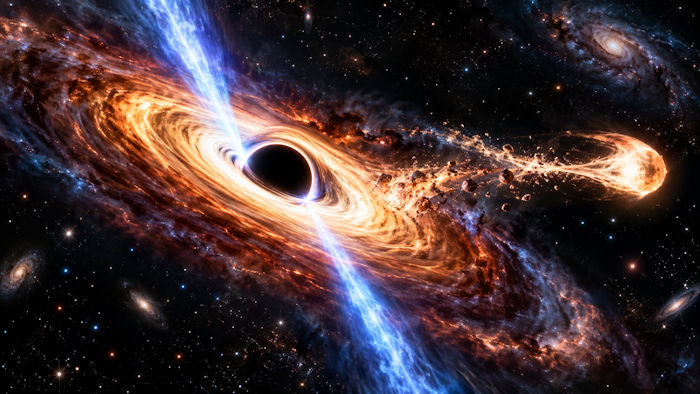
Abell 2744–QSO1 appears just 700 million years after the Big Bang, an era when astronomers expect to find young galaxies still putting themselves together. In that picture, stars should come first, building up the visible mass of a galaxy, while black holes grow more gradually inside them. But this object, seen by the James Webb Space Telescope, looks almost upside down.


“A dead galaxy from the early universe is forcing astronomers to rethink galactic evolution”


Over the past decade, astronomers have detected many stellar-mass black holes that don’t quite make sense.

Stellar-mass black holes range from a few times the mass of our sun to several tens of solar masses. They typically form when a massive star collapses at the end of its life.

But scientists say some stellar-mass black holes – those over about 45 times the mass of our sun – are too massive to have formed from a single star. So where did they come from?


“Strangely large black holes are built, not born”


Over the past decade, astronomers have detected many stellar-mass black holes that don’t quite make sense.

Stellar-mass black holes range from a few times the mass of our sun to several tens of solar masses. They typically form when a massive star collapses at the end of its life.

But scientists say some stellar-mass black holes – those over about 45 times the mass of our sun – are too massive to have formed from a single star. So where did they come from?


“Tracking Changes in the Trifid Nebula With the Hubble”


The Hubble Space Telescope has been operational for more than 35 years now, delivering exquisite views into the cosmos. To celebrate its latest birthday, researchers have released this new image of the Trifid Nebula, also known as Messier 20. It’s a star-forming region located about 5,000 light-years away and appears to be broken into three sections, separated by dark dust lanes. The nebula is only 300,000 years old, and will dissipate into the interstellar medium in a few million years as its stars ignite.


“Exploding Stars, Black Holes, and the Forbidden Gap”


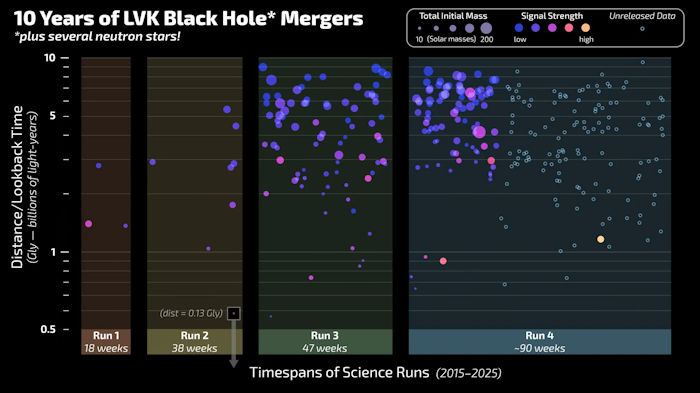
The gravitational waves from colliding black holes were first detected in 2015, with many more collisions found in the following decade. The theories say that stars between 50 and 130 solar masses should collapse and become black holes, but black holes with more than 45 solar masses are extremely rare. This is known as the Forbidden Gap. But what is the cause?


“Black hole Cygnus X-1’s dancing jets”


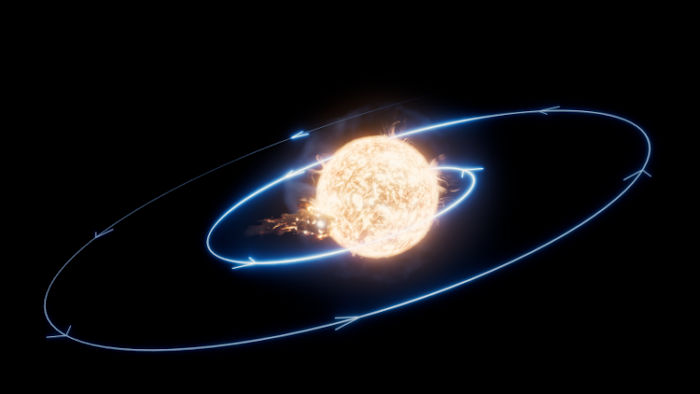
The Cygnus X-1 black hole has a special place in the history of astronomy. In 1971, astronomers confirmed it as the 1st known black hole. And now, a new study has shed light on the immensely powerful jets that stream from it.

These jets are bending and dancing, blown by the stellar winds from a large nearby star. By measuring the motion of these dancing jets, researchers were able to calculate their power.

They found the jets have an astounding 10,000 times the power output of our sun! Plus, they travel at half the speed of light.


“Scientists reveal the hidden forces shaping how gravity works across the Universe”


Gravity behaves predictably in your daily life. Drop a ball, and it falls. Planets loop around stars. On paper, the same rules should also govern matter spread across the universe. But the farther astronomers look, the more that certainty gets tested.


“Early Galaxies Were Surrounded by Huge Clouds of Hydrogen, and Astronomers Found a Whole Bunch!”


The first stars and galaxies formed out of immense clouds of neutral hydrogen, but it was theorized these clouds were surrounded by even larger “Lyman-alpha nebulae.” But only a few thousand of these clouds have ever been detected. Now, astronomers have discovered tens of thousands of halos that existed 10 to 12 billion years ago, at the time of Cosmic Dawn, when star formation began in the cosmos.


“Two Monsters, One Galaxy, and a Collision 100 Years Away!”


Most galaxies contain supermassive black holes, built up through countless mergers of less massive black holes. This means we should see galactic black holes in all forms of evolution, and occasionally see them coming together. Now, researchers think they’ve found a close pair of supermassive black holes in the galaxy Markarian 501, located about 450 million light-years away. They’re locked in their final spiral, orbiting one another every 121 days, separated by 250-540 times the Earth-Sun distance.


“Cosmic simulations reveal how galaxies formed and evolved over billions of years”


Cold gas does not look dramatic at first glance. Neither does dust. Yet those two quiet ingredients sit at the center of a new effort to build a far more realistic picture of how galaxies formed. They help explain how galaxies changed and spread across the universe over billions of years.