Sanctuary Water Project Progress: A Report


Since March 2011, the water project at the Red Rock Consecrated Sanctuary has made significant progress.

The importance of this five-year project cannot be overlooked. Once it is completed, development of our Sanctuary can begin in earnest and with much greater potential—putting 17 million gallons of water annually to beneficial use. Our Community has invested close to $200,000 in this project thus far and nearly 10,000 volunteer man-hours.

Phase 1

The existing well head. PHOTO: Ted Staver

Phase 1 of the water project entailed building a structure around the existing well head at the Argonaut site.

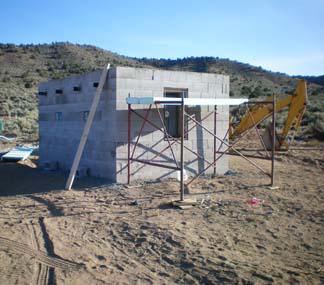
Main structure of Argonaut pump house under construction. PHOTO: Ted Staver

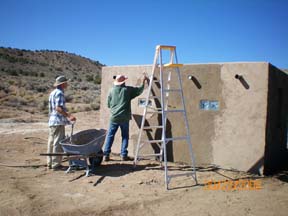
Argonaut pump house being finished with stucco. PHOTO: Ted Staver

With that completed, Church work crews were able to install the necessary electrical switches and conduit along with a high-voltage transformer for power distribution throughout the sanctuary. The Argonaut pump site was finalized with the installation of all remaining conduit, electrical wiring, service boxes, and signal wire for the control sensors. A high-voltage transformer for power distribution to a lift pump station and power distribution for future expansion was also installed.

View of some of the inside electrical fittings in the Argonaut pump house. PHOTO: Ted Staver

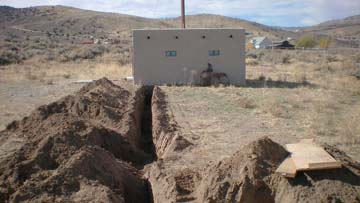
The photos below show the trench leading to the first “pull box.” This is where wire connections are made for electrical distribution. Power cables from the Argonaut pump site to the Chapter House (a distance of almost one mile) were laid.

Pump house and trench to first pull box. PHOTO: Ted Staver

The pull boxes are rather large, and there is a total of 17 of these boxes stretching up to the Chapter House.

Last pull box. PHOTO: Ted Staver

The concrete pad for the lift station was poured and the housing unit put into place. Finally, the final 300 feet of trench were excavated and water pipes installed, completing the connection from the lower portion of the Sanctuary to the upper part. Two small transformers were installed in separate locations for use with smaller irrigation pumps for future expansion.

Phase 2
The second phase of the project involved the connection of the high-voltage power lines from the main pump house up to the lift pump station, and the planning and placement of the water lines from the tank site to the lift pump site. This work was performed primarily by the Reverends Ted Staver and Herman Aggenbach.

Once that was completed, a concrete pad for the lift pump housing was poured and the housing placed on it. From that point on, it was simply a matter of configuring the placement of all the electronic controls for controlling the lift pump and monitoring water levels in the tanks. The photos show that the crew managed to load a lot of things into the small housing.

The final step in this phase of the project was to acquire and install a second transformer for the lift pump station and a variable motor speed controller. A booster pump capable of producing 40 gallons per minute was also needed, as well as a 4,000-gallon water tank. (The holding capacity for the tank was raised from 2,500 gallons, as reported last year, to 4,000.) The cost of these items was between $12,000 and $15,000. Work continued once funds were raised.

Phase 2 was nearly complete at the time this article was posted. It is just a matter of weeks before the final connection of wire is made and the components are tested. The next step will be to acquire the water tank that will supply water for the lift pump and to make the final water pipe connections. The crew expects to be pumping water to the upper level of the Sanctuary by the end of August 2012.

This project has taken several years to reach this point. It represents not only the attainment of water rights for the church but also future growth for new residences because of the availability of water and power. In planning the system, the crew included means to connect wind and solar to the pumping system so as to make it an off-grid system in the hope that the Sanctuary can be totally self-reliant in the future.

It is hoped also that we will be fully utilizing the new water distribution system by mid-summer, putting to use our water resources and saving precious dollars as a result of energy savings. It also means that the indoor and outdoor vegetable gardens, which were expanded last year, can be more fully utilized.

Remodeling of another portion of the Chapter House has begun so that a fourth staff-minister can reside at the Chapter House and assist with additional landscaping and greenhouse gardening.

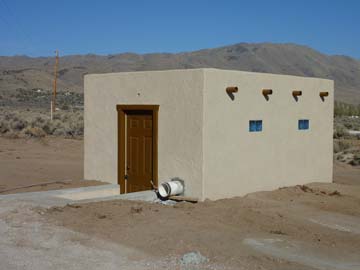
Completed pump house on Argonaut Way. PHOTO: Ted Staver


James Oschman, PhD: “Conversing with the sun”

Dr. James Oschman, the keynote speaker at the 2011 Conference on the Spiritual State of the World presented by Cosolargy International, has written a short piece about, as he puts it, “conversing with the sun.”

The article was inspired by the people he met in the Community during his visit to Reno, where he participated in Sunrise Divine Service and Chapel Services, the Steamboat Health Center open house, as well as the conference itself.

Follow this link to read the entire article on www.Cosolargy.net.


THE LUMINOUS TEACHING STONE OF CHINA: The Stone Itself, Part 1: Introduction

The Monument at Peilin

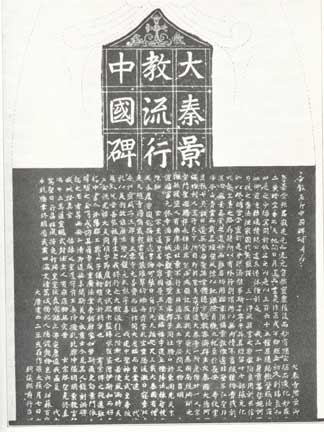
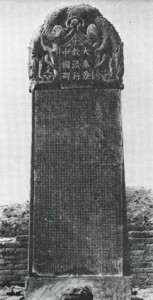
In the year 781 of the Christian era, a monument was erected in the western suburb of the Chinese capital at Ch’ang-an to commemorate the mission of the ancient Church of the East to the great T’ang dynasty. With it begins the indisputable (accessible) history of Christians in China. (See footnote 1) The stone itself is a single slab of hard, grey limestone, nine feet in height, between three and four feet in width, tapering toward the top, and nearly one foot in thickness. The weight is rather more than two tons. Its inscription is written in both Chinese characters and a form of Syriac that, like the Chinese, is written vertically and from right to left. The stone is known as the “Luminous Teaching Monument” (ching-chiao pei) to the Chinese, who style it a “grand tablet” (feng pei), a term commonly and almost technically applied to tombstones.  

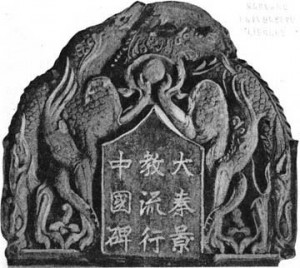
The nominal purpose of the monument is to praise the emperors under whom the East Asian Church had flourished. Nine large Chinese characters arranged in three rows form the titular heading of the stone read:  

Monument headstone

A MONUMENT COMMEMORATING THE PROPAGATION OF THE TA’CHIN LUMINOUS TEACHING IN THE MIDDLE KINGDOM

The verses of an ode and a long prose preface occupy the stone’s face. (See footnote 2) Both the ode and the preface were composed by a Persian father of the Church (named Ching-ching in Chinese and Adam in Syriac) who resided at the monastery at Ch’ang-an. (See Supplement 1)  

The narrative preface is arranged in eighteen paragraphs. The six paragraphs of the first part briefly outline the Teaching and the practices of its ministers. The first paragraph proclaims at once the existence of the True God, Elohim. The second introduces the etheric processes of creation leading to the formation of man. In the third, the ethereal theme digresses into a description of the Fall of Man and the subsequent degeneration of his descendants. God intercedes for man in the fourth paragraph: A Messiah announced by Angels appears in human guise, and the Persians are given knowledge of his birth in the land of Ta-ch’in by means of a star. The same paragraph sets forth the works by which the human Messiah brings the ancient law to completion. The theme of salvation thereby passes from the Messiah to his ministers and their customs. Here the doctrinal portion of the inscription changes into the historical narrative. A transition paragraph relates the difficulties of naming the true, unchanging System called the “Luminous Religion.”  

The next eleven paragraphs tell the story of the Teaching’s entrance into China and the patronage which the emperors of China extended to it for nearly 150 years. In the space of the first four paragraphs of the history, the missionary Rabban A-lo-pen arrives (A.D. 635), is favorably received, and conducts his first interviews with Emperor T’ai-tsung. The result of these initial meetings is the issuance of an imperial edict that authorizes the propagation of the new doctrines throughout the empire and the building of the first monastery (A.D. 638). This section closes with evidence of the continued favor shown to A-lo-pen by T’ai-tsung’s son, Kao-tsung. The seven following paragraphs trace the changing fortune of the Luminous Teaching after its establishment until the monument is raised: the disorderly years (A.D. 688–699) when audacious Buddhists influenced the usurping Empress Wu and raised their voices against the Luminous Teaching in the province of her Eastern Capital; the year of slander and ridicule in the Western Capital (A.D. 712) (See footnote 3) and the restoration of the Teaching under eminent monks; the granting of imperial protection (A.D. 742); the auspicious arrival of the priest Chi-ho from the West to reinforce the mission; the establishment of the religion under state sponsorship; the rebuilding of the monasteries; and the imperial favors and meritorious deeds of the most recent emperors. The final paragraph of the historical narrative, the seventeenth, describes the titles, virtues, and honorable imperial service of the priest I-ssu, the great benefactor of the Church. A line of the Syriac below the Chinese inscription identifies this same man under his Turkic name as the donor of the monument, Iazed-buzid. (See Supplement 2) The eighteenth paragraph is a short transition leading directly into the ode.  

The ode, composed in ancient style, is a eulogy to the five emperors who sponsored the Church of the East from the time of its first mission under Rabban A-lo-pen to the time of the erection of the monument (A.D. 781). In eight stanzas it covers the same ground as the long historical narrative that precedes it. (See Supplement 3) The inscription ends with the date the monument was raised (first, according to the Chinese calendar and then, in both Chinese and Syriac, by mention of the ruling patriarch of the time) and with identification of the calligrapher who wrote it: Lu Hsiu-yen. (See Supplement 4)  

At the foot of the stone, on the front face below the inscription, is a list of credits made partly in Syriac and partly in Chinese. The date, here given according to the calendar of the Greeks, is followed by the names of several individuals involved with the monument: the donor, his son, presbyters, church heads, and supervisors at the raising of the stone. The names of seventy monks, most with Syriac-Chinese equivalents, are catalogued in rows along the narrow edges of the stone. The back of the monument is innocent of inscription.  

The symbols cut into the crown of the stone, like the Syriac words at the foot of the inscription, are traced with a hand that is graceful but much less certain and positive than the young hand of Lu. The design of the figurehead adopted by the ancient churchmen is called by Professor P.Y. Saeki (See Supplement 5) “a Hindu idea that had become thoroughly Buddhistic”: an immense pearl held between two monstrous creatures with the bodies of fish coiled into the shape of snakes. (See Supplement 6) For all his comprehension, Professor Saeki fails to explain the obvious resemblance of the “pearl” to the Sun of Spirit and the significance of this mythologem to the early Christians, for whom the pearl also represented the latent spiritual nature of man. Neither does he mention the occurrence of similar dragon figures in the Pistis Sophia (See Supplement 7) and The Acts of Thomas. (See Supplement 8)  

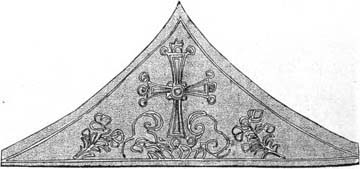
Incised scene beneath the pearl in the center of the headpiece

Beneath the pearl in the center of the headpiece — framed on either side by sprigs of either myrtle or lily (the former a regular Buddhistic emblem, the latter a familiar Christian symbol) — is the apex of a triangle that forms a canopy over a significant incised scene: The Flying Cloud of Chinese Muslims and Taoists rising out of the Buddhist Lotus Flower to support the Cross of the Apostle Thomas, ignited from above. (See Supplement 9) It is the presence of this form of the cross that gives the monument its special appeal. Its presence signals that the inscription may hold trace elements of the one True Teaching (a teaching that is itself timeless and unchanging but is lost and then revealed cyclically again and again at various times and in various places), some evidence that a fragment of the Teaching still remained even into the eighth century of the Common Era.  

It is said that the cross on the stone is no longer very clear and must be searched for before it can be found. One authority suggests that its form may be a copy from memory of the Roman papal cross used up until the sixth century when it was discarded. The Portuguese missionary Alvarez Semedo saw it in the seventeenth century as “a beautiful cross, whose ends, finishing in fleurs de lys, resembles that carved upon the tomb of the Apostle St. Thomas in the city of Meliapor.” (See Supplement 10)  

From the information preserved in the Acts of John, we know that this form of the cross signifies not the wooden cross of crucifixion but the Cross of Light. (See Supplement 11) The descendants of the ancient Church of the East, still in existence but split and factioned among themselves, retain the same form of the cross as their sign. This cross, in silhouette, or shadow, form, has remained to our own time in the form familiar to us as the Greek, or Eastern Orthodox, cross.  

With rectified proportions and symmetry, the image of this same cross was revealed to the Second Advent Church, whose members know it also as the Cross of Enlightenment, the sign of God’s Image and Word in the Spiritual Sun, the Solar Cross, the representation of the Golden Flower, the Body of Light, the cross whose twelve sun symbols represent the twelve revealed religions of man and their cycles, the twelve great teachers, the twelve great nations, the twelve apostles, and the twelve signs of the zodiac — the cross whose numbers multiplied among themselves represent the sacred numbers of The Church. This cross was known and used in China by the Apostle Thomas, who had come to China to remind the people that he was part of the prophecy of the sages, to remind them that the Great Sun Teaching was part of their heritage and was held in their genes but had been forgotten. (See Supplement 12)  

Robert G. Petrovich  

1989, 2010 

FOOTNOTES  

(1) The inscription carved into its stone is one of the nine early Christian documents written in Chinese that have so far been uncovered in China. All of them have been placed within the context of the history related through the inscription by the twentieth-century sinologist Dr. P.Y. Saeki. He identified the inscription and four of the others as creations of the early seventh century and called them “Bishop A-lo-pen’s documents.”  

A-lo-pen (described in paragraphs seven and eight of the inscription) is the Persian missionary met by a Chinese guard of honor in the western suburb of Ch’ang-an in A.D. 635 and conducted to the palace, where he was interviewed by the emperor. Over the next three years, Rabban A-lo-pen translated in the imperial library at least one of the treatises attributed to him for the emperor’s personal investigation of “The Way.” Three years later, in 638, the emperor gave special orders for the propagation of the Teaching.  

The other four documents Dr. Saeki attributed to Bishop Chi-lieh, a missionary who (according to paragraph eleven of the inscription) came to Ch’ang-an with eminent priests and noblemen from the “Golden Region” shortly after the Christian teaching was slandered by inferior Taoist scholars from western Hao in A.D. 712.  

In addition, two ancient Syriac manuscripts have been discovered: one during the 1930s in a building attached to the imperial palace, the other in 1908 at the oasis city of Turfan in the northern desert of Central Asia.  

(2) The Chinese considered the prose foreword to a poem to be fully as important as the poem it prefaced. Often the author used his preface to create allusions to Chinese cosmogony and to convey secret thoughts through the veil of conventional phrasing.  

(3) The ode, like the preface, passes from A.D. 683, the end of Emperor Kao-tsung’s reign, to the reign of Emperor Hsuan-tsung, beginning in A.D. 712. While the eleventh paragraph of the preface gives some account of the period of disorder during the Sheng-li years, this same period in the ode is marked only by the space between the third and fourth stanzas, the stanzas that praise the emperors Kao-tsung (reign A.D. 650–683) and Hsuan-tsung (reign A.D. 712–755). 

Read THE LUMINOUS TEACHING STONE OF CHINA: The Stone Itself, Part 1: Supplements

Read <THE LUMINOUS TEACHING STONE OF CHINA: The Stone Itself, Part 2: Discovery>


Nevada Prayer Breakfast Reinstated

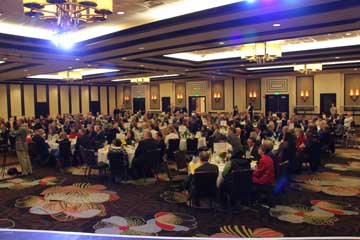
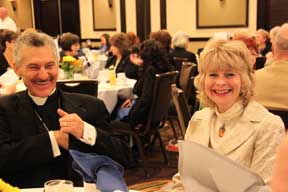
More than 300 clergy and congregants gathered at the 2010 Nevada Prayer Breakfast. PHOTO Rob Roy

The Nevada Prayer Breakfast, sponsored by the Nevada Clergy Association, was held Tuesday, November 16, 2010, at 7:00 AM at the Atlantis Hotel. This powerful gathering brought together over 300 local people across a variety of religious communities to join in prayer for the good of the state of Nevada.. The event also sought to remind civil authorities and other community leaders of the spiritual considerations to keep in mind when decisions are made that affect human lives.

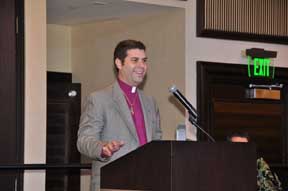
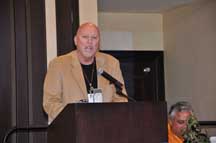
Rt. Rev. Sean Savoy acted as Master of Ceremonies at 2010 Nevada Prayer Breakfast. PHOTO Stephan Fuelling

The Right Reverend Sean Savoy, Chairman of the Nevada Prayer Breakfast Committee, served as Master of Ceremonies for the program of music and prayer, providing the opening remarks, graciously introducing program participants and musicians, and recognizing the civil and religious dignitaries present, with special mention of members of the Nevada Prayer Breakfast Committee and of the co-hosts of the event: The Honorable Robert Crowell, Mayor of the state capital, Carson City; The Honorable Robert Cashell, Mayor of the city of Reno; and The Honorable Geno Martini, Mayor of the city of Sparks.

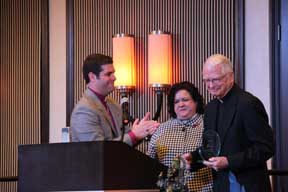
Rt. Rev. Sean Savoy looks on as Rev. Stefani Schatz presents award to Fr. Jim Jeffery

The Right Reverend Gene Savoy Jr., President of the Nevada Clergy Association, together with Reverend Stefani Schatz, Rector of Trinity Episcopal Church, presented the first Vision Award to the Reverend V. James Jeffery, Rector Emeritus of Trinity Episcopal Church, in recognition of his dedication and contribution to interfaith dialogue and collaboration in Northern Nevada for over thirty years.

PHOTO Rob Roy

(Read Rt. Rev. Gene Savoy’s Welcome Address and introduction to the presentation of the Vision Award: HERE.)

(Listen to Rt. Rev. Gene Savoy’s Welcome Address: HERE.)

PHOTO Stephan Fuelling

(Read Rev. James Jeffery’s Keynote Address: HERE.)

(Listen to Rev. James Jeffery’s Keynote Address: HERE.)

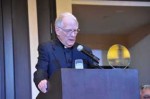
Rev. Bill Bartlett delivers expression of faith from Buddhist perspective. PHOTO Stephan Fuelling

Father Jeffery’s Keynote Address was followed with prayerful expressions of universal love and guidance provided by a number of regional religious representatives from their local and personal traditions.

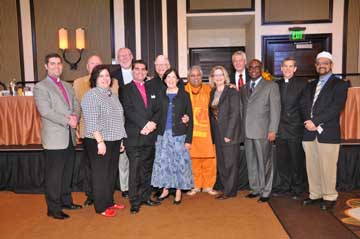
Members of the dais gather together. PHOTO Stephan Fuelling

The 2010 Nevada Prayer Breakfast revived, in a new form, the old tradition of the Governor’s Prayer Breakfast after a ten-year absence of the once annual event. The Nevada Clergy Association (NCA) plans to continue the tradition of the Nevada Prayer Breakfast as one of its programs. Other programs and events sponsored by NCA are the annual Martin Luther King, Jr. Memorial Celebration, the annual Interfaith Thanksgiving Eve Service, now in its 25th year, the bi-annual Clergy Lunches hosted by the various participating congregations, occasional conferences and study groups, and regular email communications on programs and events of mutual interest.

Revs. Robert and Francine Petrovich at the Church's patron table. PHOTO Rob Roy

The International Community of Christ was represented at the event by a patron table of eight of its members, who were there to promote and encourage the event, which is in line with the Church’s mission to knock on the doors of churches to aid in the joining together of all religions under God’s Light.


Solar Teachings Symposium Held in Los Angeles

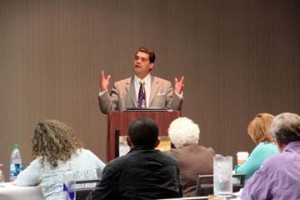
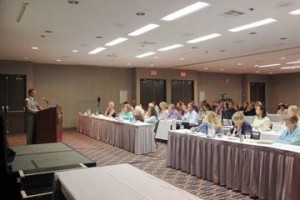
The Sacred Solar Teachings Symposium was held at the Gateway Sheraton Hotel in Los Angeles, California, on June 26, 2010. The event was planned and cosponsored by the Jamilian University of the Ordained and Dr. Mitchell Gibson of Tybro Corporation, a psychiatrist, author, spiritual teacher, and former Consociate of the International Community of Christ. Bishops Gene Savoy Jr. and Sean Savoy lectured alongside Dr. Gibson, speaking on a wide range of topics related to spiritual enlightenment and solar teaching. Bishop Gene Savoy spoke on ancient solar cultures and the modern solar spiritual Community. Bishop Sean Savoy discussed the nature of the Spiritual Sun and the benefits and practice of solar techniques and presented some basic solar techniques as well. Dr. Gibson spoke on the nature of the sun and changes to come in 2012. The event was photographed by the Reverend Robert Roy. Also in attendance from the International Community of Christ were Academy members Charlotte Davis of Los Angeles and Margaret Myota of Wisconsin, who joined nearly 60 other attendees and assisted with details of the day’s event.

The conference was conceived by Bishop Gene Savoy Jr. in March 2010 while speaking to Dr. Gibson on other issues. Dr. Gibson quickly agreed to the collaborative effort, and arrangements for the June 26 seminar began shortly thereafter. In Los Angeles, the speakers agreed to continue working together and made tentative plans to hold other such seminars in Phoenix, Dallas, Chicago, Milwaukee, New York, and Montreal. Dr. Gibson has also accepted the invitation to speak as part of the Conference on the Spiritual State of the World at The Community’s 2010 annual Convocation in September in Reno.


Father Reano Castell Passes into the Light

A funeral service to honor the life of the Reverend Father Reano Castell (March 26, 1931 – March 9, 2010) was held Saturday March 20, 2010, in the Chapel of the Holy Child, Reno, Nevada. In recognition of Father Castell’s office in The Church, his casket was draped with The Church flag; in recognition of his citizenship and proud service in the Swiss army, the foot of his casket was draped with the flag of Switzerland. The order of service included scriptural readings, eulogy, benediction of commital, and final blessing. A special addition to the service was the reading of the Swiss national anthem, “Landeshymne,” in both German and English, the anthem often referred to as the “Swiss Psalm” because it reads like a sunrise prayer. Another special addition was the solo performance of the song “Edelweiss” from the movie The Sound of Music in recognition of Father Reano’s love for this national flower of Switzerland. (For the full order of service, see: Father_Reano.order_of_service
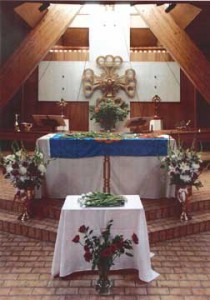
A banquet reception to celebrate the life of our departed Brother in Light was held at the Rectory-Abbey on Carmel following the service. The remains of Father Castell were anointed by the Head Bishop, the Right Reverend Gene Savoy, Jr., before the funeral in a private ceremony on Saturday March 13 and cremated following the funeral service.

The eulogy for Father Castell was composed and read at the funeral service by the Right Reverend Sean Savoy. The transcript follows:

The Reverend Father Reano Castell

March 26, 1931 – March 9, 2010

EULOGY

Delivered by Rt. Rev. Sean Savoy

Introduction

It is a distinct honor for me to have been chosen to speak today for a few brief minutes on behalf of all of us who knew Reano, our dear departed Brother in Light. And I’d like to thank each of you in attendance and those who couldn’t be here today who contributed information on Reano’s life.

I first remember meeting Reano when he moved to Reno from British Columbia, Canada. I was 10 years old, and we were engaged in building the East Wing of the Rectory. Ironically, perhaps, all these years later I reside in that parsonage, so, believe me, Reano (and the rest of the building crew) aren’t often far from my thoughts.

For twenty-seven years, Reano was part of life in The Community. And even though he was a fixture in the weekly lives of each of us for nearly three decades, I’m not sure many of us really understood the private Reano — the man beyond the old stories and jokes he was so prone to repeat — whether it be the story of being forced to eat his mother’s onion pie, the time he put ink in the holy water at school, when he tied his classmate’s pig tails together as a prank, or even when he had to kneel for hours on pebbles as punishment for his mischievous ways.

Those who did have the chance to know Reano on a more personal basis, I believe, found a good and loyal friend in him. I know that my father was one of them. In the early years — Reano began communicating with my father in the 1960s — correspondence between them was often by letter, but later on, Reano became more than an associate and student of Gene Savoy at a distance. By the time he moved to Reno in 1983, he had become an extension of our family and of the Rectory.

I remember it was Christmas 1983, and Reano was invited to a big Italian dinner. He walked into the Rectory kitchen and enthusiastically asked, “What can I do to help?” So my dad gave him a block of Parmesan cheese and a cheese grater. Reano had a great time grating the cheese while my mother and Ileana cooked the pasta and sauces. Needless to say, it became a tradition anytime Reano came for Italian, that he was in charge of the Parmesan.

There wasn’t a birthday or holiday to which Reano wasn’t invited, and I believe these joyous times together gave him a sense of belonging—something that seemed of utmost importance to him.

In one of his early applications to join the Sacred College, he wrote:

“I would spend more time and energy to find the real purpose of life here. My primary goals are to gain a better understanding of this life and spiritual life, to help and lead man to ultimate reality of God. But how can I help? For some reason I’m setting on the fence, and I ask myself: Does God really want me? I don’t know if I qualify for Ministerial training. I leave that to the Community and God.”

Despite this vulnerability and any flaws he may have shown, indeed, Reano put his trust in The Community, in his service to a New World, and in his devotion to God. Many of us here were witness to this dedication.

Background & Church Life

Reano was born March 26, 1931, to Enrico Castell and Martha Catharina Nagel in Olten, Switzerland. He was raised in a family of twelve children, five siblings and six orphaned cousins taken in by his parents. All the children were only a few years apart, but Reano was the oldest. His home and school were in the Swiss mountains. He skied to school in the winter months. When he was about 13, he was sent to live and study at a monastery in southern Switerzland. There, he had to learn Italian because no one there spoke German, his native tongue.

As a young man he trained as a Swiss Grenadier, completing his mandatory military service. The following story relates one of the dangerous episodes he lived through as part of his military training:

When Reano was eighteen, he was assigned to work in a tunnel in the Swiss mountains. His supervisor detected a gas leak in the tunnel, and it was up to Reano and his superior to warn all of the other soldiers and get them out of the tunnel safely. Everyone was out of the tunnel but Reano and his supervisor when the area exploded. They were thrown from the tunnel. Reano received severe injuries to his head and spine. He overheard the doctors telling his parents that he would likely never walk again, but he would not accept the prognosis. Six months after the accident, he walked for the first time, from his bedroom to the kitchen, where his mother was. Ironically, she told him to go back to bed because he was not well enough to be up yet. As a result of his injuries, he was prone to seizures for the rest of his life.

Reano also undertook religious studies. After one and a half years of ministerial training at St. Marie College, he continued his education in civil engineering, carpentry, and architectural drafting.

When he was twenty years old, he traveled by ship to Canada with only a quarter of American money in his pocket. Upon his arrival on Canadian shores, he bought two loaves of bread with his quarter. He kept one for himself and gave the other to a family with children. He walked and caught rides across the continent, working at various farms along the way. He sometimes worked for people who did not speak a language he knew. Eventually, he was taught English by the wife of one of his employers.

He saved his money and eventually married his wife, Betina. They settled in Victoria, British Columbia, where he owned and ran a contracting business, which employed several European master craftsmen specializing in the building of high-end custom homes. To complement his professional and spiritual interests, over the years he took courses in, and later taught, cosmobiology, astrology, and Kabbalistic philosophy.

He was in correspondence with the International Community of Christ Church since the mid-1960s after seeing an article in Fate magazine about Gene Savoy. He later joined The Academy in 1971. In his letters to the Center — whether in Lima, Mexico City, or Reno — he often praised The Community for the depth of information, for the quality of our publications, and, most important, for the education and knowledge he believed he was privileged to receive.

Reano was an early member of the Andean Explorers, such as it existed in the 1970s, and wrote with praise for the book Antisuyo and of his appreciation for our work in Peru and the Amazon, as well as his desire to maybe one day visit the jungle. Although he never made that trip, he did serve on the board of directors when the club was resurrected in the 1980s, and he was honored for his early design work on Feathered Serpent III.

Giving over his contractor’s business to his sons, Brandon and Rob, in 1983, he left Canada and his family to become a permanent resident of the Reno Community in order to complete his ministerial training in The Church and dedicate his life to the Sacred Teachings of Light within the Jamilian Order.

Frustrated that his wife was adamantly opposed to religion in general and was not supportive of his spiritual endeavors in this Church (or any other, for that matter), Reano — I don’t believe — ever really got over the loss of his family, who rejected him and his decision to be part of The Community. Yet, Reano was steadfast in his decision.

Following first-level ordination in 1983, he was immediately assigned to The Church’s Building Department and became a resident of the Chapter House at the Red Rock Consecrated Sanctuary attached to the Cathedral Abbey of Monte Viejo. Upon taking the vow of nonmaterialism, he assumed liturgical functions and administration of the sacraments as an assistant to the Pastor, and in 1986 received second-level ordination. He was assigned as part-time faculty of the Jamilian University and was given a Lector’s chair at the Chapel of the Roses at the Steamboat Priory.

In 1993, under new pastorship papers, he was given several administrative appointments under the designation of Canon, including a seat on the Sacred Oversee, the leadership of the Building Department, the priorship of Steamboat Hot Springs Priory-Mission, and the role of secretary-director for the International Community Guilds and the Steamboat Springs Water Works.

In 1998, he was made Rector of the Church of the New Covenant, and in the year 2000, he was appointed co-Chair of the American Association of Concerned Clergymen of the Advocates for Religious Rights & Freedoms. Reano remained active in some or all of these capacities until his passing, although his administrative duties became fewer and fewer in the last few years.

In 1991, he was among the first to enter the Order of Patriarchs, and it is this role that he cherished toward the end of his life, holding to his daily devotions and the rituals of life at the Sanctuary. As a “Father” of The Community, in his later years — despite the frustrations of old age — Reano assumed a more serene attitude, even though he never lost the feistiness that endeared him to — and often frustrated — his fellow companions.

Some may not realize that before he took his vows of poverty/nonmaterialism, Reano was a constant supporter of The Community with his financial donations. He supported many projects, including the Publishing Department, exploration and research projects and, of course, the Sanctuary. Even after taking his vows, he was generous with the small amount of funds he had available to him. He would often give small contributions to help out other projects of The Community not related to his areas. And just a few years ago, after saving up several thousand dollars unbeknownst to anyone, he was able to purchase and install a small greenhouse for the perpetuation of the Sanctuary.

Memories

Reano had many talents. He was a master builder, a contractor, a draftsman, a painter, and a craftsman. He was a competent astrologer and an avid reader. He might have been a meteorologist, as he could often predict the weather with a certain accuracy. He loved to garden. He loved to dance. Does anyone remember his now infamous “chicken dance,” which he would perform from time to time at gatherings? He loved to make fondue on his birthdays. And he loved his wine. Yes, how he loved his wine — a Valpolicella or a nice Chianti, please.

Always the ladies’ man, he enjoyed the company of all the devoted women of The Community, and did not hesitate to turn on the charm during one of our holiday parties or at a dinner of the Andean Explorers.

Reano enjoyed having the company of the men working on projects at the Sanctuary—especially recently, when he no longer had the weekly visits by my father or the Saturday lunches he used to enjoy at the Rectory to keep his spirits up.

In his last years, Reano continued to be active as best he could with work crews, if only to lend a helping hand and, more important, to offer moral support. And he never faltered from his duty to escort the Sunday groups on their trips to perform “second services” each week.

Certainly, each of us has our own memories of Reano. To summarize, I’d like to share a few memories of Reano as submitted by his friends and companions. These brief stories convey best the essence of the man, far better than I could attempt to do.

“I am very proud to have had Reano as a dear and loyal friend all of these years. I loved sitting at the table with Reano and Rev. Gene and listening to them discuss work projects and tell jokes. I also loved my many walks around the Sanctuary with my friend. I will miss his beloved presence very much.” (Barbara Whitney)

“Over the last two years there has not been one week where he would not tell me at least twice about how every Wednesday the late bishop would come out to the Sanctuary and bring with him a bottle of wine, a loaf of bread, cheese and olives, and the two of them would sit and talk about ‘certain things’ (he would say), and then they would go hiking around the Sanctuary. He never really recovered from the loss of his friend, and I believe that he is with him now.” (Ted Staver)

“Reano was one of the first people to greet me when I joined the Church. His warm laugh and great sense of humor always lifted my spirits and put a smile on my face. I learned that my birthday fell on the same day as his daughter’s, who had a very short life. This seemed to create a bond that stayed with us for many years.” (LaCynda Gibson)

“Reano always remained loyal to his beloved teacher. When his parents passed away about 1994, he turned down his inheritance and the title of [burgermeister] of the region he had been raised in. His surviving family continued to reject him. He hung on to The Church for the sake of his faith and his loyalty. He proudly accepted and took very seriously the title Rev. Gene gave him, “his Swiss Guard.” (Barbara Whitney)

“He loved to sit with a glass of wine and talk for hours about his days in the Swiss army. He was a grenadier (equivalent to our Green Berets). ‘You had to be one tough son of a gun to make it through that,’ he would often say. And he would talk about the refugees that came into the country during the war and how the Swiss would extend their hands in welcome and that ‘in those days we helped one another, not like today.’” (Ted Staver)

“One of the most endearing contributions I will always remember Reano for was his great and long-lasting role as our dear Santa Claus. We had more fun watching him and listening to him coming in with all of the reindeer. I think [they] had more fun than any of us.” (LaCynda Gibson)

“I remember the time the Bishop, Reano, and I were watching the men work on the Temple Mount. Some of this work involved dynamiting portions of the rocky terrain to make way for the fence. Reano had been pushing the ignite button to ignite the dynamite, and at one point he looked at me, smiled, and asked: ‘Here, you want to do it?’ Of course I did. (LaCynda Gibson)

“When I think of Reano, my mind races with episodes of adventures. I remember the time he was working out in the field at Red Rock and his thumb nail got caught on something and bent backward. (Ouch!) One of [the men] grabbed him, drove him to the Chapter House, and held his hand over the sink with running water, and flipped the thumbnail back into place. The yell from Reano echoed throughout the valley.” (LaCynda Gibson)

“I considered Reano a master storyteller. He had a way of telling a story over and over again and everyone would listen as if it were being told for the first time.” (Robert Roy)

“I was saddened to hear of the passing of Rev. Father Reano. He was a wonderful, precious man who was always very kind and helpful to me. I will miss his gentle presence.” (Bruce Bunch)

“Reano was a good man and a dear friend of your father’s who loved him very much. I am sorry to hear of his sudden passing.” (Sylvia Ontaneda-Bernales)

“The passing of Rev. Father Reano was a great shock to me. He has shown many kindnesses to me. May his soul rest in peaceful Light.” (Shinobu Uwataki)

“The first memory I ever had in my life was of Reano. I was around one year old, and I remember him tucking me into my crib at night.” (Matthew Madonna)

“Just a thought about Reano. For Mother’s Day he gave the women of The Church hand-drawn cards of the Madonna and Child – which he did twice that I can recall — a very kind thing for him to do.” (Mary Foust)

“I was talking about this with Reano two weeks ago: I remembered walking up to the Church of New Ephesus with Reano. It was spring and it had been a wet winter. The wildflowers were everywhere. I spotted a small white flower which I did not recognize. Reano looked down, and with a gasp in his breath, he said it was edelweiss, the national flower of Switzerland. He just stood there gazing at that flower. I knew he was thinking of home. When he looked up, there were tears in his eyes. He said the flower told him he was home at Red Rock, just like Switzerland.” (Amanda Buchanan)

And this final thought from a fellow Canadian:

“Reano was a man for all seasons. From assistant hog farmer in central Manitoba, Canada, to independent building contractor in Victoria, B.C. From Swiss national guard trooper jumping out of low-flying light aircraft into Swiss mountain snow banks to sergeant in the PPCCL, a crack Canadian forces airborne regiment. From apprentice carpenter to master builder; and from school boy in monastic school to a Rt. Rev. Priest and venerated Patriarch in the International Community of Christ (not to mention a rather convincing Santa Claus). He played a very important role in the construction of the Community’s infrastructure, notably the Chapter House and Sanctuary buildings and the open-air churches; the East Wing of the Rectory; the Cathedral towers, platform, and communion table. These projects and many others that are well known to all of you. They stand better than any words of mine as tribute and memorial to his life and character. I enjoyed working with Reano. While working it was no nonsense, but when the work was done there was always time for a glass of wine and a story or two. He was a good friend, and I know that even as we celebrate his well-lived life and are glad he is in a better place; we feel a sadness at his passing. Rest in The Light, my friend!” (Patrick Newman)

As a child, I came to know and respect Reano — with all of his eccentricities, his charm, his intelligence, his good will, and, of course, his accent. I have many memories of him, but I believe enough has been expressed this afternoon in tribute to him. I will say, however, that although he could be hard line — “no-nonsense,” as Pat put it — on the job site, during Young Explorers outings at the Sanctuary, or on the sports field — where he made sure the guys, or the kids, including myself, followed direction, he was a proud, kind, and good man who strove for the proper outcome no matter what the project.

Most of all he was a spiritual person, who will be greatly missed. As a final tribute, the pasture area in front of the Chapter House where he lived for twenty-seven years, will be designated Castell Park and Memorial Gardens in his honor.

It became a popular tradition in the 1970s to take the melody of Edelweiss — one of Reano’s favorite songs and flowers — and to make it into a Benediction. I thought it would be appropriate to read these words as a conclusion to our thoughts on Reano’s life.

May the Lord, mighty God,

Bless and keep you forever.

Grant you peace, perfect peace,

Courage in every endeavor.

Lift your eyes and see His face,

And His grace forever.

May the Lord, mighty God,

Bless and keep you forever.

+

+  +

+


Satyachetana Collaboration

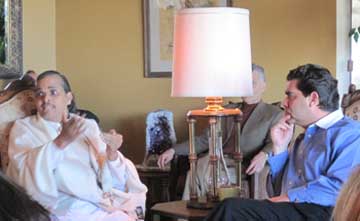
On October 9 and December 1, 2009, the leaders of two spiritual movements met in Reno, Nevada, to discuss ways in which their two movements and organizations might collaborate. On both occasions, Swami Sri Atmananda, founder and leader of the Satyachetana Movement and Divine Mission, together with a number of his devotees, met with the Right Reverend Gene Savoy Jr. and members of Cosolargy International and the International Community of Christ.

Read the transcript of the December 1, 2009, meeting at Bishopstead on Carmel here:  ICC_Satya-chetana_meeting.120110.

For general information on the meeting and the mutual collaboration of both organizations, see the Cosolargy.net article, “Cosolargy & Satyachetana to Collaborate”: http://cosolargy.net/2009/12/14/cosolargy-satya-chetan-to-collaborate/ .


Reno Community Hosts 2009 Annual Convocation

The Community’s annual Convocation officially opened on Wednesday September 9. It was prefaced on Monday and Tuesday September 7–8 with Residence Training III seminars on Color and Sacred Imagery for those Consociates needing to complete these requirements. These early attendees also enjoyed an evening at the Steamboat Hot Springs Spa on Monday evening. Another such spa evening was offered on Wednesday as well.

The first Convocation event was a Project “X” seminar on the ancient solar cultures of Greece and included lectures given by the Right Reverend Gene Savoy Jr. during the Project “X” tour of Greece in May–June 2009 as well as talks by guest lecturers the Reverend Dr. Bill Bartlett and Dr. Tom Lee, the new Community Archiater (physician). Dr. Bartlett spoke on solar teachings in the Buddhist tradition, and Dr. Lee on health and healing modalities planned for Steamboat Healing Center. The lectures were offered in the Chapel of the Holy Child and the Monastery Gardens in Sanctuary.

The usual annual Convocation events took place over the remainder of the week, including the Andean Explorers Foundation meeting and awards banquet and presentation held at the Tuscany Room of the Peppermill Resort and Casino in Reno on Thursday evening. The Right Reverend Sean Savoy presented slides and commentary on his recent trip to Peru to continue the society’s work there.

The week’s events included the thirtieth annual Clergy Counsels, lectures held at the Monastery Gardens in Sanctuary on Asclepian healing traditions and techniques. Again, these lectures were adapted from those given by Bishop Savoy in Greece earlier in the year. This year’s program included a celebration of The Community’s Golden Jubilee, commemorating fifty years (1959–2009) of the Second Advent Church. A high point of the celebration was the interfaith prayer service for world peace held at sunset on Friday evening September 11 at the open-air Church of New Pentecost and Church of the Americas at Red Rock Consecrated Sanctuary. Clergy from numerous sects and denominations around Reno participated and offered prayers for peace from their traditions. It was a special experience and a fitting tribute to the second anniversary of the passing into Light of The Church’s First Apostle, the Most Right Reverend Gene Savoy Sr.

As a side note, unbeknownst to The Community members at the time, the evening also introduced it to one Devashish (aka David Mitchell), who was a last-minute replacement for Rajan Zed, the intended representative of the Vedic tradition. Devashish was quite taken with the experience at the Sanctuary and later introduced Community leaders to his teacher, Swami Sri Atmananda of India, and the Satya-chetana Movement that the swami heads and with whom The Community has since formed a collaboration to reintroduce the Teachings of Light to the Vedic and Brahmanic traditions (see related articles).

On Saturday evening, topping off a day of final Clergy Counsels, Communion Service, and the Emancipation of Acolyte Marie Walters, was the Counsels banquet and program at Bishopstead. As a Golden Jubilee celebration, the dinner was deemed a Vigil Meal and began with a simple course of Essene bread and wine similar to a Community Pannuches meal. The evening’s introduction also included the first-level ordination of Dr. Tom Lee and a rededication of the Chapel of the Innocents at Bishopstead. A buffet supper in several courses created by Community chef Francine Petrovich followed this ritual course. Between courses, the attendees were treated to musical performances by the Community schola, directed by the Right Reverend Gary Buchanan, as well as relevant readings from Second Advent scripture.

The final day of Convocation, Sunday September 13, began with a concelebrated Jubilee Sunrise Divine Service at the Cathedral Church of the Americas at Red Rock Consecrated Sanctuary, followed by the second-degree ordination of the Reverend Dr. Bill Bartlett. Afterward, a fellowship breakfast at the open-air refectory was enjoyed by all. The final event at Red Rock was the rededication of the open-air Church of New Philadelphia in the northlands of the Sanctuary. The church’s table had been restored after being damaged by vandals and the elements. Head bishop Gene Savoy Jr. presided.

The Convocation ended with an optional trip to Lake Tahoe on Sunday afternoon.


Sonatherapy and Wave Front Bioresonance added to System

During the spring, The Community has continued with many projects following upon last summer’s publication of the Reverend Gary Buchanan’s book, SONA: Healing with Wave Front BIOresonance.

Plans are under way for a new treatment facility at Steamboat Hot Springs Healing Center & Spa wherein new holistic therapies of sound, light, color, and water may be applied. Meanwhile, The Community is trademarking the new technology under the names of Sonatherapy® and Wave Front Bioresonance® so that these revolutionary new approaches to healing may become part of the overall System of Cosolargy — as an ongoing research department under the auspices of the Cosolargy Institute.

Meanwhile, working with colleagues from around the globe, Rev. Buchanan, through The Music Guild, is meeting regularly with the “Sona Working Group” in the design and manufacture of a new unit and applicators to be used at the Healing Center.

In regard to the new sound research, Rev. Buchanan published an online article in the AVS Journal in February titled “Wave Front Bioresonance and Consciousness.” (See www.harmonicresolution.com/AVSJ{1fa2ef75e2e78439128d99df03acfe1d8ee3047374abe3d4676fe3470ff8b909}202009.pdf)


Order of Matriarchs Established

On April 4, 2009, during the Saturday evening Pannuches meal rite observed in the Chapel of the Holy Child, the Right Reverend Ileana Isfan was appointed First Matriarch of the Order of the Holy Child.

Following the reading of the “Act of Formation Establishing the Matriarchal Order,” read by the Right Reverend Sean Savoy, the Right Reverend Gene Savoy Jr. offered the following homily:

“We have just read the ‘Act of Formation Establishing the Matriarchal Order.’

“But before commenting on the initial role of the Matriarchs of The Church, I would like to read portions of “The Eighteenth Saying” [of Jamil] relating to the Patriarchs, as the Matriarchs and Patriarchs are to hold the same requirements.” [Reads the Saying]

“Now, I am not reading these words merely as an inspirational message or to pass the time. These are lofty words with a message of great import; and, as with all of our sacred scripture, it contains keys which allow us to better understand the meaning and purpose of the author, which is the Holy and Wondrous Child speaking through the Prophet-Teacher.

“And we may wonder: how are these lofty tasks and ideals going to be accomplished? How are they going to be put into action? I say, they will be accomplished in due time by taking steps now and by making an initial action in accordance with Sacred Law and Sacred Guidelines.

“If we look at the history of this Community over the past fifty years – half a century — we see that accomplishments and designs are realized by perseverance, spiritual dedication, and fortitude. But these accomplishments are also realized by adhering to the disciplines of The Order and by employing the Codes that have been revealed and entrusted into our care by means of the written word, and more importantly by the Word of God inscribed on the tablets and the hearts and minds of our spiritual beings.

“The Sayings mention a ‘preordained’ time when the Patriarchs — and the Matriarchs, as well — will be called out for a holy mission. I believe this is the time — this is the preordained time — to activate both the Matriarchal and Patriarchal Orders of The New Community of Light for a blessing to the sun and for a blessing to the world.

“I have dreamt lately of my father — he comes to me in my dreams every so often — and speaks to me — not in words — never in words — but in gestures and by the look in his eye and the smile or laughter on his face. But we are always conversing in some silent manner. And I contemplate these messages — sometimes for weeks or months, asking the Light for guidance and wisdom to be able to discern the message and make certain determinations concerning our course.

“All of you have experienced similar situations, and I know that each of you also ask the Light and angelic beings for guidance. And in time you receive an answer or are afforded an insight. And I know that our late Teacher comes to many of you and speaks to you in similar manner. It is unmistakable the times when we feel his presence or see his angelic figure in the sun, for he aids this Community as a patron saint, so to speak. His work here on earth was only the beginning of his work as a Being of Light.

“And we know that these messages — these symbols — are true and right.

“So, after much contemplation on this subject, and on the occasion of The Community’s Golden Jubilee year, it is time to activate these Orders. And this preordained time has to do with a certain maturity The Community has reached over half a century. And it also has to do with the numerology of the number 50 – Nun — and the role that the women of the Ministry play and will continue to play. For let me state that there is no inequality in this Church in any way. This is a Universal Religion, and it is truly open and available to all who seek their spiritual origins.

“Some of you may remember that the Order of Patriarchs was formed in 1991 but never activated, for whatever reason. That is neither here nor there at this point.

“Now is the time to take certain liturgies of the Church to a new height and a more directed level, and the Patriarchs and Matriarchs will do this conjointly — together and with harmony, the female balancing the male, and the male balancing the female.

“This is for one primary reason: As the Saying says that we just read:

‘To live the laws of God and by so doing restore the sun and the earth and the cosmos to goodly order in preparation for the New Creation that is coming!’

“So, we will start by taking an initial action — by taking the first step.

“The Man, Gene Savoy, took an initial step when he began his ministry in 1957. And look where we are at fifty years later. Probably not exactly how he envisioned it, but it’s real and here. The Community is real and here, physically and nonphysically. We took the first step in building this Chapel thirty years ago, and we took a first step when we planted the first cross or erected the first communion table at the Sanctuary. Now look at it. It’s a lot different than it was in 1981.

“Our first step will be to officially call a small number of you into these two Orders — at first, a very small number. And those of you called will be asked to take additional vows, some of which have never been taken by anyone with the exception of the first Patriarch of the Church, the late Head Overseer.

“Second, those called will begin observing certain Canonical Hours, specifically at sunrise, at noon, and at sunset. These will be expanded in time to come. The Ceremonial Christology will also be performed on a daily basis.

“Third, in addition to your personal devotions of inflection and reflection, new liturgies will be introduced and proclaimed daily, and these will be observed as official services of the Church.

“The idea here is to begin a cycle of continual relationship with the Sun — to feed, nurture, and sustain it. This will be the primary purpose of the Patriarchs and Matriarchs.

“It is of vital importance that the Patriarchs and Matriarchs be free of worldly cares or desires, which is to say they must be free to express their spirituality in a way most cannot do. And although we strive and yearn for this, for most of us this is not possible.

“This is by no means to say that Patriarchs and Matriarchs will be withdrawn from the activities of The Community. On the contrary, they will be more deeply involved, for they will be exemplars of a higher spiritual role.

“But I stress that it is key to begin with those who are free — those who do not have to worry about the problems of the temporal church, about administration and paying bills; those who do not have the burden of toiling for their physical sustenance — for food or for clothing or shelter; those who do not have the weight of the world’s social, political, and/or other ills on their minds. These offices of Patriarch and Matriarch are reserved for those in The Community who come as close to true freedom as one can get in this world. As we read earlier:

‘Making their withdrawal from human society complete, dedicating their entire lives to the service of God and seeking their origins in Light until their final mergence with God.’

“Most of us don’t have that luxury, what with money problems, the stresses of day-to-day living, relationship issues, the raising of children, traffic jams, and so on.

“But let me say that it has to be real and serious. If not, it will make a mockery of the Teachings of Light. So, those initially called will pave the way for others to be called in time to come — so that others may reflect to the Sun of Righteousness on a continual basis. They will be allowing the rest of us to sustain the temporal church, as they relate to the spiritual Church or feed the Sun of Righteousness. That is not to say that the rest of us do not sustain or relate to the spiritual Church or feed the Sun of Righteousness. Not at all. They will be doing it on a more profound level. When one can devote one’s entire day to this undertaking, it becomes a much different thing than spending a few moments each day.

“And what this does, as I’ve said, is to allow the younger people — even those of you in your fifties and sixties who can still work — to build the Church. And it is something to look forward to as we progress in years. We will find in age that our lives are not over; they are not useless. On the contrary, it will give purpose to one in older years and comfort in knowing that service and dedication continue until transfiguration into Light at the end of the earthly journey.

“And let me blunt and say that you may be asked to do things you may not necessarily want to do. But it will be essential to the realness of this endeavor and indicative of the success of the Order and your own personal success, as well, for it will be the setting of an example to others.

“More will be developed in the days and weeks to come, and we will see if The Community is ready to jump to the next level. I believe that it is.

“Let me say, on another note, that I appreciate your hard work and dedication. We are all experiencing troubling times materially, but this, too, is paving the way for a different world, and we must all learn to cope. I urge us to be unified, to stick together, to be positive, and to continue our work in physical and nonphysical realms for the sustenance and perpetuation of this Community.”