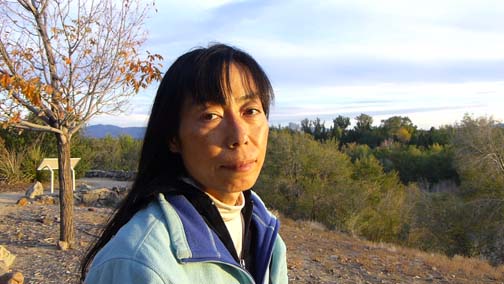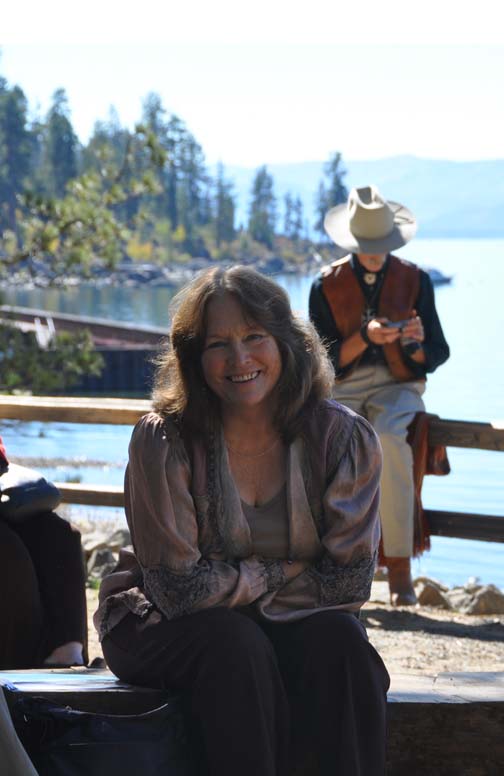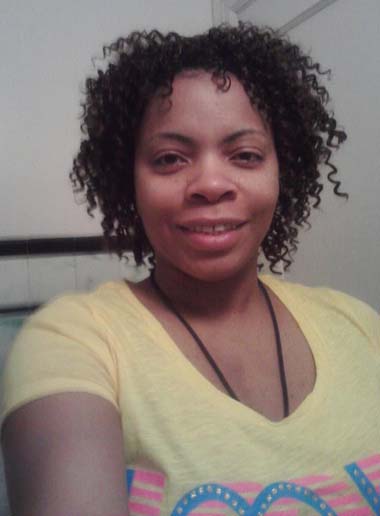
PHOTO: Crystal Rae
Greetings,
I want to give a little background on my spiritual journey. I’ve been married for almost 15 years, and I had met my husband at a Seventh-Day Adventist conference, about 8 months before we married. I’ve always been a seeker of knowledge. What had originally guided me to the Seventh-Day Adventists was the subject of the “Sabbath.”
As I’d progressed and learned much in that setting, I still sensed that there was more to learn. I had done some research here and there on some biblical subjects, and about 5 years ago—I believe I was approaching the age of 35—I noticed a mark on me that appeared to be somewhat of a birthmark in form, but I didn’t have this at birth. I’m a lighter-skinned black woman, and this mark appeared as a brownish tan circle underneath my left breast bone, but almost centered in the chest. Anyway, what was unusual about this mark was that it started as a full circle, maybe twice the size of a quarter. Well, the full circle started to pull apart and break up into several tiny circles. They spread out and kind of made a link, or chain, of some sort.
I don’t recall the time period over which all of this happened, but the circles made a formation and then came back together to the full circle, and then sometime after, the full circle completely disappeared. I thought it was peculiar but didn’t think too much on it. Well, as time went on, my curiosity and searching for other spiritual subjects had deepened. If I didn’t know better, I would have thought that the mark was some type of activation within me, as I’ve often reflected upon it.
Well, in my seeking I had come across information that stated that the Bible was mythical stories, as if a lot of the characters hadn’t existed or that the stories were taken from “Ancient Egypt.” This started a shift for me. My foundation was shaken regarding “Jesus” and the teachings of the Bible. I started seeking all kinds of information for answers.
I’ve had an experience, as I imagine we all have, where I spontaneously projected outside of my body. One time this happened, early into my marriage, when, somehow, I was in the hallway of my house and in front of our bedroom. I knew my husband and I were in the bedroom that was in front of me. I thought I had died, because I was in one place and also another. I didn’t actually see my body but sensed that my husband and I were in the bedroom. It made me afraid because I didn’t know about “astral projection” at that time.
I had another experience of hearing some women talking, but my sight was complete blind, as in blackness; I couldn’t see anything, but I could hear them discussing something. In my mind, I asked myself, “Why were they discussing this?” and I wondered, “Who are they?” Then one of the women says to another, “I think she can hear us.” That really shook me up, because I didn’t know what was going on; it appeared I was somewhere, someplace else. Another time, while in a very relaxed mood, I saw this energy moving from the back of my head, or side of it, and it floated or moved in front of me. It looked like a “spider web” of energy. I just watched it and was amazed. It later dissipated. I had never seen anything like that before; later, I learned from reading, and seeing on the Internet, about an “astral cord” and thought perhaps that is what I had seen.
I have followed some teachings of a certain teacher that have helped me, in some ways to be familiar with energies and beings, etc. I still have no teacher. Some systems are very expensive, and I am unable to afford them at present. I’ve always wanted to travel to sacred places, meet various beings/teachers, etc.
I had started doing some solar practices and others things that I had learned from Dr. Mitchell Gibson’s YouTube videos, and other videos that I had purchased from his website. One time, I had seen these two HUGE beings in my room. The thing is, my eyelids were closed, and I was trying to understand how in the world was I able to see them. They appeared transparent with a bunch of tiny lights throughout their beings. They appeared as if they were statues, but they weren’t. I can’t even begin to fully express that experience. What I do remember saying to them, by some way of telepathy, was, “You’re real, you’re really real.” I don’t know why I was saying that to them, as if I knew them on some level within. I do know that whoever these beings were, they had revealed themselves to me for a reason; one, I think to let me know that they are there and perhaps always have been. They almost looked like two huge cat beings. It’s hard to describe them, but it was quite amazing. I also believe spiritual beings can take many forms, sometimes; the same being may be appearing to us, but in another form.
I had learned about staring into a candle flame, etc. and later was able to see beings around the energy of the candle flame. The head had begun small, then it started becoming bigger; at first, I was a little apprehensive because I didn’t know what was going to happen. Oh, initially, the face started out faintly, and then it started to come in much clearer. I grew accustomed to the images. Later, the flames from the candle would emit geometric symbols of all sorts. Some forms I had never seen before. One could have been a blueprint for something, I don’t know. What was amazing was that it was golden energy, or plasma or something, that did its thing in the area facing me. Later, the energies had started spinning, clockwise and counterclockwise.
I had seen much activity with the sun gazing that I do around sunset and sunrise. There have been various times, in my meditations while listening to something at very low volume, or listening to attunement, that I was able to hear a kind of garbled speech or someone talking in my left ear. It was always my left ear; never the right ear. Also, for some time now, I have been sensing an energy presence on my left side. Sometimes, around the crown area, as well, but mainly on the upper left side of my body. I have often wondered if some being was checking in on me. I had been told by a couple of people that it was my solar body etc.
For some time, I’ve been desperately seeking a teaching and direction in my life. I recall on the night of July 6, 2014, how I poured out my heart while sitting in front of my candle flames. There are several faces I’m seeing now and just white flames within the flames as well. I had been saying a prayer, the Ana Beko’ach, and asking for direction, wanting to make sense of the energies I see, and asking whether I have a teacher, and where is my teacher—I had so many questions. The energy of the flames just did its spinning out of energies as usual, but it appeared as if I was heard somehow.
The next day, I heard in a lecture the word Cosolargy, and it had triggered a search within me. I was doing some solar work and had seen information regarding solar techniques, etc., on the Jamilian website. I’ve always been a curious being. I was able to connect with a man named Robert (Bob) at the University. I admit, I do have some financial challenges in my life that I’m working on. My income is limited; however, I am persistent and will do all I can to pursue this chapter in my life with the teachings that this University has to offer me. I believe I’m right where I’m supposed to be at this time. I trust that this Community will assist me further with my spiritual unfolding.
Crystal Rae