Advent Day Vigil and Second Advent Easter Observed

Pannuches Meal Rite
The 61st Pannuches Meal Rite held Saturday, February 19, 2011. Jubilee Sunrise Service was held the following morning in Sanctuary.

The 62nd Pannuches Meal Rite held Saturday, April 9, 2011. Jubilee Sunrise Service was held the following morning in Sanctuary.

Advent Day Vigil
To commemorate the forty-ninth anniversary of God’s Second Advent, Sunrise Divine Services were held at the open-air Church of New Epiphany from Advent Day, Wednesday, February 2 through Sunday, February 6, 2011.

Second Advent Easter
On Monday, April 18, 2011, a concelebrated Sunrise Divine Service was performed at the Cathedral Church of the Americas. Special readings by the officiants included Psalm 19, excerpts from the Sermon on the Mount, and the Essene Morning Hymn. A light breakfast was served at the Sanctuary Refectory following the service.

April 18th is celebrated as True Easter in the Second Advent Church in a twofold manner: first, we commemorate the spiritual resurrection of Jesus on this date in keeping with the solar calendar, which is fixed; second, we remember the Revelations received in Sanctuary on this date in 1982, an event which served to confirm the importance of this date in the Sacred calendar of the Church. Revelations received on this date are recorded in The Book of God’s Revelation.


Seminar April 30-May 1 at Mequon, WI


The Healing Place is very pleased to present two days of special classes:

INTRODUCTION TO THE SYSTEM OF COSOLARGY
Saturday April 30th 10AM to 11:30AM

ADVANCED COSOLARGY TEACHINGS
Saturday April 30th 1PM to 3PM

COSOLARGY, CYMATICS & SONATHERAPY
Sunday May 1 10AM to 4PM

The Healing Place
10500 N. Port Washington Rd.
Mequon, WI 53092
262-241-5056
www.healing-place.net

Click HERE for more information @ Cosolargy.net


2011 Interfaith Clergy Luncheon held

The Northern Nevada Biannual Interfaith Clergy Luncheon on April 14, 2011 was hosted by Volunteers of America Family Shelter in downtown Reno.

The luncheon this Spring addressed the issue of homelessness in the Truckee Meadows. The Nevada Clergy Association will be working with Reno, Sparks, and Washoe County to encourage religious and business leaders to support the campaign. A meeting was planned with Reno Mayor Bob Cashell, Sandy Isham of Volunteers of America, and Bishop Gene Savoy, Jr. Representing the International Community of Christ at the event were the Rt Reverends Gene Savoy Jr. and Sean Savoy, and the Rev. Dr. Bill Bartlett.

In conjunction with the project to encourage community leaders to address the problem of homelessness in the Reno area, an article on this campaign by Bishop Gene Savoy Jr. appeared in the Reno Gazette-Journal on April 12.


Fourth Annual Hindu Baccalaureate held

Presenters at 2011 Hindu Baccalaureate (Rev. Robert Roy, back row, second from right) PHOTO Debbie McCarthy

The fourth annual Hindu Baccalaureate Service was held at the University of Nevada-Reno on the evening of April 17, 2011. The Service was organized by the Indian Student Organization in collaboration with Rajan Zed to bless the graduating class in traditional Hindu style according to Vedic scripture.

Among those who read prayers of blessing was the Reverend Robert Roy of the International Community of Christ, who read the following blessing:

May the God of salvation bless you with every good
And keep you from all evil,
And enlighten your spirit with the wisdom of life,
And grant you eternal knowledge,
And turn His face of mercies towards you for eternal peace.
May you walk in the spirit of God,
Consisting of healing and abundance of bliss
With length of days and fruitfulness;
And all blessings upon you without end
And eternal joy in perpetual life,
And a glorious crown and garment of honor
In everlasting Light.
Amen


Funeral for Rev. Onie Cooper well attended

Photo of Rev. Onie Cooper displayed at his funeral PHOTO Bilde

A funeral for the late Reverend Onie Cooper was held on the morning of Friday, April 15, 2011, at Second Baptist Church in Reno, Nevada. Rev. Cooper passed away at Saint Mary’s Regional Medical Center on April 6 at the age of 86.

A two-hour program of scriptural readings, special presentations, song, and family reflections celebrated the life of Rev. Cooper with a crowd of attendees that stretched out of the church sanctuary, onto the stage, and into the hallway.

Bishop Gene Savoy Jr. addressing funeral congregation. PHOT Bilde

Among the special presenters was The Right Reverend Gene Savoy, Jr., president of the Nevada Clergy Association and chairman of the Northern Nevada Martin Luther King, Jr. Holiday Committee, who was asked to make a few remarks on behalf of Reverend Cooper, at the request of Rev. Cooper’s wife, Mary.

Mary Cooper reflecting PHOTO Bilde

Reverend Onie Cooper and Bishop Gene Savoy Jr. became good friends over the years. Bishop Savoy was invited by Revrend Cooper to serve on the Holiday Committee in January 2009. In November of that same year, as Rev. Cooper’s health began to fail, he asked Rev. Savoy to take his place as chairman. Since that time, through the auspices of the Nevada Clergy Association, Bishop Savoy has carried on the tradition, begun by Rev. Cooper, to honor the life, work, and legacy of the Rev. Dr. Martin Luther King, Jr. by planning the annual Martin Luther King Jr. Memorial Service and Memorial Caravan, which drives the 21-mile stretch of US Highway 395 named after Dr. King.

It is of interest that Rev. Cooper was first introduced to the International Community of Christ in 1999, when the Advocates of Religious Rights and Freedoms enshrined Dr. King as an Advocate of Human Spiritual Rights. At that time, the late Most Right Reverend Gene Savoy Sr. also forged a friendship with Rev. Cooper. At Bishop Savoy’s funeral in 2007, Rev. Cooper was among those who spoke in recognition of Bishop Savoy’s work.


The Modesty of Alfred Russel Wallace

THE PROTAGONIST: 

Alfred Russel Wallace (1878)

Alfred Russel Wallace was born on January 8, 1823 in the Welsh village of Usk in Monmouthshire, a remote pastoral district of low rents and country food. About the time that Darwin was secretively preparing the journal of his famous Beagle voyage for publication at his Down House estate in Kent, Wallace reached the age of fourteen and left home to glimpse the marvelous streets of London. He attended workingmen’s lectures, read Thomas Paine’s Age of Reason, and gazed into the windows of the best shops before he went back into the country to support himself as a surveyor. 

Wallace spent the next seven years near the North Downs as a solitary student of the fossils he saw lodged in the ancient strata of wild streams and valleys he wandered through between intervals of surveying. Later, for a little over a year, he was a school teacher in Leicester. In the town library he became a reader of Charles Lyell (Principles of Geology), Alexander von Humboldt (Personal Travels in South America), and Thomas Malthus (An Essay on the Principles of Population). There he also met and befriended Henry Walter Bates, the young entomologist who would later accompany him on his journey to South America. 

When a death in the family called Wallace away to Neath, he read there Darwin’s Journal of Researches; he also read Chamber’s Vestiges of the Natural History of Creation. From Neath, Wallace wrote a letter to Bates. In it he expressed his desire to study some one family of life thoroughly – “with a view to the theory of the origin of species” – twelve years before the publication of Darwin’s first famous volume. 

THE ANTAGONIST: 

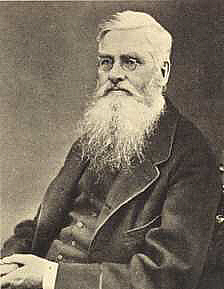
Thomas Huxley (1880)

Thomas Henry Huxley (1825-1895), despite his youth, was one of the three scientists whose blessing Darwin sought before publishing his Origins of Species. (The other two were Sir Joseph Hooker and Sir Charles Lyell.) It was through him that science declared its independence from theology; but Huxley, with typical candor, never to the end of his life concealed the fact that Darwin’s theory was for him nothing more than a good working hypothesis. 

Huxley himself was deeply interested in theology. He insisted that atheism was untenable on purely philosophical grounds and coined the term “agnostic” to indicate his own intellectual position. He occupied his later years with contributions to periodical literature on subjects touching philosophy and theology. A passage from “An Apologetic Eirenicon,” an essay he wrote three years before his death, illustrates his personal creed, a kind of scientific Calvinism: 

The doctrine of predestination, of original sin, of the innate depravity of man and the evil fate of the greater part of the race, of the primacy of Satan in this world, of the essential vileness of matter, of a malevolent Demiurgus subordinate to a benevolent Almighty…faulty as they are, appear to me to be vastly nearer the truth than the ‘liberal’ popular illusions that babies are all born good; that it is given to everybody to reach the ethical ideal if he will only try; that all partial evil is universal good; and other optimistic figments….
 
 From his father, Huxley derived a quick temper and an artistic temperament; from his mother, her characteristic rapidity of thought. Huxley called his mother “a typical example of the Iberian variety” and admitted that he was “mentally and physically . . . a piece of her.” T. H. Huxley himself generated a distinguished family line: He begot the biographer and man of letters Leonard Huxley, who begot two famous sons, the critic Aldous Huxley and the biologist Julian Huxley.
 
*


THE MODESTY OF A. R. WALLACE 

To remember a man is to recall his name and give an account of his deeds. To celebrate him is to speak of those deeds as victories of the spirit. At this celebration in honor of the naturalist Alfred Russel Wallace,(1) it would seem appropriate, therefore, to recount his theories and concepts on the spiritual nature of man. The list is long and varied . . . but Alfred Russel Wallace is a man we barely know. His counterpart Charles Darwin, however, is a man whose name and, to some extent, whose doctrine we are all acquainted with. 

That is because history belongs to the victors. In our age, book burning is an ineffectual ritual; and the destruction of libraries in order to eclipse a people’s knowledge of its origins and history is impractical – yet this truism of history remains valid.(2) Before Wallace’s writings are completely extinguished – put out of print or removed from library shelves to make room for more current volumes – I want to make a note on the event that led to his almost complete anonymity. Today the event itself has been generally forgotten. 

Wallace, by nature modest and retiring, led a life that was quietly spectacular. He was a collector of natural specimens who lived by his collections – for four years in the Amazon, and for eight years in Sumatra, Java, Borneo, the Celebes, the Moluccas, Timor, New Guinea, and the Aru and Ke Islands. He was a lecturer in Boston, New York, New Haven, and Baltimore. He was a botanizer in the Sierra Nevada, a visitor to the Yosemite Valley and the Redwood Forests, an essayist of clear and incisive style, an experimenter in spiritualism, and a discoverer of the law of natural selection. Above all, Wallace was a gentleman; and in 1858 he began to commit an extended act of courtesy that remains our misfortune to this day. A brief account should serve to explain. 

Charles Darwin (1854)

In 1855 Wallace’s first paper on species (“The Law which has regulated the Introduction of Species”) is brought to Darwin’s attention by the geologist Sir Charles Lyell. Lyell points out that the ideas bear an alarming resemblance to Darwin’s own. Darwin replies to Lyell with vexation over the notion of writing for priority and over the possibility that someone else may publish his doctrines before him. 

Two years later, Wallace initiates a direct correspondence with the well-known naturalist. His first letter to Darwin arrives at Down House in May. The young man (then in the Celebes) puts questions to his senior on varieties and the breeding of domestic animals. A second letter, which arrives in December, puts questions on distribution. Then a critical and unexpected event occurs. In February 1858, the theory of natural selection is born to Alfred Russel Wallace in the Moluccas. Muffled in blankets in the cold fit of a severe attack of malarial fever, Wallace begins to think of Malthus’s Essay on Population; and the idea of the survival of the fittest flashes upon him. He thinks out the theory during the rest of the shivering fit, drafts it the same evening, writes it out in full during the two succeeding evenings, and sends it to Darwin by the next post. 

Wallace’s third parcel shocks Darwin and fills him with awe. The older naturalist recognizes that the conception of organic change which he has held for nearly twenty years, and pocketed for time to develop a larger body of evidence, has been given a viable and independent form by a stranger in the middle of a tropical rain forest. A marsupial, long evolved in isolation from her eutherian counterpart and bearing her own embryonic young in her pouch, might feel a similar awe at the witness of a live birth. Darwin (whose powers of conception resemble the characteristics of that branch of mammal – the lesser powers of integration, the embryonic offspring pouched until fully developed, the heart more like a bird’s than a man’s) cannot help noticing that the ideas, which are familiar to him, are conveyed with unfamiliar force and clarity. 

On that same crucial day, Darwin writes to Lyell: “I never saw a more striking coincidence. . . . if Wallace had my Ms. sketch written out in 1842, he could not have made a better short abstract! Even his terms now stand as heads of my chapters . . . so all my originality . . . will be smashed . . . .” With his letter to Lyell, Darwin encloses Wallace’s essay. Darwin begins another letter, one to Wallace, in which he will renounce all claims to the theory; but he cannot bring himself to finish it. 

A week passes, or perhaps a month, and Darwin begins to have second thoughts about establishing priority over Wallace. On June 25th, in another letter to Lyell, Darwin expresses his concern over publishing honorably. To this letter he adds a portentous note: “About a year ago I sent a short sketch, of which I have a copy, of my views to Asa Gray, so that I could most truly say and prove that I take nothing from Wallace.” Shortly after Darwin posts the letter, scarlet fever appears in his household and consumes his infant daughter. Under the pressure of this morose circumstance, Darwin sends his short sketch and an abstract of his views on natural selection to his friend, the biologist Joseph Hooker, in London and writes: “I cannot think now. . . . I am quite indifferent, and place myself absolutely in your and Lyell’s hands.” 

Hooker and Lyell move rapidly. On July 1, 1858, Darwin’s two closest friends oversee the reading of Wallace’s uncorrected essay “On the Tendency of Varieties to depart indefinitely from the Original Type,” together with some of Darwin’s notes and sketches as a joint paper at the meeting of the Linnean Society of London. The natural sequence of events that leads to this conjunction, and the modifications of the future that result, ultimately develop only one variant of the theory of natural selection – Darwin’s – into the dominant species of thought.(3) 

Neither Wallace nor Darwin attend the Linnean Society meeting. At the time, Wallace is traveling the Malaysian islands in pursuit of the rare bird of paradise and rarer butterflies. He does not learn that he has forced Darwin’s hand until three months later. By that time, Darwin has aborted the “Big Book” he was expecting and conceives of a series of papers made of the same materials; he begins a period of gestation at the King’s Head Hotel on the Isle of Wight and by 1859 recognizes that his “Abstract of an Abstract” too will be born a book. Wallace, still in the remote jungles, continues to increase his observations and collections, unaware that the moment of strange and wonderful insight he once felt is about to lead Western thought onto a new path. 

Alfred Russel Wallace (circa 1860)

Darwin’s book, On the Origin of Species, comes into print in 1859. Wallace receives his copy from the publisher early in 1860 while he is still in the islands. He reads the entire volume before he embarks at the end of February on his last and most hazardous exploration of the eastern Spice Islands. Later Wallace states in a private letter to his brother-in-law that he backs Darwin “in his conclusions” and looks upon him as “the Newton of Natural History.” After Darwin’s famous volume is published, its author still cannot point to a single case he has observed in the wild; unlike Wallace, Darwin has to draw analogies between what he has observed man do with artificial selection in English barnyards and what nature does with natural selection. As a result, his book ends up reading like a long legal argument prosecuting the Creation Theory. It is received by the public with outrage. 

When the first wave of frivolous abuse dies down, criticism of a more serious nature arises. Questions come to face Darwin – who reads so slowly, writes so slowly, even thinks so slowly, that he always feels himself desperately behind, like the Galapagos tortoise who concentrates his energy on every next step as he creeps in haste towards the perpetual horizon. These questions Darwin’s knowledge is inadequate to answer. 

It is now that one of the cool young new thinkers present at the famous Linnean Society meeting, T. H. Huxley, takes up position as Darwin’s general agent and bulldog. In a short time Huxley becomes the most formidable scientific debater of the century. He takes on the hostile armies of bishops and archdeacons while Darwin remains at home and conducts his program of biological experiments in the quiet of his garden at Down, content to answer his critics in successive editions (or mutations) of the Origins. Wallace, reassuring and generous, and sometimes a little trying, continues to anticipate Darwin’s ideas and sends them to him from the jungle in the form of letters and collections of notes. 

In 1862 Wallace turns homeward with birds of paradise as his companions. Two years later he publishes a paper on man in Anthropological Review (“The Development of Human Races under the Law of Natural Selection”). Darwin, who believes that he and Wallace should agree on everything scientific, invites Wallace to write the indispensable book on man and offers Wallace all his bibliography and notes. Wallace, busy with a book on his travels in the Malay peninsula, courteously declines. The current of opinion in the meantime moves strongly in favor of evolution. Darwin, fifty years old when the Origins appeared, is revered before he reaches sixty as the “Newton of Natural History” (a reiteration of Wallace’s appreciative phrase), and “Darwinism” (another term generously advanced by Wallace) becomes almost a synonym for biology. 

Wallace publishes a second article on man (“Limits of Natural Selection Applied to Man,” 1870). In it he posits the natural origin and evolution of man’s animal at the same time that he posits a supranatural origin to be the only possible origin for man’s otherwise unaccountable faculties. Huxley – who senses deeply that the universe is really only a single hostile action – now steps out from the ring of educational controversy and attacks Wallace ferociously in public. Joseph Hooker (one of the two scientists who originally communicated the papers of Darwin and Wallace to the Linnean Society meeting) writes to Darwin about Huxley’s denunciation of Wallace with curious emotional enthusiasm: “The tumbling over of Wallace,” he says, “. . . is a . . . service to science.” Now, without too much reluctance, Darwin himself undertakes the project he once offered to Wallace; and in 1871, at the age of 62, he publishes the Descent of Man, the book in which he maintains that the difference between man and the lower animals is merely one of degree and not of kind. 

Charles Darwin (circa 1880) near the end of his life

For the next several years, public disregard forces Wallace to earn a meager livelihood by grading examination papers. Darwin and Huxley, perhaps out of shame or embarrassment, arrange in 1879 to alleviate Wallace’s impoverished condition (an arrangement in which Joseph Hooker refuses to take part). The modest government pension Wallace receives through the efforts of these two men, whose ignorance and bravado had done so much to injure him, allows Wallace to continue writing articles and books until he is nearly ninety-one. Darwin’s last decade, by contrast, is valedictory, even posthumous. Upon Darwin’s passing, Wallace serves, with Hooker and Huxley, as one of the ten pallbearers who carry Darwin’s body to lie in the grave beside Newton’s in Westminster Abbey. On the golden anniversary of the Linnean Society meeting at which the Wallace-Darwin papers were first presented, the living members of the Society gather to celebrate the event and award the first Darwin-Wallace medal to Wallace. In 1908 Wallace claims for himself no more than he had claimed in 1858. 
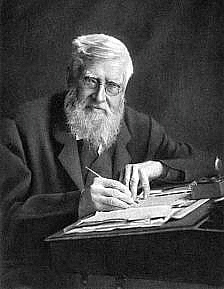
Alfred Russel Wallace (1913) near the end of his life

Thus the tale ends. It comes to pass that Wallace’s portrait never appears beside Darwin’s in our children’s textbooks or in the innumerable books and journals that extol Darwin’s scientific achievements. The respectful deference Wallace paid to Darwin throughout his life not only permitted but, it seems, even promoted Darwin’s popular image as the originator of the theory of natural selection and all its related species of thought. Yet, what may not have been? A truly compelling science, one more comprehensive and accurate than our own, is still visible in the record of reasoning and observation which Wallace has left to us. 

One final comment. I would have preferred to present you with something more than the documentation of a single historic moment – a review of Wallace’s argument for man’s place as a spiritual being in the world of life, for example, or an application of his first biological theorem to illustrate how on earth a spiritual variety of the human could grow into a new species of spiritual beings – but circumstances, and my ignorance, require that I first make this note, perhaps poorer (and longer) than you would have wished. Let us hope that the future will permit us other, more delightful and more useful, literary varieties. 

Robert G. Petrovich 

1996, 2010 

ENDNOTES 

(1) This note is based on a talk given at the Human Spiritual Rights Conference sponsored by the Advocates of Religious Rights and Freedoms, Reno, Nevada, Fall 1996. 

(2) The following titles by Wallace are still in print: Contributions to the Theory of Natural Selection, The Action of Natural Selection on Man, Tropical Nature, The Malay Peninsula, Narrative of Travels on the Amazon & Rio Negro, Darwinism, Miracles & Modern Spiritualism, My Life (2 volumes), and Island Life. Only one is a soft-cover trade book; the remainder are relatively inaccessible library editions. 

Among the number of Wallace’s writings out of print are two that we should have considered essential to consult for this essay: Man’s Place in the Universe; a study of the results of scientific research in relation to the unity or plurality of worlds and World of Life; a manifestation of creative power, directive mind and ultimate purpose. Both of these volumes have been out of print for more than eighty years. Why this is so may be explained by a statement Wallace made in a letter to a fellow scientist in 1913. These two works, he said, “form together a very elaborate, and I think conclusive, scientific argument in favour of the view that the whole material universe exists and is designed for the production of Immortal Spirits.” The demise of these books, it would seem, is simply a matter of political science. 

(3) To make clear the nature of the connivance carried out by Darwin’s two friends requires the insertion here of a few specific details. First, the body of this joint contribution comprised four elements arranged in chronological order: an introductory letter signed by Lyell and Hooker; an abstract from an unpublished manuscript on species by Darwin “sketched in 1839, and copied in 1844”; an abstract of a private letter to “Professor Asa Gray, of Boston, U.S.” dated September 5, 1857; and last, Wallace’s essay “written at Ternate in February, 1858.” Lyell and Hooker listed the parts of the joint contribution according to the date of composition in order to justify the order of their presentation. Most scientists would agree that the etiquette of publication would allow Lyell and Hooker, at best, to append their letter and Darwin’s excerpts to Wallace’s manuscript, which is complete and prepared for publication. To add fragments from Darwin’s papers never intended for publication was exceptional. To assign these fragments priority in the presentation was unjustifiable. 

Second, Wallace’s manuscript was entitled “On the Tendency of Varieties to Depart Indefinitely from the Original Type.” The title on the page of the Linnean Society Journal of Proceedings reads: 

“On the Tendency of Species to Form Varieties; and on the Perpetuation of Varieties and Species by Natural Selection. By Charles Darwin, Esq. F.R.S., F.L.S., & F.G.S., and Alfred Wallace, Esq. Communicated by Sir Charles Lyell, F.R.S., F.L.S., and J. D. Hooker, M.D., V.P.R.S., F.L.S. & c.” 

The title of the Journal article magnifies Darwin and the communicators, Lyell and Hooker, with academic titles that diminish the standing of Wallace; the Journal title also presents a message that is quite different from Wallace’s contribution. In his essay, Wallace presents a concept of how a variety could become a new species; the printed Journal title speaks to the formation of varieties from species, and to the perpetuation of both by natural selection. This is a drastic shift in emphasis. 

The third detail concerns the introductory letter written by Lyell and Hooker. The text of the letter states: 

“Two indefatigable naturalists, Mr. Charles Darwin and Mr. Alfred Wallace, . . . having independently and unknown to one another, conceived the same very ingenious theory to account for the appearances and perpetuation of varieties and of specific forms on our planet, may both fairly claim the merit of being original thinkers in this important line of inquiry. . . . neither of them having published his views. . . .” 

Lyell was acquainted with Wallace’s 1855 essay; for him to write that neither of them had published his views was a departure from the truth that was likely deliberate, and intended to justify publishing Darwin’s private papers. From these three examples, it should be clear that these two powerful members of the scientific community – Lyell and Hooker – attempted to ensure Wallace’s anonymity from the outset of his public career. 

FURTHER READING 

John Langdon Brooks: Just Before the Origin: Alfred Russel Wallace’s Theory of Evolution. (Columbia University Press, New York, 1984) in which the twentieth-century biologist John Langdon Brooks provides a re-assessment of A. R. Wallace’s contribution to the theory of organic evolution and attempts to reconstruct, step by step, Wallace’s elaboration of his ideas about the laws of organic change – what we now call evolution. The final three chapters re-examine the influence of Wallace’s ideas on Darwin’s own conceptions and expose the anomalies surrounding the events of Wallace’s initial discovery, the presentation of Wallace’s essay at the Linnean Society meeting, and Darwin’s completion of the theory he published as his Origins. 


The Solar Christ in Nahuatl Doctrinal Texts

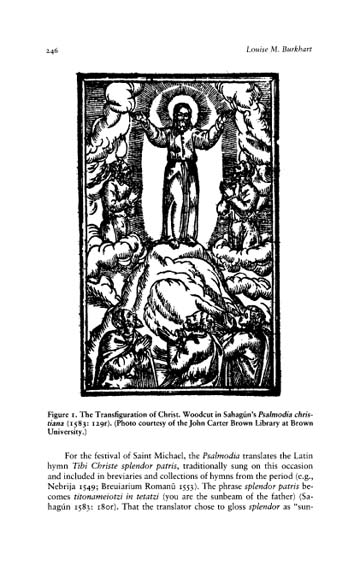
The Transfiguration of Christ, a woodcut in Sahagun's Psalmodia christiana, from page 14 of "The Solar Christ in Nahuatl Doctrinal Texts of Early Colonial Mexico."

“The Solar Christ in Nahuatl Doctrinal Texts of Early Colonial Mexico” by L.M. Burkhart (1988)
Ethnohistory, vol. 35, no. 3, pp. 234–56.

A reprint published by Duke University Press and housed at JSTOR.ORG, “The Solar Christ” is not an easy read, but I think I can say, in view of everything else, that this article looks like an important piece of information missing from mainstream Christianity and could be easily swept under the rug (or almost has been). Mostly when I search for articles connecting the Christ with the sun, I look for articles concurrent to the period of the New Testament and as far back as the Ancient Egypt Motherhood, and geographically mostly to the European, African, and Asian continents. I always come up short-handed when hoping for a more unified “big picture.” Well, it now looks like we might not have to go all the way back to the beginning every time, but to look to a more recent period (the sixteenth century) when friars and monks had knowledge of another side of Christianity. Why this became an isolated instance of departure from the more or less standard Christian conversion is not known, but it is known through this article that an exception was made because of the unique view of the cosmos that the Nahua had.

This article, consisting of twenty-three pages, states that Indians today view Christ as a solar deity, using the symbolism of sun and light to express their views. As stated in the first page citation:

The Mendicant friars who converted the Indians of Mexico to Christianity after the Spanish Conquest left behind a large corpus of Christian doctrinal literature in Nahuatl and other Mesoamerican languages. These texts include sermons, catechisms, biblical excerpts, dialogues. hagiography, meditations, hymns, and confession manuals. They were written by friars conversant in the native languages, in collaboration with indigenous students who were educated in Spanish and Latin and who had considerable influence on the native-language texts. Because of their dominantly European content, these texts have received relatively little attention from ethno-historians more interested in the indigenous side of Indian-Spanish contact. Thus these texts constitute a largely unexploited ethno-historical resource of great value for interpreting colonial culture, particularly in regard to religion but also to language, political and social relations, and other aspects of Indian life….

This article, per Internet usage, can only be found in full at JSTOR.ORG. JSTOR is part of ITHAKA, a not-for-profit organization helping the academic community use digital technologies to preserve the scholarly record and to advance research and teaching in sustainable ways. The article is available to membership or costs fifteen dollars otherwise.

Another article related to the above that is helpful and references Burkhart’s “The Solar Christ” is Sacred Books and Sacred Songs from Former Days: Sourcing the Mural Paintings at San Miguel Arcangel Ixmiquilpan by Elanor Wake, circa 1992,and about thirty-six pages long. This article has illustrations of the paintings at the San Miguel Church accompanying the text. The illustrations are thought to be converted native song(s) synthesized with the new Christian teaching. There is no charge associated with this article (found elsewhere than JSTOR at dialnet.unirioja.es, to name but one of many sites).

Optional Reading http://www.albany.edu/anthro/nah_theater/nah_home.htm

This web page is devoted to Nahuatl theater, especially the Nahuatl Theater Set co-edited by Louise M. Burkhart and Barry D. Sell, published by the University of Oklahoma Press.

 Louise M. Burkhart is professor of Anthropology at the University at Albany, State University of New York (SUNY).

 Barry D. Sell is an independent scholar residing in Glendale, California.

Submitted by Jim Elliott, November 2010.

We are making the article available to you in PDF format in accord with the terms and conditions established by JSTOR: Solar Christ in Nahuatl

Please read the terms and conditions of use before downloading.


Nevada Clergy Association members visit Sacramento Spiritual Life Center

On Sunday, April 3, 2011, Bishop Savoy and two other members of the Nevada Clergy Association, the Reverends Bill Bartlett and Robert Petrovich, both of the International Community of Christ, made a trip to Sacramento, California to attend a Sunday Celebration Service at the Spiritual Life Center. The purpose of the trip was to meet with the minister conducting the service, the Reverend Michael Moran.

During the March meeting of western region interfaith leaders at the Western Regional Interfaith Leaders Conference, March 7-8, 2011, Bishop Gene Savoy Jr. met Unity minister Rev. Michael Moran and was impressed with what he had to say about the interfaith movement. Based on their religious and theological conversations during the conference, Bishop Savoy offered to visit Rev. Moran in Sacramento. Following the Sunday celebration April 3, Bishop Savoy was able to speak with Rev. Moran. Bishop Savoy invited Rev. Moran to attend a sunrise service in Reno and gifted him a copy of Jamil: Child of Light.


FROM THE ARCHIATOR: Protection from Radioactive Contamination

Dr. Tom Lee, Church Archiator, offers the following suggestions for supplemental and hygienic protections against radioactive contamination in light of the nuclear disaster in Japan.

Thomas S. Lee, NMD, APH


Hello ICC Members and Friends:

The past several months have been difficult for many of us, both around Reno and much of the rest of the country. With weather, health, and economic challenges, it has been a tough winter. As difficult as we have had it, the disaster in Japan has shocked us with the intensity of suffering and number of lives lost among those kind and elegant people. And beyond that, the biological disaster will affect our world for years to come.

This letter is to suggest some supplemental and hygienic protections for those of us who will be visiting Japan next month. They are suggestions that will be good to consider on a more limited basis for the rest of us here as well, as the radioactive contamination continues far beyond the borders of Japan. Low-dose radioactivity affects everything living thing in some way, usually badly.

The most dangerous isotopes affecting us in our food and water are iodine, cesium, uranium, and plutonium. There are others that either have short half-lives or are bound to less metabolically active metals, so it’s easier to avoid them and keep them out of our bodies. The more dangerous ones are perceived by our bodies as slightly disguised versions of normal minerals that are important to maintain good health, and our bodies take them up, especially if it is deficient in that mineral.

The supplements I suggest here will nourish your body with the minerals that radioactive isotopes “imitate.” If these minerals are at optimal levels before exposure, it will be easier for the immune system and digestion to refrain from absorbing the radioactive versions into the body.

Iodine nourishes and protects from radioactive isotopes of iodine; cesium imitates potassium; uranium imitates chromium; and plutonium imitates iron. Radioactivity of any type will cause death if it is too intense, regardless of these characteristics, but nutritional protection will help with low-level environmental exposures.

For those heading to Japan, I would encourage you to start taking the following supplements before, during, and after the trip:

• Modifilan (90 capsules)
http://www.naturodoc.com/PSD-Mod.htm

• Lugol’s Iodine, 5{1fa2ef75e2e78439128d99df03acfe1d8ee3047374abe3d4676fe3470ff8b909} (1oz liquid dropper bottle)
http://www.naturodoc.com/ND-Lug1.htm

• SuperSulfur, Organic Pure Sulfur Crystals
http://www.naturodoc.com/LB-OS.htm

• Organic Greens and Reds
http://www.naturodoc.com/D-57402.htm

Modifilan is a concentrated, dried extract of the brown seaweed Kombu (Laminaria japonica). It has a fascinating history that dates back to the Chernobyl nuclear reactor accident. We have had years of experience and amazing reports from clients who use it regularly to remove heavy metals, radiation, and strengthen their thyroid and digestion. Read up on it and decide if you want to include it in your arsenal. I recommend that you do so. Before travel, take 1 capsule three times a day with meals. While in Japan, take 2 capsules after each meal, always with a slowly swallowed full glass of water.

Lugol’s Iodine Solution (5{1fa2ef75e2e78439128d99df03acfe1d8ee3047374abe3d4676fe3470ff8b909}) is one of several iodine sources available, but it is the most reliable and affordable form we know of. If drops of a colorful liquid are too fussy to deal with, you can get it as tablets called Iodoral. Read up on dosing and testing procedures on the Naturodoc website.

As a starting dose for those unfamiliar with iodine, take 2 drops of Lugol’s Iodine in water or beverages twice a day. This will approximate 24 milligrams of elemental iodine daily. Build up with an extra drop per dose every couple of weeks so that when you are traveling in Japan, take about 4 drops twice a day for a total of about 50 milligrams daily.

If you experience any problems from this such as muscle aches or rashes, cut the amount in half and persist. If you are both iodine-deficient and halogen-toxic (too much chlorine, fluorine, or bromine in your system), you could have an unpleasant cleansing reaction, if you take too much. There’s no need to be uncomfortable, just dose it lower and slower for a while.

Organic Greens and Reds is a concentrated extract of whole fruits and vegetables. Stir 1-2 tablespoons into juice or a fruit smoothie and drink that every morning with breakfast. The nutrients in this concentrate will provide a broad range of protective antioxidants, bioflavonoids, and minerals in a bioavailable form. This tastes pretty good. These supplements would not be as important if you already eat a lot of fresh organic produce and regularly juice fresh fruit and vegetables. Most of us would like to do that, but somehow lack the housekeeping and service staff to keep it going.

SuperSulfur is a crystalline form of MSM, which is so good for the muscles and joints. This dissolves immediately in a small amount of hot water, and then you can dilute it with any liquid of choice to cut the natural bitterness of the sulfur. Coffee or grapefruit juice cloak it well.

These four items will protect and strengthen someone in a radioactively polluted environment.

Other supplements that you like and use are fine to continue, and the Reverend Robert Roy’s Two Feathers Healing Formula paste taken as a 1/8th of a level teaspoon one to two times a day would also help to keep your body alkaline and cleansed. Alternatively, two tablets of the Formula taken twice a day would also be of benefit. To learn more about the Two Feathers Healing Formula, call Robert at (775) 324-4889. He is offering the Formula at a discounted price for ICC members. The paste is $88, and the tablets are $65.

Finally, be aware that most of the risky exposure is airborne or carried on surfaces you might touch. Be up on your hygiene and cleanliness. Take a zip-lock baggie with a soapy wet washcloth in your travel bag or purse. After you touch public surfaces like handles, doors, or counters, take a moment and wash your hands. At the end of the day, clean and refresh the washcloth for the next day. You will have access to stores and markets there. Get containers of baking soda, and every two or three days take a hot bath with about 3 cups of baking soda for a long hot soak. This will help to alkalize your skin and draw out toxins. It also just feels good and relaxing.

As for dietary advice, you all have advisors and opinions galore. Basic concepts are that you should not stress out and weaken your digestion by eating too much, and avoid the foods that have little or no nutritional value. Traditional Japanese cuisine will be wonderful. For the wine lovers, go slow on that, because wines are loaded with fluorides and sulfides, and alcohol exhausts the adrenal glands and pancreatic functions. Excess sugar and pastry sweets will also ruin your digestion and energy level. You’ll enjoy your travel and your body more if you keep the diet light and stay active.

Some of the products I have recommended have become scarce and are hard to find, while my company, NaturoDoc, does have them all in stock. Here are Internet links to the website and blog for more detailed information.

www.naturodoc.com

www.naturodoc.com/blog

You can get these products online from the NaturoDoc Store, where we’ve set up a special discount for ICC members. Or you can order by phone by calling 1-877-867-4743 from the U.S. and Canada.

My suggestions to products that I sell on my site are to inform you about them. I encourage market comparison out there with anything of like quality you have access to.

That’s it. Have a great trip and represent us well. Learn a lot from the Japanese people and share your discoveries with us when you get back.

In the Light,

Thomas S. Lee, NMD, APH
Church Archiater


Japan Intervention Service held

More than 50 members of the International Community of Christ and the Satya-chetana Movement gathered in Reno at the Chapel of the Holy Child at 4:00 PM on Saturday, March 19, 2011, to hold a special service of intervention to help prevent the recurrence of earthquake and tsunami disturbances in Japan and to arrest immediately the threat of nuclear explosion. Similar services were held simultaneously in India at the Sri Kalahasti Temple near Tirupathi in the state of Andhra Pradhesh and in Japan in Kurume, south of Fukuoka City, on the southernmost of the four main islands of Japan.