Project “X” Tours Japan Day by Day: DAY 1


9 MAY


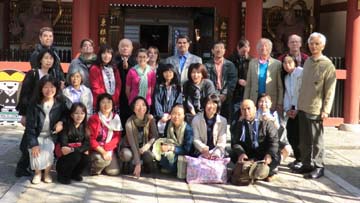
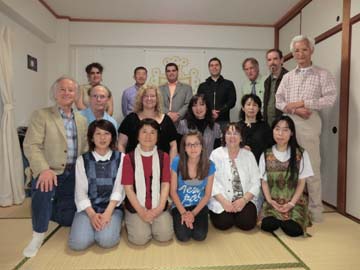
U.S. tour group and and staff of the Cosolargy Institute of Japan at the Center in Kurume. PHOTO: Keiko Inoue

ITINERARY: Arrive in Fukuoka this evening. Fukuoka is the capital city of Fukuoka Prefecture on Kyushu, the southernmost of the four major islands of Japan, whose name, Nihon, literally means “sun’s origin.” Upon arrival at Fukuoka you are met and transferred by car to Kurume. Kurume, in the south of Fukuoka Prefecture, is a city of green mountains, beautiful rivers, and hospitable people.

Kurume is also home to the Cosolargy Institute of Japan and the Solar Cultures Promotion Society. Overnight at Kurume Hotel Espirit.

Visit Kyushu through Wikipedia


COSOLARGY INSTITUTE OF JAPAN

“In late afternoon we visit the Cosolargy Center Yukinori Matushita has established in Kurume. It is a beautiful building — being put to full use.

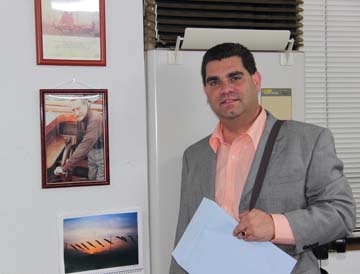
Gene Savoy Jr. at the offices of the Cosolargy Institute of Japan. PHOTO: Robert Roy

“The bottom floor is a Reading Room full of pictures and literature on Cosolargy and the Andean Explorers Foundation, with photos of Feathered Serpent III-Ophir, Gene Savoy, etc. The room is also made available to local people as a meeting hall when needed.

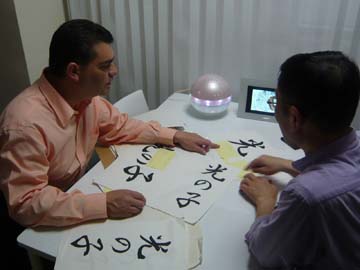
Gene and Yuki at work in the reading room at CIJ offices. PHOTO: Sean Savoy


“The second floor is offices, with a kitchen and lunch room, a Chapel, and a Cymatic Therapy room used by Yuki. All very nicely done!”

—Journal entry by Gary Buchanan


Visit the official web site of the Solar-Culture Promotion Society in Japan,  a direct affiliate of the Cosolargy Institute of Japan.


<PREVIOUS>

<DAY 2>


2012 Second Advent Pentecost Observed


Bishop Gene Savoy Jr performing Pannuches Meal Rite. PHOTO: Stephan Fuelling

Pannuches Meal Rite
The 70th Pannuches Meal Rite was held Saturday, May 5, 2012. Jubilee Sunrise Service was held the following morning in Sanctuary.

The 71st Pannuches Meal Rite was held Saturday, June 23, 2012. Jubilee Sunrise Service was held the following morning in Sanctuary.

Predawn view of the east on Pentecost 2012. PHOTO: Stephan Fuelling

Second Advent Pentecost
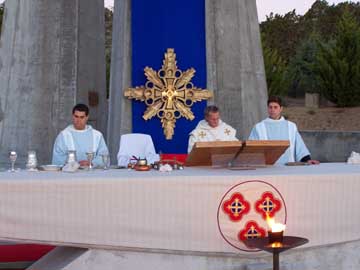
On Wednesday, June 6, 2012, Second Advent Pentecost was observed with a celebration of Communion and Sunrise Divine Service at the Cathedral Church of the Americas at Red Rock Consecrated Sanctuary. The service was photographed by a professional photographer. A light breakfast was served at the outdoor Sanctuary Refectory afterward.

Pentecost in the Second Advent Church means that God has bestowed the Divine Presence upon the Community in Sanctuary, the Image and the Word that nurture the spirit and soul with Life and Wisdom. The old First Dispensation Christian celebration commemorates the descent of the Holy Spirit upon the Disciples seven weeks after the Resurrection. In the old Hebrew calendar, Pentecost — Shavout, or the Festival of Weeks — commemorated the giving of the Law on Mount Sinai. In the Second Advent, New Laws have been revealed at the Temple Mount for a new age under God at the Second Coming. Revelations given on this date are recorded in The Book of God’s Revelation.

Preparing for Sunrise Divine Service on Pentecost 2012. PHOTO: Stephan Fuelling


Project “X” Tours Japan Day by Day: Participants

Full group photo at Koya San (except for Keiko Inoue, who is behind the lens). PHOTO: Keiko Inoue

On May 7, 2011, the Right Reverend Gene Savoy Jr., the Right Reverend Sean Savoy, and a delegation from the Reno Community made up of the Reverend Gary Buchanan, the Reverend Robert Roy, Jamila Savoy, Sonya Savoy, and Jalayne Grady left for Japan via Los Angeles, where they joined several other Community members from the United States: the Reverend James Elliott, the Reverend Karen Elliott, and the Reverend Ron Theriault.

Once in Japan, Japanese Community members joined the group to participate in the twelve-day tour of southern Japan, visiting shrines, temples, and other sacred sites. Community members from Japan who participated in the entire tour were Bishop Yukinori Matsushita, the Reverend Koshu Kawahara, the Reverend Miyuki Okayama, the Reverend Yaeno Sanada, the Reverend Shinobu Uwataki, Mitsuyo Fukuyama, Sadayuki Hagiwara, Chieko Higashi, Kazuno Kawasaki, Noriko Soejima, and Yoko Taniguchi.

Other Community members from Japan who participated in parts of the tour were the Reverend Keiko Inoue, the Reverend Shoko Ohba, the Reverend Eriko Ueno, Nami Aiki, Kazuko Akinaga, Kayoko Ikeda, Fumiyo Machida, Motoko Mitobe, Wakako Mitsunobu, Fumie Nagai, Mami Nakamura, Yasuko Nishimura, Yoko Nishimura, Satsuko Noriyuki, Kuniko Saito, Shoko Taketomi, Mitsumi Taniguchi, Saeno Tokunaga, and Keiko Yamaguchi.

The Reverends Keiko Inoue, Shoko Ohba, and Eriko Ueno worked for months prior to the tour dates to arrange the seminar tour. The Reverend Miyuki Okayama acted as tour coordinator and was assisted in this task by the Reverend Yaeno Sanada, head of the Solar Cultures Promotion Society, the organization that sponsored and produced the tour. The Reverends Koshu Kawahara and Shinobu Uwataki also served as assistants during the tour. Bishop Yukinori Matsushita, the director of the Cosolargy Institute in Japan, planned the lecture tour and served as interpreter at the symposium and throughout the tour as needed. In addition, Ms. Shinko Yoshida of the Nippon Travel Agency conducted the tour.

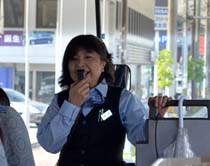
A tour conductor of the Nippon Travel Agency. PHOTO Jim Elliott

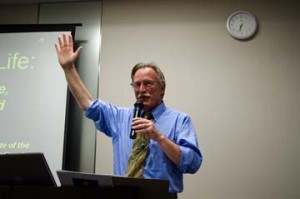
Informal talks on the ancient solar cultures of Japan were given throughout the trip, and a seminar on vibrational healing was conducted in Kyoto by the Reverend Gary Buchanan near the end of the tour.

Rev. Buchanan lecturing in Kyoto. PHOTO: Jim Elliott

Most tour members returned to the United States on May 21. As their return flight stopped in South Korea, the Head Bishop and Cardinal Bishop, together with the Reverend Robert Roy, Jamila Savoy, and Sonya Savoy, remained in South Korea for a few additional days to visit sacred sites in that country, returning to Reno on May 26.


 <PREVIOUS>  

<NEXT>


THE LUMINOUS TEACHING STONE OF CHINA: The Stone Itself Part 3: Recovery

Bust of Frits Holm

In 1908 Frits Holm communicated the first statement of his work in writing to the president of the International Congress of Orientalists; then again, in 1909, to the Explorers’ Club of New York and a number of academies and universities. His report to the Congress of Orientalists evidences that he had already begun the book manuscript for a popular account of his expedition written in the form of a travelogue with all the entertainments convenient to that genre. He published the book My Nestorian Adventure in 1923, perhaps to inform the general public of the existence of the monument, perhaps to retrieve something of his personal financial outlay for the expedition. I set down here the contents of that three-hundred-page volume, pared down to its simple plot and circumstances. My account is faithful, with the addition of a few comments and a passage or two from other sources. 

On the evening of January 12, 1907, at Queen’s Hall in London, in the presence of King Edward VII and the Fellows of the Royal Geographic Society, the distinguished Italian sailor and alpinist, the Duke of Abruzzi, delivered an illustrated lecture on his explorations among the equatorial mountain ranges of the Ruwenzori in Africa while a young Dane in the audience listened absent-mindedly. For the last year and a half, the young man had been a constant reader in the British Museum with a view towards perfecting his knowledge of things Chinese. Three years in the Far East had caused him to acquire, and later cultivate, a profound admiration for the ancient Celestial Empire, its history, its religion, and its relics. While in China, he had heard more than once of the shamefully neglected Nestorian Monument of Sian-fu. He had spent the entire afternoon before the lecture studying abstracts from various sources on this stela of ancient Christian origin. Now, that evening, while the Duke pointed out the trail of his mountain trek and His Majesty read the congratulatory speech prepared for him, a nebula of plans and ideas took shape in his mind. Two days later, the young man found himself in one of the oriental departments of the British Museum, closeted with a somewhat irascible elderly official, discussing the possibilities connected with the attempt of obtaining the Nestorian Tablet, or a perfect replica in stone of that famous monument, for the Western scientific world. In June, as a young explorer, he reached the hundred-year-old resting place of the monument. 

During the early months of 1907, one of the last years of the Manchu dynasty, the twenty-six-year-old Holm had continued his visits with various museum authorities and leading men of the kind who take an interest in the preservation of irreplaceable historical monuments. First in London and later in New York, he discussed with them the ways and means of obtaining possession of the monument. Encouraged by everyone, but charged by no one with an official mission, he himself organized an expedition to the Chinese interior. Finding sympathy, but no backing, Holm eventually sold all his belongings for initial capital and made his way from London to his native Copenhagen, where he collected family investments; from there he traveled to New York en route to Vancouver, where he caught a British ship to Yokohama in Japan, and from there, a Japanese ship to the Chinese coast. He spent the month of April in the coastal city of Tientsin busily searching for an interpreter and a personal servant, chartering a houseboat, purchasing equipment and provisions, and taking care of all the hundreds of details an expedition requires. On the early morning of May 2, his interpreter, Mr. Fong, presented himself at Holm’s hotel room to announce that the houseboat was ready. A month of tedious travel by river and overland road brought Holm to the central Chinese province of Shensi and its capital, Sian-fu (once called Ch’ang-an, the ancient western capital of China), where he found lodging for himself and his interpreter in the home of a sympathetic German postmaster. 

Arched stone gateway in ruins

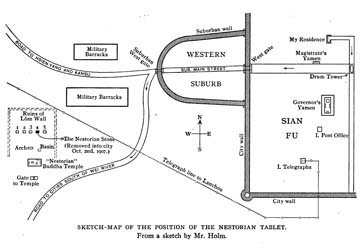
On June 10, alone and on horseback, he left the ancient capital through the city’s western gate and traversed the suburb beyond to an old Buddhist temple. There an arched stone gateway in ruins and a withering mud wall indicated the former extent of the temple grounds. Four Chinese characters inscribed on the gateway in 1584 read: “The best of the garden that was dedicated to Sakyamuni.” At the center of the grounds Holm found a modern building more like a farm than a temple, and in the fields everyone busy with the wheat harvest, even the three Buddhist monks.   

Position of the monument before its removal

Row of five monuments

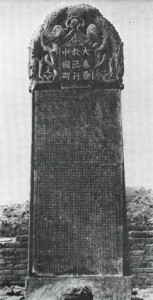
Behind the farm-temple, on an undignified piece of ground some sixty yards north of the gateway, amidst fields of opium poppies and wheat, stood five large stones in a row. Second from the east (second from the right in the photograph) was the Chingchiaopei, the Luminous Teaching Monument, on the back of a clumsily worked stone tortoise, with nothing left of a protecting shed.

Holm made numerous visits to the temple during his first month in Sian-fu. Eventually, principally through the medium of well-selected gifts, he earned the friendship of the kind-hearted seventy-six-year-old chief priest, Yu Show, who had resided on the spot for fifty years and considered himself the guardian of the stone. According to the old monk’s statement, which Holm credited as theoretically sound, the arch and all the monuments on the premises belonged to the temple, which, again, he said, belonged to him. (Over time, Holm came to see that all would pass into the hands of the secondary priest, Yu Show’s opium-steeped adopted son.) 

Chief priest Yu Show, guardian of the monument

Gradually and with increasing force, it became clear over the weeks that virtually every local denominational missionary Holm had met during his stay at Sian-fu fondly considered himself a co-operative proprietor and high protector of the stela. One hospitable Roman Catholic prelate even mentioned casually that he had once seriously considered shipping the stela to the Vatican as a gift from himself. The difficulty of transportation, the bishop said, would be overcome by cutting the two-ton, nine-foot monument into three pieces! Day by day, through remarks he was fortunate enough to pick up here and there, Holm also came to recognize that suspicion was crystallizing about him and the object of his visit to Sian-fu. On June 29, without finishing his negotiations with the Buddhist priest Yu Show, he departed south with his interpreter and a small entourage on a transmountain expedition to divert that suspicion. 

In spite of the heat and his poor health, Holm chose a slow and troublesome route in order to study China, across the flea-ridden Chingling Range by caravan and south along the Tan and Han Rivers by native houseboat. After a month of dirty inns along the mountain mule tracks, the travelers arrived at the river fortress of Kingtzekuan on the Tan River. Once at the fortress, Holm sent Mr. Fong back to Sian-fu with minute instructions to carry out their secret arrangements for the production of an exact replica of the monument. 

On his return trip to Sian-fu, Holm met his interpreter, Mr. Fong, sixteen miles outside the capital as prearranged. Now, a month after their last meeting, Fong reported the progress he had made during Holm’s absence. Upon his return to the city, Fong said he had traveled straight to the Fuping stone quarries, where he and a contracted stonecutter obtained fresh from the rock a suitable slab of stone. (The Christian missionaries twelve hundred years before had taken the raw materials for the famous tablet from the same quarries, two stages northeast of Sian-fu. The hard, grey, subgranular oolite that had yielded material for the original monument would be used also for making the replica. The identity of the materials was later established by the Smithsonian Institution in Washington through microscopic examination of a chip from the original, which Holm had brought with him from his previous trip to Sian-fu, and a chip from the replica.) This slab they then transported to the temple grounds. Owing to enormous difficulties, and the bad roads they took to avoid the eyes of the city, Fong said the stone did not arrive at its destination until August. Once the stone was at the temple, the contractor engaged the services of three other stonecutters. Holm, while still in Sian-fu two months before, had obtained the gracious permission of Yu Show to use his barn as a studio to house the stonecutter and his assistants while they carried out his secret project. He had also rented another room in the temple complex for Mr. Fong, to keep him out of the path of nearby city temptations. The four stonecutters executed their work of art in eleven days, including two days of polishing. One of the men, who was an artist and an expert in “stone dragons,” confined himself to sculpting the entwined dragon figure of the headpiece. Another, who had a better education than his fellows, undertook the chiseling of the Syriac characters and the remarkable Christian cross at the top. The remaining two artisans carved the principal inscription of Chinese characters in splendid T’ang calligraphy. After delivering his message, Fong returned to the city. 

On September 16, two days after meeting Fong, Holm rode into the capital alone. The young German postmaster Schaumloeffel welcomed him and again offered the accommodations of his private residence. On the second day after his arrival, Holm saddled Mr. Schaumloeffel’s pony and rode out to the temple. There in the barn he found a huge replica of the monument exquisitely executed. All four stonecutters were present, pretending to be occupied with final touches but actually waiting for him. The old monk too awaited him in good health and heartily welcomed him. Immediately Holm sat down to the exacting task of comparing the original text with the facsimile. Using the complete paper rubbing of the original inscription that he had on him and working conscientiously with lens and print for hours, Holm was unable to find a single error; using his scale, he found the dimensions accurate practically to a millimeter. (1) 

Late in the afternoon the next day, two officials from the Shensi Foreign Office called on Holm to invite him to meet the directors of the Foreign Office over tea with the compliments of His Excellency, the governor of Shensi. The governor reportedly could not receive Holm himself, so ashamed was he of his appearance, since he drank copious amounts of wine and smoked plenty of opium. Holm met them the next morning and persuaded his hosts to come out and inspect the replica he had executed in secret. At first none of the assembly appeared to know the monument even by its Chinese name, Holm’s pronunciation probably being guilty. But when he produced his paper rubbing, their minds seem to clear. They arranged to meet again that afternoon at the residence (yamen) of the young head magistrate. 

The procession inspects the resting place of the monument

From the magistrate’s yamen, they all went in procession to the resting place of the monument. Twenty or thirty painted red signs with characters of gold and the other paraphernalia of authority were jostled about by coolies running before the magistrate and shouting “Make way for the Right Honorable Chu,” who was carried along in his chair at considerable speed, followed by his three assistants on shaggy Mongolian ponies. After them came Holm on horseback, and at the rear, six carts containing the intelligentsia of the Shensi Foreign Office. 

Mandarins pose before the monument

When the entourage arrived at the temple, the magistrate immediately stepped down to view the replica, then walked quickly around the back of the temple to the row of stones. Behind him ran the chief priest in a state of sheer fright, dressed in his yellow robes. Holm followed. He did not understand everything the magistrate said to YuShow, but it was clear that the magistrate was giving the priest strict instructions to see that “Ho-lo-mo” tampered no further with the Chingchiaopei. It was evident that not one of the officials present had ever laid eyes on the monument before, although they now displayed a keen interest. Holm took a couple of photographs of the remarkable group of mandarins with the stone as background before they all returned to town. The magistrate left behind two uniformed runners as a guard. 

Frist Holm standing by the stone before its removal

Holm occupied his next days with constructing a special cart designed, partly from his own drawings, to transport the replica the 356 miles to the Chen-chou Railway. To obtain a proper stone-cart from the quarries would have been easier, but the hired stonecutter assured Holm that after Mr. Fong’s previous bad conduct no quarryman would help them there. 

On October 2, 1907, the day before the replica finally departed, Holm rode out to the temple to pay the monk Yu Show some money he owed him for rent of the barn. There he witnessed the fulfillment of an act that should have taken place three hundred years before. Nearing the temple grounds, he saw the original monument had disappeared. With feelings that can better be imagined than described, he galloped to its former resting place. All he saw was a hole in the ground where the sad-looking stone tortoise had been left. He went immediately to the barn to see whether anything had happened to his replica and found the old monk in a bad humor. The stone Yu Show had watched over for fifty years was gone. 

High Priest Yu Show seated where the monument had stood before its removal

The old priest did not know its destination. Holm rode back through the western suburb. Halfway between the suburban gate and the city gate, he overtook a procession of funereal aspect moving toward the capital. He watched as four dozen coolies in synchronized step slowly carried the priceless stone, hanging under a multitude of bamboo yokes, in the way heavy coffins are usually transported. 

Coolies carry the priceless stone

The following day, Holm visited the peilin, the Forest of Monuments, on the grounds of the Confucian College inside the south gate of Sian-fu. The keeper there showed him the place where the tablet was destined to be reerected on the back of its stone tortoise. (Holm was later informed by mail that it took some weeks before the monument was finally erected in its new position.) His business in Sian-fu completed, Holm packed his replica onto the six-mule cart the next day and watched it leave the temple. Then he left for the coastal city of Chen-chou to meet it. (2) 

Monument replica being unloaded from a freight car at Han kow, January 1908

At the end of December, after four months of bad roads and diplomatic obstructions, the replica arrived in Chen-chou. (In the meantime, while Holm had been waiting there, assassins had made an attempt on his life.) Holm’s arrangements to transport the stone by railway to Hang-chou in early January were further delayed at the Chinese Imperial Customs House, where the stone replica underwent minute customs inspection for almost a month before it was exported by steamer to Shanghai. From there it went on to Hongkong, Manila, Cebu, Sumatra, the Suez Canal, Boston, and finally New York, where Holm would begin a career of lecture tours. For fifteen years, days of praise would alternate with days of damnation. The early years would bring him lawsuits filled with fantastic allegations. Later he would at times deny himself necessities so that he could make gifts of the dozen casts he had made of the replica for as many eager museums and governments and so that he would finally be able to see the replica settled in a permanent home. 

Sailor swinging the replica aboard ship

On June 16, 1908, in accordance with arrangements made with museum director Sir Purdon Clarke, Holm deposited the replica in the Metropolitan Museum of Art on Fifth Avenue in New York City as a loan. The result of a universally praised expedition, the subject of numerous theses and treatises about its history and its rightful place in archeology broadcast in a dozen languages, his replica remained at its appointed place close by the Bishop jade collection for an unexpected eight years. During that time, the museum refused the offer of acquiring the replica at cost. The director said the museum would gladly accept the replica as a gift, but Holm could find no donor; so long as the stone was accessible to the public gratis, wealthy philanthropists did not bother themselves about its acquisition. At the end of the eight years, a new museum director decided he wanted the space occupied by the replica for the display of some unimportant temporary exhibit, and during the summer of 1916 he ordered his workmen to undertake the laborious task of bringing the replica down the stairs into the basement of the museum. 

After prolonged negotiations, the stone came under nominal ownership of a Roman Catholic convert that same year and was moved to the beautiful former palace of the popes, the Lateran in Rome, where, as pontifical property, the Monumentum Syro-Sinicum came to occupy a place of honor opposite the main entrance. The setting of the stone was accomplished with considerable expense, rearrangement, and trouble, as a huge sarcophagus had to be moved upstairs in order to yield the better space. 

Holm, not without amusement, ends his popular written account of the expedition with a single line from the Latin inscription on the marble base of the Vatican display that distinguishes his part in acquiring the replica: Fredericus Holm ex Dania … diligentissime nec sine capitis periculo (“Frits Holm of Denmark . . . most diligently but not without the risk of his head”). 

Robert G. Petrovich 

1989, 2010 

FOOTNOTES 

The Monument at Peilin

Replica cast

(1) What Holm fails to mention is that the headpiece of his replica, executed by “the expert in stone dragons,” was by no means so exact as the calligraphy. The comparison of a photograph of the original monument (photograph to the left) to the photograph of the replica cast displayed in Holm’s book (photograph to the right) is enough to make the difference clear to even the casual observer. 

(2) Another foreign visitor to Sian-fu, a Dr. Kuwabara, Professor of Chinese Classics and Oriental History at Kyoto Imperial University, has left for us a report of these same days. In September 1907, Dr. Kuwabara had visited the relics at Chin-sheng-ssu temple in company with other scholars during the weeklong excursion their group spent sightseeing about the ancient neighborhood of Sian-fu. Two days after Dr. Kuwabara had seen the famous monument, his tour left on a trip to the north country. On October 4, Dr. Kuwabara’s tour returned to Sian-fu. Entering the city that day, he and his group met a group of coolies carrying toward the center of the city a big foundation stone shaped like a tortoise. The stone was not unfamiliar to Dr. Kuwabara, but he was in a hurry to return to the hotel and did not stop to make any inquiries about it. That night a Japanese professor connected with the Hsin-fu School visited Dr. Kuwabara in his room. The scholar told him the rumor of a certain foreigner who had arrived in the city and had offered to buy the stone for a sum of three thousand taels. This rumor had so startled the governor of Shensi, the professor said, that the provincial director ordered the monument to be carried to the Forest of Monuments and forbade anyone even to take a rubbing of it without the permission of the proper authorities. Hearing this, Dr. Kuwabara concluded that the tortoise-shaped foundation stone he had seen being carried into the city a few hours before must have been that very stone. The following morning, he again visited the old temple and found, as he had expected, the stone was gone. This pleased him because he knew the absence of the stone meant it would now be under the protection of Chinese authorities.

Dr. Kuwabara left for Peking with his group on October 9. In the afternoon of the twelfth, they halted at Fu-shui-chen and chanced to observe a large cart, obviously constructed for some special purpose, drawn by seven or eight horses with great difficulty, owing to the weight of their heavy load and the bad state of the road after the rain. On enquiring what it might be, the chief coolie replied that they were carrying down to Chen-chou a monument newly made at Sian-fu. In January 1908, the professor received a letter from his friend and fellow traveler, Prof. T. Uno, together with a copy of the Hankow Daily News. Reading the paper, he found that the rumored foreigner had been Frits Holm and the stone monument they had overtaken on the road, his replica. 

Read THE LUMINOUS TEACHING STONE OF CHINA: The Stone Itself, Part 4: Recognition 


INSIGHT BOOK REVIEW: The Cipher of Genesis

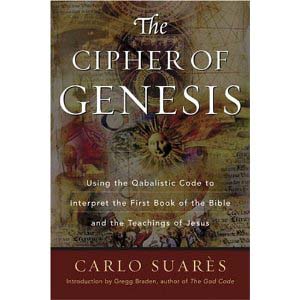
Carlos Suares (1892–1976). The Cipher Of Genesis: Using The Qabalistic Code to Interpret the First Book of the Bible and the Teachings of Jesus (2005)

A book by Carlos Suares of a little more than 200 pages, translated into English in 1970. This book presents us with a translation of the book of Genesis using a code to decipher the traditional meaning of the Hebrew words in the text. Originally each of the twenty-two letters of the Hebrew alphabet represented archetypes emerging as cosmic forces whose interplay not only creates this Earth, but all Worlds and every dimension of Being. Suares reveals this lost Ha-Qabala, held by ancient Rabbans that unlocks the true understanding hidden in the first book of the Torah. Relentlessly, the contents in Cipher of Genesis teeter on the brink of understanding, but always unfathomable, and not quite fully grasped.

Genesis in its original content is not lore from the distant past, but expresses states of consciousness, living forces present now, intended to project into our very being. Each letter in the text has a designation, interacting with other letters within the word to form a concept. This concept is then put in syntax with other word-concepts within the indigenous verse, revealing something quite unlike any conventional reading. By no means would one word convey the entire meaning of the line, but let’s take one word from Gen 1:3 “And God said, Let there be . . .

AWR. The Hebrew word for light.
Pronounced ‘Or’, it is composed of the three letters: Aleph, Waw, and Raysh. Each letter corresponds to the following:

Aleph— the unthinkable abstract principle of all that is and all that is not. It is the creative immanence but was never created, the imperishable pulsation penetrating all existence, timeless and elusive, emanating from beyond all realms.

Waw (or Vav)—expresses a copulative or connecting mediator, a fertilizing agent.

Raysh—Each germ of life has an envelope. Raysh is the ultimate expression of this. It is the cosmic container and is conceivable in the same manner one might ponder the finiteness of the physical universe.

The schema Awr (translated as “light”) can be cognized as the unconditional movement of the discontinuous and unthinkable Aleph imprinting itself on Raysh, the exalted multiple and infinitely expanding container. The true context of AWR is an ever-occurring primordial event: the wedding of Two Infinites. It is around all everywhere. In all everywhere. Beyond all everywhere . . . it is alive. Although this is only a single word from Gen 1:3, one might get the sense that the verse is not confined to a ‘Once upon a time’ episode, but a continual process outside of “moment by moment.”

Such is an example that Suares admits he cannot offer the truth of Genesis, but only images of that truth, because to understand it in its original intent is not to synthesize a language but to experience “a would-be transmission from the unknown.” This book is not a leisurely read. Although the subject matter is laced with commentaries of psychology, sociology, politics, and physics that lend the reader breathing space, it is still a very dense publication.

The author conveniently offers a formatted Code of the Hebrew letter-numbers, and while the initial letter code is brief, oftentimes a letter’s explanation is expanded throughout the course of the book. Because the quintessence of the letters is by nature conceptual, it is risky to confine them in any brittle terms of our languages. The interaction of these primal archetypes do not occur linearly but more in a simultaneous sense. Even so, The Code can be viewed as an ordered emanation of existence, one primordial essence sequentially leading to the next. An explanation of the first five letters, in their order, illustrates such an idea:

Aleph, no.1 the unthinkable life-death, abstract principle of all that is and all that is not. Aleph does not possess the qualities of existence in duration. It is beyond that.

Bayt (or Vayt), no.2 is the archetype of all dwellings, of all containers. Bayt conveys the whole duality of existence, it allows energy to reflect so energy can discern that which is not itself.

Ghimel, no.3 is the movement of every container animated by Bayt. Ghimel is motion expressed as uncontrolled function, action that is not predisposed.

Dallet, no.4 is the resistance to destruction. Dallet is the archetype of resistance, allowing energies to order.

Hay, no.5 is the archetype of universal life. The previous four emanations bring about the emergence of Hay, which does not exclaim individual existence, but is rather its potential.

Following the explanations of the letter-numbers six through nine, we come to Yod, the 10th letter, which culminates as a projection of Aleph into temporal continuity, creating duration, which by its very nature creates its own demise.

Yod is existence. Intent on itself. In contrast, Aleph, open to all possibilities, is timeless— yet deeply hidden, almost absent, buried by Yod’s pronounced disposition to mimic it. As Yod struggles to re-invent Aleph in an effort to perpetuate itself, it must eventually yield to Aleph or otherwise be consumed by its own duration. In order to prolong itself, Yod is constantly balancing resistance and flexibility: resistance to maintain its identity and flexibility so that it can be transient.

These letter-numbers are aspects, issuants, of one cosmic energy just as every color of a rainbow is of, and in, the light. They begin to express their complete meaning only through interaction with other letter-numbers, and their play is not restricted by phonetical positioning as are secular characters. Shemesh (Sheen-Mem-Sheen) is the Hebrew word for “sun.” Sheen the “Breath of God”. Mem the maternal waters. Sheen: the “breath of God”. Fusion! And then again something else . . . left entirely to the reader. That is the nature of Autoit Qabala. Open. Breathing. Aborting the meticulous.

Adam, Eve, Cain, Abel, The Garden of Eden, Elohim, Jehovah, and many other archetypes are addressed, decoded, and placed in context to the Genesis story events, opening an entirely new vista, never imagined by most. These biblical figures seen in the light of the Qabala become what Suares calls “abstract formulas of cosmic energy focused in the human psyche.” As the book progresses, Suares leaves it more for the reader to make in-depth inquiries into the specific translations.

It is worthy of mention that Suares received a degree in architecture in Paris. Later he went on to be a painter for fifteen years, researching the composition of light and color, which resulted in his book L’Hyperbole chromatique.

Forty years of effort culminated in Suares’ Cipher of Genesis, which some consider his pinnacle publication. Such a unique unveiling as this comes along only every 50 years or so. Anyone involved in language, psychology, religion, sociology, anthropology, architecture, or fine arts would find the disclosures of this book to be a welcome resource in their tool belt.

Reviewed by Michael McIntyre


Check out the book online at Amazon.com.


Project “X” Tours Japan Day by Day: Preliminaries

THE SEARCH FOR THE SECRETS OF IMMORTALITY:
Solar Cultures of Ancient Japan


The work of PROJECT “X” is to search for knowledge of the ancient Orders who practiced a similar System of Spiritual Regeneration at varied places throughout time – knowledge that is the divine birthright of every living person. At one time, this secret System was known to high religious Orders throughout the world. The methods and disciplines of The System were known to the Palestinian Essenes, the Egyptian Therapeutae, the early Christians, and members of other ancient high spiritual Orders around the world, including in India, China, and Japan.

For nearly forty years, PROJECT “X” has explored the history, myth, and legends of the ancients and answered such intriguing questions as: What did the solar cultures of Egypt, Israel, Greece, Persia, India, China, Mexico, Peru, and Japan have in common? How did these people use the sun’s energy to advance their civilizations to unheard-of heights? What do creation myths around the world all have in common? And what was the real purpose of the temples, shrines, and pyramids of the ancient priesthoods? The discoveries of PROJECT “X” expeditions provide new horizons in science and are certain to influence philosophy, psychology, and religion the world over.

THE SEARCH FOR THE SECRETS OF ANCIENT JAPAN was one in a unique series of PROJECT “X” travel programs designed for travelers who want to follow in the path of those mystics who introduced the world to knowledge of the immortal soul and the Spiritual Sun by teaching the Way of Light. The 2011 research travel program to Japan focused on the solar cultures of ancient Japan on the islands of Kyushu and the south of Honshu.

In this report, follow the thirteen-day trip day by day and immerse yourself in the mystic heritage of a land where the past seems to blend seamlessly with the present. Come to know the ancient Mystery Schools as you visit shrines and temples vicariously through the experiences of Project X members who took part in the tour. Attune with the natural beauty of sacred precincts grown out of millennia of spiritual teachings in locales where the people have long communed with the sun and knew The Way.

Archeological evidence places the first human settlement on the islands of Japan around approximately 10,000 BCE, but little is known for sure about human activity in the area before the sixth century CE. One of the purposes of the Project “X” tour was to investigate this past in order to present on-site information on these early times, including the little-known influences of the “Luminous Teaching” and teachers of the early Church of the East (called Keikyo in Japan).


THE JAPAN PROPHECY

“After Heaven’s Gate is open, and all the islands of Japan are connected, a Golden God will appear in the years of the Ox and the Tiger and be seated on the Throne.” These cryptic words foretell a spiritual event currently in the making, one in which the islands of Japan play a vital role.

Literally meaning “of the sun’s origin,” Nippon or Nihon has an ancient and mystical solar culture legacy, one which we will learn more of during the upcoming Solar Mysteries of Ancient Japan lecture tour. We will share the rich histories and secrets of the Shinto priesthood, solar Buddhism, and the little-known legacy of what has been called Nestorian Christianity – a remnant of the True Church that made its way from Syria, Persia, and India to China in the fifth century C.E. and then to Japan a century later under the esoteric spiritual master Kukai, also known as Kobo-daishi. The sacred shrines, temples, and other sites to be visited will shed light on the mysterious Luminous and Illustrious Religion and reveal the hidden meaning of Japan as a spiritual nation.

It was the purpose of the 2011 trip to Japan (May 9 – May 21, 2011) to gather further evidence of this ancient solar culture and share our research.


<NEXT>


Services for the Week of August 4, 2012


Saturday, August 4, 2012
10:00 AM COMMUNION
Chapel of Holy Child

RR Gene Savoy, Jr
Lector: RC Elizabeth Reece
Cantor: Dea. Stephan Fuelling
Reader: Rev. Herman Aggenbach
Organist: RC Gary Buchanan

Sunday, August 5, 2012
5:52 AM NEW DIVINE SERVICE
Church of New Pentecost
Leave: 4:45
Gate:5:30
Sunrise 6:07

RR Gene Savoy, Jr
Concelebrant: RR Sean Savoy
Assistants:
RC Roger Weld
Rev. Ted Staver
RM Carol Ann Crabb
Organist: RC Gary Buchanan

OPEN-AIR COMMUNION
Church of the End Times                    RC Elizabeth Reece
Church of the Americas                    Rev. Barbara Whitney
Church of the New Covenant                    Rev. Mike McIntyre

Wednesday, August 7, 2012
 12 N COMMUNION
Chapel of the Holy Child
RC Gary Buchanan


Friday, August 10, 2012
9:00 AM PRAYER & FELLOWSHIP
Chapel of the Roses
Rev. Barbara Whitney


Is There a Theory of Everything?

Popular science programs often revolve around the question of whether physicists will find a “theory of everything.” What that usually means is a single theory that explains the four known fundamental forces of nature: the two nuclear forces, strong and weak; the electromagnetic force; and the gravitational force. Physicists, however, usually refer to such a theory as a “unified field” theory.

Currently, a single theory or model that includes all four forces is a tough and long-standing problem. The current theory that explains the nongravitational forces is called the Standard Model, and is an outgrowth of particle physics and quantum theory. It is quantum in nature, which is to say that it explains the forces in terms of quanta, or indivisible quantities of mass or energy. The best gravitational theory (the General Theory of Relativity) is primarily geometric in nature and contains no feature that would allow for the quantization of gravitational energy. This is particularly frustrating for those who study black holes, as all four forces interact there as nowhere else. More significantly, the General Theory breaks down at the center of a black hole.

If a unified field theory is found, it is doubtful that it would be a “theory of everything” that explains all that there is to know about the physical universe, but the question itself is worth pondering. Could there be a point where everything is known about the physical world? A self-consistent set of theories that completely explains the physical universe would imply that the physical universe is a closed system; i.e., that there is nothing beyond, for if there were something beyond, it too must be explained by the theory or else be completely isolated from the physical. Perhaps the close relationship between physics and mathematics can provide a few clues.

The ability of mathematics to explain the world we live in has been noted several times by scientists and philosophers. Nobel laureate physicist Eugene Wigner referred to the “unreasonable effectiveness of mathematics” in explaining physical phenomena, and Albert Einstein is quoted as saying, “How is it possible that mathematics, a product of human thought that is independent of experience, fits so excellently the objects of physical reality?”

Time and again, mathematical concepts and structures developed in isolation have turned out to apply to the physical world, and mathematical models developed to describe some observed phenomenon have predicted previously unobserved phenomena. For instance, when the physicist Paul Dirac developed a key equation that describes the behavior of moving electrons in the late 1920s, he noticed that there was another solution where the charge of the electron was positive instead of negative. In 1932 just such a particle was discovered: the anti-electron.

Mathematics is of course based on axioms, or simple statements that are accepted as factual and are not required to be proven, with everything else being derived logically from the axioms. The axioms themselves seem to be observations of the world we live in. If there are two pencils on a table, and I add two more, it is a directly observable fact that there are now four pencils on the table. Whatever axioms result in the conclusion that 2+2=4 can comfortably be said to be directly observable facts of the world we live in.

But what of the logical processes by which deductions from axioms are made? As some have put it: Is mathematics only a product of the human mind, or does it have an existence independent of human thought, as Plato and his followers thought? Without attempting to answer such a deep question, it is still possible to accept this close relationship for what it is, with the aim of gaining an insight into the physical world, by examining the mathematical one.

In light of the above, it may be helpful to look more closely at the concept of a closed system by considering a simple closed mathematical system consisting of the set of integers (all whole numbers, the negative whole numbers, and zero) and the operations of addition and subtraction. Any two integers when added together will always produce another integer. Likewise, any two integers when subtracted from each other result in another integer. This system is closed, i.e. every possible operation within it results in an object which is a member of the system. This system is in fact a special kind of closed mathematical system called a “group.”

Now add the operation of multiplication to the system. Here again, the system is still closed, as any two integers when multiplied together always produce another integer. If the operation of division is added to the system, however, one sees immediately that it is no longer closed: 2/5 and all other such fractions are not integers, and the concept of number must expand beyond integers in order to accommodate division of integers.

Of course fractions (the rational numbers) have been part of mathematical knowledge for at least three thousand years, but this is hardly the only time in which the concept of number had to be expanded to accommodate expanding knowledge. Another example is the conundrum faced by the ancient Greeks when it was proved by the Pythagoreans that the square root of two could never be exactly represented by a ratio of two integers. The Greeks were quite familiar with representing lengths numerically: the impetus for calculating the square root of two was in fact to determine the length of the diagonal of a unit square. Since they only knew about rational numbers, imagine their surprise when they determined that numbers as they knew them, could not represent the diagonal length! This proof was in fact kept secret under penalty of death, for fear of unsettling consequences.

If a theory that unifies gravity and the other three forces in a single framework is ever developed, there is a real possibility that it may require a re-envisioning of some fundamental physical concepts, such as time, space, matter, and energy, in much the same way that the computation of the diagonal of a square required an expansion of the concept of number. Even so, it would still not be a “theory of everything,” as it would not prove that physics, and by extension, the physical universe is a closed system. So is mathematics itself a closed system, the extent of which simply hasn’t been found yet?

There is an account in Euclid’s Elements of an argument that addresses the aforementioned Pythagorean problem, but the issues raised by this problem were not really settled for over two millennia and required that numbers be represented by an infinite string of digits. In the nineteenth century Georg Cantor and his students explored this new concept of number, which today comprises irrational numbers. As any grade school student today knows, using decimal notation, rational numbers are represented as a string of digits that eventually becomes an infinitely repeating sequence of digits, whereas irrational numbers never repeat and therefore cannot be exactly represented by a finite set of quantity symbols. (The radical sign, which is used to represent roots, symbolizes an operation on its argument and not a quantity per se.)

Many mathematicians of Cantor’s time objected to the inclusion of infinite processes in mathematics; nevertheless, irrational numbers are an accepted concept today. Even Cantor’s description of infinite (or transfinite) quantities by means of set theory is now commonly accepted. The notion of number has expanded several times since the days when shepherds needed to know whether a sheep was missing at the end of the day!

So mathematics now includes, and reasons about, infinite quantities (an “infinity of infinities”), but can it be said to be either open or closed? After all, calculus, which is centuries old, deals with infinite and infinitesimal quantities. For instance, an integral is nothing more than the sum of an infinite number of infinitesimally small quantities that , when done correctly, results in a finite quantity.

The question of the closure of mathematics was raised more directly in the early twentieth century by the eminent mathematician David Hilbert, who is most remembered for his list of twenty-three important unsolved problems, which was published in 1900. Hilbert and many of his contemporaries espoused a “formalist” view of mathematics whereby all of mathematics could be based on a few well-chosen axioms and that all derivations from these axioms would be complete and self-consistent.

To elaborate a bit on formalism, computer-programming languages are all formal languages, as opposed to the natural languages that are spoken by people. Each word and each element of syntax has, and must have, one and only one meaning or function. If there is ambiguity in any element, it can result in ambiguity of any statement expressed in the language. Imagine how the English sentence “My car needs to be washed badly” would be interpreted by a formal language system where the word “badly” can have only one meaning!

Curiously, this formalist impulse parallels the thinking of physicists of about the same era. In the late 1800s it was generally thought that only a few more details in physics needed to be worked out, such as why things glow when they are heated up, and determining what the medium was in which light waves traveled. In fact these two small and troublesome details turned out to be just the tips of larger icebergs of knowledge. Unraveling the former led to quantum theory, and investigating the latter led to the theory of Special Relativity.

The expectations of the formalist school of mathematics were not to be realized, however. In 1931 Kurt Gödel published his Incompleteness theorems, which proved the impossibility of mathematics’ ever being completely self-consistent, which has forced the formalists to retrench and set more limited goals. In essence, Gödel demonstrated that no logical system that is complex enough to include arithmetic, can prove or disprove all possible propositions that are expressible by it.

A simple example of an undecidable proposition is: “This statement is false.” The self-referential nature of the statement is understandable, but the statement taken by itself is neither true nor false. Such a statement is useful in the more inclusive sphere of human reasoning: it has just been used as an analogy of a mathematically undecidable proposition. Of course the human mind is not a formal logical system, but Gödel showed that any more-encompassing system of formal logic in which this statement is decidable in some way, would itself contain undecidable propositions.

So where does all of the above leave the issue? Is there a “theory of everything”? Assuming that the close parallel between physics and mathematics continues to hold, physicists will never know everything about the physical universe due to Gödel’s remarkable theorem. There arise inevitable gaps in what mathematics can prove, and it would be surprising if the physical sciences did not share the same characteristic.

Moreover, the trends in both physics and mathematics would argue against a theory of everything. Seemingly small, unsolved problems in physics often turn out to be the tips of much larger issues, and concepts about numbers and operations on them have constantly expanded to become more inclusive. Neither mathematics nor physics seems to be closed, which leads the reasonable observer to conclude that the physical universe itself is not a closed system.

If the universe is not closed, is it infinite? Since the histories of both mathematics and physics demonstrate that complete understanding of a subject usually requires inclusion of elements of a more encompassing body of knowledge, it is plausible that there is no end to this process and that existence in general is infinite.

Ron Theriault 2011.12.31


For further investigation:

Burger, Edward. “Zero to Infinity: A History of Numbers.” DVD Lectures. Chantilly, VA: Teaching Company, 2007.

Kramer, Edna. The Nature and Growth of Modern Mathematics. Princeton, NJ: Princeton Univ. Press, 1981.

Livio, Mario. Is God a Mathematician? New York: Simon & Schuster, 2009.

Pollock, Steven. “Particle Physics for Nonphysicists.” DVD Lectures. Chantilly, VA: Teaching Company, 2003.


THE AUTHOR: Ron Theriault earned a B.S. degree in physics from the University of Michigan, and has been working as a software engineer since then. He holds a ministerial title in the International Community of Cosolargy, and is an active supporter of the church.

Red Rock Property for Sale

Red Rock Sanctuary view of Consolatory and Cathedral Church of the Americas with Temple Mount in the background. PHOTO: Roger Weld

The Community is offering for sale 40 acres of open land near our Red Rock Consecrated Sanctuary property in Red Rock Estates. The Sanctuary and available land is in Antelope Valley, 20 miles north of downtown Reno, NV. For information you may contact Bishop Gene Savoy Jr. at gsavoyjr@communityofchrist.org or call 775-786-7827.


Sanctuary Water Project Progress: A Report


Since March 2011, the water project at the Red Rock Consecrated Sanctuary has made significant progress.

The importance of this five-year project cannot be overlooked. Once it is completed, development of our Sanctuary can begin in earnest and with much greater potential—putting 17 million gallons of water annually to beneficial use. Our Community has invested close to $200,000 in this project thus far and nearly 10,000 volunteer man-hours.

Phase 1

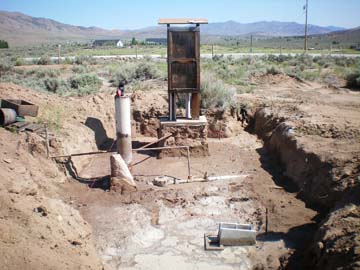
The existing well head. PHOTO: Ted Staver

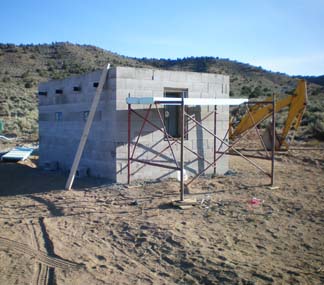
Phase 1 of the water project entailed building a structure around the existing well head at the Argonaut site.

Main structure of Argonaut pump house under construction. PHOTO: Ted Staver

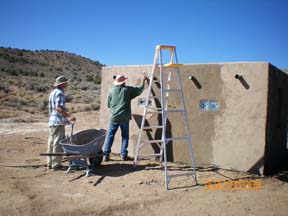
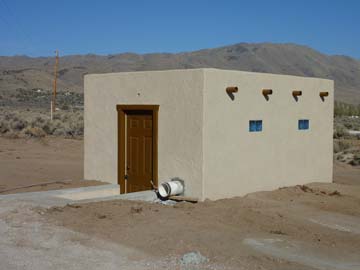
Argonaut pump house being finished with stucco. PHOTO: Ted Staver

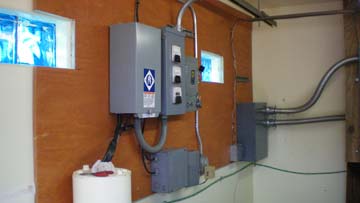
With that completed, Church work crews were able to install the necessary electrical switches and conduit along with a high-voltage transformer for power distribution throughout the sanctuary. The Argonaut pump site was finalized with the installation of all remaining conduit, electrical wiring, service boxes, and signal wire for the control sensors. A high-voltage transformer for power distribution to a lift pump station and power distribution for future expansion was also installed.

View of some of the inside electrical fittings in the Argonaut pump house. PHOTO: Ted Staver

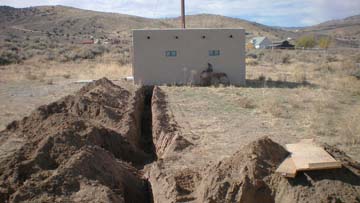
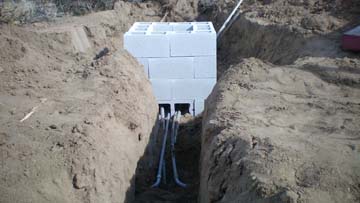
The photos below show the trench leading to the first “pull box.” This is where wire connections are made for electrical distribution. Power cables from the Argonaut pump site to the Chapter House (a distance of almost one mile) were laid.

Pump house and trench to first pull box. PHOTO: Ted Staver

The pull boxes are rather large, and there is a total of 17 of these boxes stretching up to the Chapter House.

Last pull box. PHOTO: Ted Staver

The concrete pad for the lift station was poured and the housing unit put into place. Finally, the final 300 feet of trench were excavated and water pipes installed, completing the connection from the lower portion of the Sanctuary to the upper part. Two small transformers were installed in separate locations for use with smaller irrigation pumps for future expansion.

Phase 2
The second phase of the project involved the connection of the high-voltage power lines from the main pump house up to the lift pump station, and the planning and placement of the water lines from the tank site to the lift pump site. This work was performed primarily by the Reverends Ted Staver and Herman Aggenbach.

Once that was completed, a concrete pad for the lift pump housing was poured and the housing placed on it. From that point on, it was simply a matter of configuring the placement of all the electronic controls for controlling the lift pump and monitoring water levels in the tanks. The photos show that the crew managed to load a lot of things into the small housing.

The final step in this phase of the project was to acquire and install a second transformer for the lift pump station and a variable motor speed controller. A booster pump capable of producing 40 gallons per minute was also needed, as well as a 4,000-gallon water tank. (The holding capacity for the tank was raised from 2,500 gallons, as reported last year, to 4,000.) The cost of these items was between $12,000 and $15,000. Work continued once funds were raised.

Phase 2 was nearly complete at the time this article was posted. It is just a matter of weeks before the final connection of wire is made and the components are tested. The next step will be to acquire the water tank that will supply water for the lift pump and to make the final water pipe connections. The crew expects to be pumping water to the upper level of the Sanctuary by the end of August 2012.

This project has taken several years to reach this point. It represents not only the attainment of water rights for the church but also future growth for new residences because of the availability of water and power. In planning the system, the crew included means to connect wind and solar to the pumping system so as to make it an off-grid system in the hope that the Sanctuary can be totally self-reliant in the future.

It is hoped also that we will be fully utilizing the new water distribution system by mid-summer, putting to use our water resources and saving precious dollars as a result of energy savings. It also means that the indoor and outdoor vegetable gardens, which were expanded last year, can be more fully utilized.

Remodeling of another portion of the Chapter House has begun so that a fourth staff-minister can reside at the Chapter House and assist with additional landscaping and greenhouse gardening.

Completed pump house on Argonaut Way. PHOTO: Ted Staver