Mar Iazed-buzid, the Great Donor: Part 2B
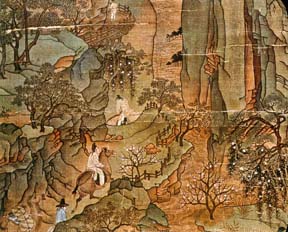
 

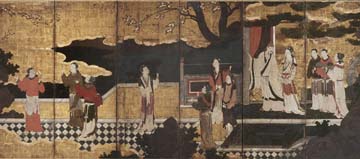
Emperor Hsuan-tsung (685-762) fleeing to Sechuan during the An Shi Rebellion. China, Tang dynasty, 8th century.

We have the winter scene of Hsuan-tsung’s final days as emperor on the good authority of Tu Fu, the poet of whom the Chinese say “to read his poems is to read Chinese history.” In the central hall of the palace, the poet tells us, the smoke of incense lilted from jade-white bodies of dancing goddesses, and grieving flutes harmonized with clear pure strings. While guests in warm sable coats savored camel’s hoof soup, fragrant whipped kumquats, and frosted coolie oranges, in the kitchen, blue-blooded families divvied up the imperial gold tableware. With music swelling, regal ministers stayed up late taking their pleasure, bathed by their choice women, whom they pampered with silks that came slowly from the hands of shivering farm wives, whose husbands were horsewhipped by tax collectors demanding tribute for the palace and whose farms were beyond hope. The people’s wise monarch, wishing them well, sent them baskets and bushels full of sincere gifts. Outside the imperial-red gates lay the frozen dead and the twisted paths along which noble men were driven. Simple-hearted people, frantic, ran themselves ragged. The one hundred grasses were in tatters, and banners trailed out into the stars. War-bound men, each wearing quiver and bow, were herded about like chickens and dogs to the borderlands, where meals, like day and night, passed indistinct, and blood swelled up like seawater. Lament seized every district. The elusive engines of grief loomed like a mountain, ready to heave and swing loose. . . . Tu Fu was a palimpsest, and his work a reflection, of those times. It is inevitable that I-ssu, perhaps at the time already an attendant at the palace, received similar impressions.

In the last month of the final year of Hsuan-tsung’s reign (AD 755), the pretender to the throne, General An Lu-shan, lifted his childlike mask. With his armies coiled in the northeast, he raised the standard of rebellion. At first An intended to wait until the death of the emperor, but now, fearing that insinuations made by the new chief minister could lead to his destruction, he struck, and paralyzed, the eastern capital of Loyang. In that city An found himself in an imperial dream: at the head of 150,000 men, proclaiming himself emperor, and proposing the new dynasty of Yen. The bravest generals of the day, Kuo Tzu-i and Li Kwang-pi, were dispatched at once into Honan against him. The counterfeit general took the road south, announcing his desire to kill the emperor’s new chief minister, Yang Kuo-chung. Several battles were fought. On the seventh day of the sixth moon in 756, at a place called Ling-pau, Ko Shu-han, one of Kuo Tzu-i’s generals, was defeated and captured. (See Supplement 5) On that day, Ko Shu-han unwittingly made a place for I-ssu to become his military successor. By the ninth day, fugitives from the battle arrived continually at the capital and filled the minds of everyone with fear when they told the story of the terrible combat and the treason of Ko Shu-han. (It was said, “Ko Shu-han’s eyes turned on a new emperor.” Whether Ko Shu-han actually joined An Lu-shan or was secretly put to death by him is uncertain.)

The bright emperor Hsuan-tsung watched anxiously from the top of the Flower and Calyx Belvedere for the “fires of peace.” Lighted each night on little watchtowers built a few li apart, this shining chain of torches signaled security between Chang-an and the Pass. But on the twelfth night of the sixth moon, there was no chain of light. In the icy dawn of the thirteenth day, a small and pale retinue accompanied the Son of Heaven through the western gates of the city with a quota of armed men. As day broke, Hsuan-tsung passed through the Gate of Lingering Autumn in his chariot. Golden whips were broken in haste. In a downpour of rain, the emperor fled among the shadows that towered over the imperial highway, leaving members of his own clan to fend for themselves. For I-ssu, circumstances now left only two possible courses of action. We do not know which he took: Either (A) he now joined with the hordes of populace who were passing before and behind the imperial retinue, polishing smooth the way southward to Szechuan where the emperor’s soldiers and adherents were numerous, or (B) he remained in the city multitude and witnessed the arrival of the barbarians and their acts of slaughter.

<PART 2C: THE RED COURT>


SUPPLEMENTS

Supplement 5:
The Capture of Ko Shu-han
General An Lu-shan

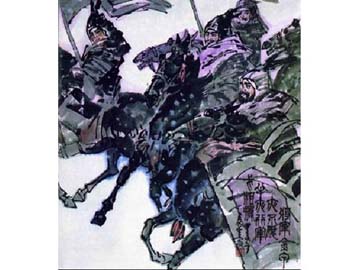
After Loyang sunk under waves of invasion, the horses of 300,000 hu barbarians dashed against Lofty Barrier Pass, the single crossing between Honan and Shensi. The pass was held by Ko Shu-han and 200,000 men. The new chief minister, Yang Kuo-chung, impatient and consumed with anxiety for his own life, persisted in urging the emperor to order Ko Shu-han to leave his safe position and advance through the pass until the imperial army prevailed. Ultimately, orders from the palace, inspired by Yang Kuo-chung, forced the fiery Khitan general, a seasoned military governor of the northwest since AD 747, to abandon his safe position, to meet and be engulfed by the oncoming waves of An Lu-shan’s barbarians.

Ko Shu-han led his men through the towering walls. At Dividing River, several hundred groups of hu barbarians suddenly appeared on horseback. The general urged his horse, and the imperial army moved onto the heights. By sunset, the fume of his marching men pervaded the forest on the winding mountain summits. Like clouds and mists, the imperial troops and their horses massed themselves, clinging to cold rocks on precipitous paths. At one moment, the glint from the surface of the mountain waters was pierced by shining arrowheads; at the next, the imperial forces were defeated and Ko Shu-han captured.

Intercessions & Memorial Prayers: September 2012

SEPTEMBER

1
Daniel Holley and his Family

5
Murray Larson

8
Murray Larson
Terry Stinson
Jim Whitney
Inge Veith †
Daniel Holley and his Family

12
Jim Whitney
Terry Stinson
Heather Vinson
The Late Bishop Gene Savoy, Sr. †

15
Jim Whitney
Terry Stinson
Heather Vinson
The Late Bishop Gene Savoy, Sr. †

19
Jim Whitney
Homer Brodie
Eli Flyer †
Roslyn Flyer
Ludwig Schrek

22
Jim Whitney
Homer Brodie
Eli Flyer †
Roslyn Flyer
Ludwig Schrek
Stephen Allen Sharp †
Sylvia Ontaneda-Bernales

26
Heather Fridlund
Ludwig Schrek
Jim Whitney

29
Heather Fridlund
Ludwig Schrek
Jim Whitney

† indicates Memorial Prayer


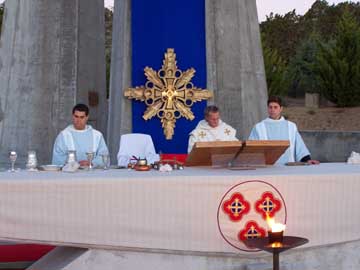
Services for October 13, 2012


Saturday, October 13, 2012
10:00 AM COMMUNION
Chapel of Holy Child

RR Gene Savoy, Jr
Lector: RC Rebecca Willis
Cantor: Rev. Michael Spohn
Reader: Rev. Michael McIntyre
Organist: RC Gary Buchananan


Sunday, October 14, 2012
6:51 AM NEW DIVINE SERVICE
Church of New Epiphany
Leave: 6:00
Gate: 6:40
Sunrise: 6:58

RR Gene Savoy, Jr
Concelebrant: RR Sean Savoy
Assistants:
RC Roger Weld
RC Ted Staver
RC Rebecca Willis
Organist: RC Gary Buchanan

OPEN-AIR COMMUNION
Church of New Mt. Tabor                    Rev. Mike Tamburello
Church of New Mt. Carmel                    Gary Huss Jr.
Church of New Mt. Hebron                     Rev. Greg Klinedinst


Wednesday, October 17, 2012
 12 N COMMUNION
Chapel of the Holy Child
RR Gene Savoy Jr.


Friday, October 19, 2012
9:00 AM PRAYER & FELLOWSHIP
Chapel of the Roses
Rev. Ben Hubbard


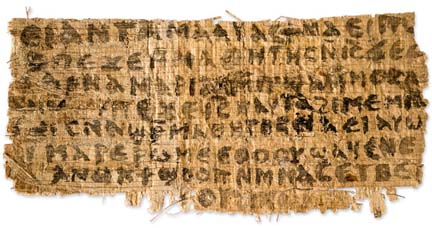
Historian Says Piece of Papyrus Refers to Jesus’s Wife

Papyrus scrap referring to the wife of Jesus. PHOTO: nytimes.com

A historian of early Christianity at Harvard Divinity School has identified a scrap of papyrus that she says was written in Coptic in the fourth century and contains a phrase never seen in any piece of Scripture: “Jesus said to them, ‘My wife …’ ”

Read the translated legible text and the entire article online in the New York Times.

Note from Bob Anderson: Be sure to read people’s comments following the article—some insights and several laughs!

Link submitted by Michael McIntyre


Maps of the Sanctuary Available

Some of the new residents of the Community in Reno have been asking for the names and locations of the various Churches in the Southland Sanctuary of Prophecy and the Northland Sanctuary of Revelation.

We found these old maps, hand-drawn by Gary Buchanan, from the Summer 1984 Community Communiqué. The names of a few places have been changed in the Sanctuary of Prophecy. What was in 1984 called the “Basilica” is now called the “Cathedral Church of the Americas” and what was called the “Forum” is now called the “Refectory.” “Monte Viejo” refers to a mountaintop designated for the Southland Sanctuary Abbey. The names of the locations in the Sanctuary of Revelation, all of them Churches, remain the same.

Below each of the photo images of the maps you will find a PDF of the map that you can print for yourself.

Map-Churches of Prophecy


Map-Churches of Revelations


Mar Iazed-buzid, the Great Donor: Part 2A

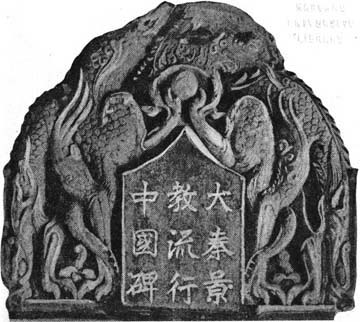
Monument headstone


PART 2: THE RED COURT

His learning was highly exalted during the reign of the Three Emperors;
his skills were extensive and perfectly complete.
First performing certain faithful service in the Red Court,
his name was eventually inscribed in the Dragon Book.


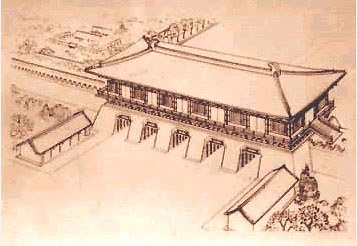
Main Gate of Chang-an in Tang times. Artist's rendition

We do not know whether I-ssu approached the towering gateway of Chang-an in autumn, when ripe persimmons hung scarlet in the trees, or in the spring, when the foothills were a soft haze of plum blossoms. Neither is it certain when I-ssu first distinguished himself at the Red Court in the private apartments of the Imperial Palace, whether it was before AD 743 or after 753. We do know that there were no new court appointments for a decade before the death of chief minister Li Lin-fu in 753. During those ten years, whenever Emperor Hsuan-tsung ordered special examinations for accomplished scholars who were not already employed in the government, Li Lin-fu, the administrator of the exams, failed all candidates; the minister then flattered the emperor that he had already brought into his services every worthy man in the empire. This perversion of official duty won Li Lin-fu his timeless infamy. His second notorious manipulation of the amiable emperor he accomplished during the last five years of his life: Jealous of power and fearful that some of the generals might win fame enough in their wars with the Turcomans to eclipse his own royal favor, Li convinced the emperor to dispense with large imperial armies on the frontiers and appoint to their defense instead the new barbarians who had recently submitted themselves to China. When the imperial troops were withdrawn, the tribes of the northeast, and barbarian generals with no real loyalty to Tang, willingly carried out the expansionist program that the Li advised the emperor to pursue. Warlords of the Khitan and the Hsi came to rule vast territories with autonomous armies while the emperor was left in control of only the palace guard. With these two ruses, the one aimed at the empire’s center, the other stretched along its perimeter, Li engineered the field of social forces to which I-ssu would have to conform his life. (See Supplement 1)

The circumstances of I-ssu’s life indicate that he most likely signed the imperial Dragon Book to consummate his first year of faithful service to the Court sometime during the desperate final years of Hsuan-tsung’s reign (See Supplement 2) – after the death of Li Lin-fu and before the dynastic eruption that raised up another emperor. During those years, the emperor played – at entertainments, at the inferior Taoist pursuit of the material pill of immortality, at the Tantric mysteries, and at love. So enamored was the emperor with his son’s beautiful concubine that he took her for his own (See Supplement 3) and left the affairs of state to Li. So distracted was the emperor by his passion for this woman that, after the death of Li and the appointment of Yang Kuo-chung as new chief minister, the jealous rival of Li’s successor – An Lu-shan – was able to rise to insurrectionary power without the emperor taking notice. (See Supplement 4)

<PART 2B: THE RED COURT>


SUPPLEMENTS

Supplement 1:
Early Infamies of Li Lin-fu

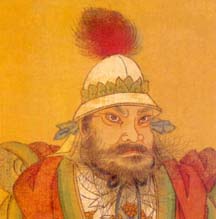
An Lu-shan. Portrait by modern artist

These infamous actions of Li Lin-fu had been preceded by others that established him in power. Two years before the appointment of Li Lin-fu to the office of chief minister, a great battle had been fought against the barbarian Khitans. The emperor proposed to make the victorious general, Chang Kiu, his chief minister. Chang Kiu, because he recognized the position was too important to be given away to a merely successful general, simply refused. The next year a Chinese army was led against the Khitans by a young man and suffered absolute annihilation. By Chinese reckoning, this act warranted the young man’s death. When Chang Kiu sent the young man, who was named An Lu-shan, before the emperor to plead for his life, the emperor, disregarding General Chang’s protest, not only forgave An Lu-shan but gave him a commission in Shantung.

Another time, when Chang Kiu warned the emperor against deposing the heir-apparent to put his eighteenth son next in line to the throne, Li Lin-fu espoused the cause of the distant young prince and, together with the child’s mother, filled the royal ear with such complaints that the emperor dismissed Chang Kiu from court and sent him to take charge of the far off district of Chihli. With General Chang’s departure from the palace, the reins of power fell into the hands of Li Lin-fu. From this time on, no one dared express honest opinions.

Years later, the emperor put An Lu-shan in charge of the northeast troops at Chihli, with disastrous results. Too late the emperor found out that when he had rejected Chang Kiu he had rejected the one man who could have saved him from the sorrows that embittered his last years as emperor.

Supplement 2:
The Virtues of Hsuan-tsung’s Early Reign

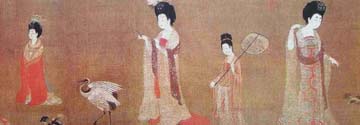
Court Ladies of Hsuan-tsung

The virtues of Hsuan-tsung’s early reign are recounted in the stanzas of the Inscription’s ode:


Hsuan-tsung with might and main pursued The Way of Truth.
The temple-names written by the Emperor shone forth.
The tablets of the celestial handwriting reflected gloriously.
The Imperial Domain was embellished and studded with gems.

[Explanation of the lines: His court was splendidly elegant. He established the long-enduring Hanlin Academy to harbor talented scholars and literateurs and an institute of music and dance to train theatrical performers for palace entertainments. He restored ancient temples and palaces throughout the Empire, and geniuses of culture flourished.]

The least and the remotest places attained the highest virtue.

[Explanation of the line: He abolished capital punishment and continued to follow the vigorous foreign policy of his predecessors.]

All sorts of works undertaken by the people flourished throughout the land, and each man enjoyed his own prosperity.

[Explanation of the line: He purged the bureaucracy of parasites and favorites, reduced court extravagances, and made special efforts to keep informed about the conditions among the people. At his capital, blue-coated scholars and men of talent assembled in the Garden Where the Talented Are Perched to await examinations or further orders. So grand was his design, Hsuan-tsung banished the mundane name of year and measured his reign in planetary revolutions instead, marking clearly his Empire’s time by the circuit of his planet about the sun.]

All of this passed, however, with the first period of his reign, which he styled “The Opening of Origins” (712–741). Had Hsuan-tsung died in middle age, his name would have been remembered with unqualified admiration. But he lived too long. By the time of I-ssu’s arrival, the emperor’s first long reign had passed into a second, styled “Supreme Virtue” (741–756), that was already near its end. The once direct, simple, and self-controlled monarch was by then turning into a besotted old man under the influence of lovely ladies, and nepotism was blooming large again.

Supplement 3:
The Emperor’s Concubine and the Five Households of Yang

Emperor Hsuan with his concubine Yang Kuei-fu and attendants on a terrace. 16th-century painting on paper by Kano Eitoku.

Yang Yu-han (“Jade Armlet”) came to be known by her title, Kuei-fu (“Exalted Imperial Concubine”), and was treated as an empress. According to the account in the Tang History, she was perspicacious, while her modest air and sidelong glances “lifted the Brilliant Emperor to the clouds.”

Her three beautiful and talented sisters were given titles coined from the names of states, as well as the revenue derived from those states: Han Kuo, Kuo Kuo, and Chin Kuo. They were each allowed annually a string of one thousand cash for their toilette, their powder, and their make-up. Their mansions were altered to resemble palaces. Before a horrified court, these three, though married, accepted the attentions of the emperor and went about in the palace as they pleased.

Besides the three sisters, two brothers also required imperial assistance. These Five Households of Yang—that is, the establishments of the three sisters and the two brothers—were thronged by people of the Four Quarters, more numerous than the people who filled the marketplace, begging favors and offering bribes. The orders that went out from these sycophantic households were obeyed with even greater celerity than the behests of the emperor himself. When Yang Kuo-chung, their cousin, became chief minister, the blossom of their nepotism reached its fullness.

Supplement 4:
The Rise of An Lu-shan

General An Lu-shan

With tragic fatality, the gigantic effort of the Brilliant Monarch to turn the vast empire into a centralized state degenerated into the satisfaction of the personal ambitions and grand desires of others. Emperor Hsuan-tsung, through his chief minister, Li Lin-fu, had induced such powerful centrifugal forces that, under Li’s suppression, these forces grew stronger, more conscious, and more cunning. For many years, the corpulent Turk An Lu-shan had often played an infant at court, cooing and even dressing in diapers, until he became too much favored by the aging emperor and his intoxicating consort. The Exalted Imperial Concubine adopted An as her son (and as her lover); the emperor himself was never content unless he had his Lu-shan in the palace.

But soon An Lu-shan would step onto the stage in the role of avenging nemesis, the huge bulk of his body representing the colossal principle of destruction that the dictator’s system had nurtured in spite of itself.

After Li Lin-fu fell ill during the tenth moon of the eleventh revolution of Tien Pao (752), Yang Kuo-chung, Yang Kwei’s cousin, returned from the West a day or two before Li’s death and succeeded him. An Lu-shan, a man of profound dissimulation, had waited until his court patron Li Lin-fu was dead; now, at the prodding of the new chief minister, he saw to it that the body of Li Lin-fu, the man most high in royal favor for nearly twenty years, was despoiled by royal command. Claiming that Li Lin-fu had been planning an uprising just before his death, An cleared himself of treasonable charges at the same time that he won new affection from the emperor.

Under the ministry of Li Lin-fu, An Lu-shan had been an awed and obedient servant of the regime, but he adopted no such attitude to the successor. Once freed from Li, the one man whose power he dreaded, An Lu-shan began to take a new and independent position of spite and disobedience toward the new chief minister. For the next three years, An Lu-shan and Yang Kuo-chung entwined in a struggle of ever-increasing intensity. While the aging, pleasure-loving emperor, half-conscious of the danger, tried to ignore what was happening, the two intrigued venomously. On the frontiers, where An Lu-shan had been already much better established, each attempted to build up military strength. In their maneuvers at court, An was bested by Yang. In the end, An Lu-shan decided that his only course lay in armed intervention.


DNA Discoveries—Greg Braden

Greg Braden PHOTO: gregbraden.com

In this report, visionary author Greg Braden, a pioneer in bridging science and spirituality, discusses three astonishing experiments with DNA that show how DNA can heal itself according to the “feelings” of the individual. The report focuses on how physical life can order nonphysical events. Consociate Terry Hutchinson, who brought this report to our attention, expressed his hope that “along with our known DNA, one day doctors will discover the true light template that helps form our DNA.”


PHOTO: garybraden.com


Read the article posted online at Red Ice Creations.

Link submitted by Terry Hutchinson


Mar Iazed-buzid, the Great Donor: Part 1

Monument headstone

PART 1: THE EASTERN PATH

 . . . a man of harmonious nature and loving to do good,
hearing The Way and diligently practicing it,
from far out of the City of the Royal Palace
came all the way to the Middle Kingdom. . . .


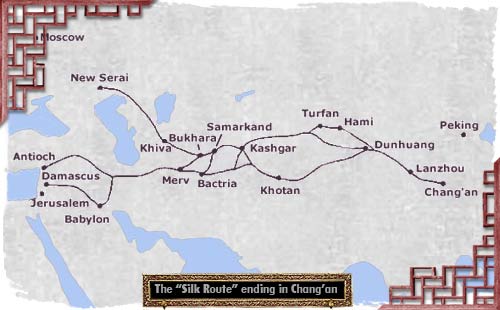
Balkh is indicated on the map as Bactria.

Along about the 100th year of the Hegira (AD 722), the man named Iazed-buzid (whom the people of Tang in China would later style I-ssu) was born in the remote Tang vassal state of Takhuristan at the time when the surrounding native tribes were rising up on the high tide of Arab expansion and pressing north in rebellion, with the Arabs, toward Samarkand. Throughout Iazed-buzid’s childhood and youth, Chinese armies crossed the mountains and deserts of his homeland to suppress the rebels. During the confusion among the tribes of the Eleven Hordes in the 121st year of the Hegira, the Chinese army destroyed a large part of them, while the tribes farther east, the hui ho, or Uighurs, and the Ko Lo Lu, combined to elect a common chief among them. This new chief of the Hordes, confirmed by the Chinese emperor Hsuan-tsung, a year later sent the severed head of his rival to the emperor; but in the 129th year of the Hegira, a coalition of Arabs and Western Turks routed the Chinese armies in a momentous battle near Samarkand: the Chinese had joined their troops and their vassal hordes with those of the king of the Pa Han Na and advanced against the Arab and Turk alliance; ultimately, however, the Ko Lo Lu at the Chinese army’s rear revolted and annihilated the Chinese on the banks of the Talas River. Four years later, in the 133rd year of the Hegira, or Flight, all the imperial troops of Tang were recalled from Central Asia. Thereafter, the people turned away from the consolation of the Buddha and toward the sabered moon of Islam.

Like so many of the seventy who are listed in Syriac columns down the side of the Monument stone, sometime before the year 133 of the Flight (755 AD), Iazed-buzid left his home at Balkh, once the royal capitol of Bactria and his father’s Metropolitan See, now the main Arab military forward base in the north of Asia. Leaving behind the walls of that weary city and the hundreds of huge circular stupas constructed there by Buddhists centuries before, he sought his fortune as an educated provincial candidate for government service in the Chinese capital. (See Supplement 1) Crossing the river, perhaps in the entourage of traders, Iazed-buzid passed across the moated citadel of Balkh, the caravan palace and its gardens. On horseback or on foot, he traveled north beyond the Oxus River through the snow-clad Hissar Mountains toward the fertile high-plain valley of Zerafshan that surrounds Samarkand, the next Metropolitan See. Passing through the narrow, winding streets of that yellow maze of houses nestled among trees, at one time the Sogdian capital but now a Muslim town, he turned east and followed the latter half of the same missionary path that his predecessor, Rabban A-lo-pen, had taken more than a century before: He headed southeast more than twenty-seven hundred miles along the Great West Road from the center of far Takhuristan to the end of the road at the opulent Western Capital of China: Chang-an, the largest city in the world, rivaled in size and splendor only by al-Rashid’s Baghdad.

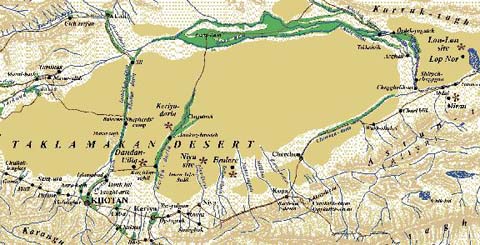
Along high mountain passes through Chinese Turkestan, Iazed-buzid made his way to the highland oasis of Kashgar, where midday was white and dazzling when it was not dimmed by the clouds of dust that choked the inhabitants and left a gray film on the black clusters of grapes. From the gardens and vineyards and pastures that sadly overlooked the desert with him, the way began to curve round the southern rim of the wide desert basin called Tarim, the storehouse of the prevailing winds that visited Kashgar two hundred days a year. Two thousand miles away, far past the other end of the shimmering desert whose sun engendered fever and whose moon engendered chills, was the next Metroplitan See, his destination: Chang-an.

Tarim Basin


From the gate of the caravan’s resting place outside the city of Kashgar, where the color of the sunset would have been the color of the sand, his caravan began its five-hundred-mile circuit against the wind to the terraces of the hospitable Aryan settlement of Khotan, the most luxurious oasis on the southern rim and the Tang garrison center guarding the key link from India and Middle Asia. From there, he moved through the trade cities of Tun-huang and Lanchow. Then, winding across Asian deserts, the caravan, descending the successive levels of the Dragon Mound, crossed two hundred miles of the emperor’s pasture to reach the central plain and finally arrive at its center: the imperial Western Capital, Chang-an.

<PART 2A: THE RED COURT>


SUPPLEMENTS

Supplement 1:
Provincial Candidates

Heart Sutra in standard style calligraphy, Tang Dynasty

The digest in the Tang history dealing with the choice of good men for office (Tang Shu Hsuan Chu Chih) states that every prefecture (hsien) and district (chou) under the Tang was provided with an Assembly Hall (kuan) for the use of students. Each year during the second of the three winter moons (the eleventh month of the year) the official in charge selected the most promising from among the body of students who had “perfected” their studies. These men, called “country candidates” (hsiang kung) offered their services in the Department of State Affairs (shang shu sheng), connected with the palace. After inspection in the Ministries of Revenue (hu pu), they reached the “barrier of examination” before the vice director (yuan wai lang).

Before Tang, the successful examination candidates, and other meritorious persons who were sent to the capital by provincial governments for employment at court, were considered part of the imperial tribute required of the area from which they came.


Visit the New Healing Place in Milwaukee

Peig Myota

In mid-June Peig Myota and Lee Ann Baum, who had been residing in Reno for the preceding eight months, announced that they were preparing to return home to the Milwaukee area to reopen their healing center with new insight and a new direction. They have been working with the Feronia Wellness Center since that time to reestablish themselves in Germantown, Wisconsin. And they recently celebrated the grand opening of their new offices.


Lee Ann Baum

Visit the Healing Center web site to read about the healing services and classes they are offering at their new location.


Mar Iazed-buzid, the Great Donor: Introduction

Monument headstone


____________
____           ____
____________
____________
____           ____
____________


Our Great Donor,

Grand Master of the Palace with Golden Seal and Purple Ribbon,

Joint Military Vice Commissioner of the Northern Region,

Director of the Palace Administration by examination,

and granted the purple clerical robe,

the monk I-ssu,

a man of harmonious nature and loving to do good,

hearing The Way and diligently practicing it,

from far out of the City of the Royal Palace

came all the way to the Middle Kingdom.

His learning was highly exalted during the reign of the Three Emperors;

his skills were extensive and perfectly complete.

First performing certain faithful service in the Red Court,

his name was eventually inscribed in the Dragon Book.

When the Secretariat Director,

Duke Kuo Tsu-I, Prince of the Fen-yang Commandery,

first commanded troops in the Northern Regions,

Su-tsung ordered him to accompany the expedition.

Though treated with friendship in the Prince’s sleeping-tent,

he made no distinction between himself and others on the march.

He was nails and teeth for the Duke,

and was ears and eyes to the army.

He distributed his rewards and gifts,

laying up nothing in his own house.

He made offering of the crystal granted him by the Emperor;

he dedicated the cloth of gold granted him when he retired and sought rest.

He restored some of the old monasteries to their former condition;

in others he enlarged the worship halls,

elevating and ornamenting their corridors and walls;

roofs and flying eaves with colored tiles

appeared like pheasants on the wing.

He exerted himself beyond measure for the Luminous School;

making benevolence his rule, he dispersed his wealth.

Every year he assembled monks from the monasteries of the four quarters;

the hungry came and were fed;

the cold came and were clothed;

he healed the sick and raised them up;

he buried the dead and laid them to rest.

Among the purest and most self-denying God-fearing men,

such excellence was never heard of;

but now the white-robed members of the Luminous Religion

see it in this man.

— the seventeenth paragraph of the Chinese inscription on the Monument for the Propagation of the Luminous Religion in the Middle Kingdom


“In the year one thousand ninety-two of the Greeks,

Mar Iazid-buzid,

priest and chorepiscopus

of Khumdan, the royal city,

son of the departed spirit, Milis,

priest from Balkh, a city of Takhuristan,

erected this monument of stone,

on which are written the Law of Him, our Savior,

and the preaching of our forefathers

to the rulers of China.”

— from the Syriac inscription at the base of the Monument.


<PART 1: THE EASTERN PATH>