Mar Iazed-buzid, the Great Donor: Part 5B
 

Zhongnan Mountain, south of Chang-an (Xian)


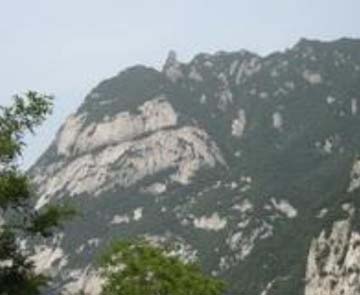
I-ssu, married to both a worldly church and a dissipating empire, traveled the 130 li across the fertile plain between Chang-an and South Mountain at least once – when he sought retreat at the monastery of Wu-chun. (See Supplement 8 ) On this plain in 617, the founder of Tang gained his foothold to march on the capital with his son, who later became Tai-tsung. A-lo-pen in 635 and Bishop Cyriacus in 732 might have passed through this same western district on their way to the capital. (See Supplement 9) Now I-ssu was crossing the field again, but his way led away from the capital, toward the monastery at Wu-chun. Perhaps, as he approached South Mountain in his tall official carriage, he had already developed the understanding that the world is only a place for redemption and that the Church is its vehicle. From the valley road, he would have seen the towers of the Ta-chin monastery and of the famous temple of Lao-tzu. In the same neighborhood, they were separated only by the small walled village of Wu-chun. (See Supplement 10) The Taoist tower rose up tall at the foot of South Mountain. To the west, and further up the slope, on the heights of a precipice, the Ta-chin temple stood, (See Supplement 11) overshadowed by cedar forests, beneath the line of pines. (See Supplement 12) Around it were hills, deep dark green, covered with flowers and trees and barley grain growing on the mountainside. From there, where peasants came to draw water from the springs, the grand snow-born rivers and little streamlets all flowed north, toward the capital, to join the waters of the Wei. An inspired visitor of the tenth century tells us that the Ta-chin temple, seen through the evening air, seems to take the shape of a mountain deer, its hind legs resting on the cliff above as it bends to drink the clear water below. As I-ssu rode up precipitous heights along the mountain paths, past Lao-tzu Temple and through town, he could see to the north the distant, high walls of Chang-an and below him a gentle ocean of fields and farms, spacious and calm: a fertile plain full of peasant villages, with silkworms feeding in the mulberry groves and, only a few li away, bamboo growing along the river in the Imperial Garden of Chou-chin. One of these images – the deer, the landscape, or the past – might have entered the mind of I-ssu as he passed.

If I-ssu had received his bishop’s staff while he was still in service to the emperor, he might have made this same trip many times, and even come to live at Wu-chun with his wife and son, somewhere past the cells of the solitaries, in the outer circle of the monastery that had grown like a little village around the central temple and coenobium, and there built a modest home where he and his wife could raise their son for the priesthood. (See Supplement 13) If not, then it might have been that I-ssu made this trip only once, when as a solitary dweller he retired and sought rest.


< PART 5C: IN THE LIGHT OF THE SETTING SUN >


SUPPLEMENTS

Supplement 8:
The Religious Retreat of Mar Iazed-buzid
Dr. P.Y. Saeki

With Professor Saeki, we assume, for the sake of circumstance, that I-ssu passed his last years cloistered here at this monastery in the neighborhood of the Four Forts, the Chang-an suburb frequented by Turkic and Indian mercenaries like those who had inhabited I-ssu’s youth.


Supplement 9:
The Western District of Chou-chih
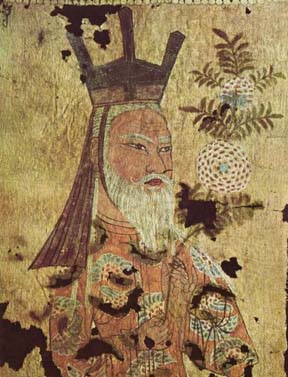
Tang Dynasty Uighur Khagan

The name Chou-chih (chou, mountain-bend, and chih, river-bend) describe a town that occupied the headland of the delta formed by the Wei-ho and Tsao-ho Rivers, noted from early times for its beautiful scenery.

Since the outbreak of the rebellion in 755, the western district of the Imperial City was an important strategic point in the defense of the capital. Chou-chih was made the outpost headquarters of the imperial army for 26 years (758–784). During these years there was no civilian life in the city, and the army left the town in ruins for many years thereafter. Chou-chih was a military town when the Monument was erected.

In 781 the district of Chou-chih was occupied by foreign mercenaries; among the soldiers were Turkic, Uighur, and Persian adherents of the Luminous Religion, Mongols, and Indians. The mercenary army, known as the Shen-tse (God-grant-strategem”) army, was outposted in the western frontier of the capital. The entire southern suburb of Chang-an was filled with Tibetans and I-ssu’s old comrades in arms, the Uighurs or hui ho, now the affluent nouveau riche at the capital.


Supplement 10:
The Monastic Village of Wu-chun
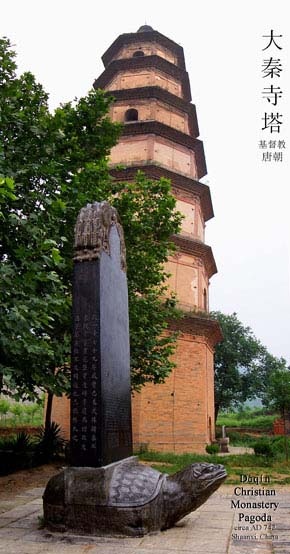
Postcard of Ta-chin (Daqin) Tower and replica of the monument stele

The Ta-chin temple at this location, which stood only one li from the village, might have been the center of the four monasteries mentioned in the Inscription. In 1444 another village, called Ta-ku, grew up around the temple. Not far from present-day Sian (once ancient Chang-an), the grounds that once surrounded the ancient temple presently hold an old town. The monastic village of Wu-chun is no more.


Supplement 11:
The Taoist Mecca of Chou-chih
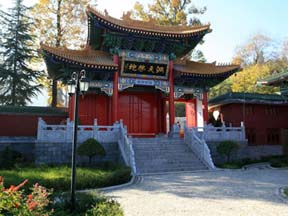
Entrance to the Louguantai Taoist temple today

The district of Chou-chih was the Taoist Mecca, where Taoists and Christians came into closest physical contact. Here were the great temple of Lao-tzu and the house of Yin Hsi, where Lao-tzu is supposed to have spoken his last words of instruction.


Supplement 12:
The Monastery Tower
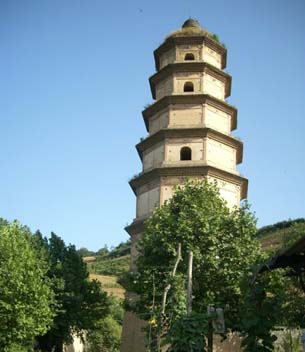
View of Ta-chin (Daqin) temple pagoda

Within the premises of the temple ground was the Guarding Immortals’ Treasure Tower (Chen-hsien-pao-ta), the White Tower of the temple, which was reported by Japanese scholars to be still standing in 1932. East of what once was the monastery, about 40 feet from the modern village, the eight-cornered tower of seven stories stood 70–80 feet high.


Supplement 13:
A Picture of the Monastic Village of Wu-chun
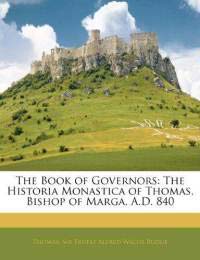
Front cover of 2010 Nabu Press edition of The Book of Governors, a monastic history written by a monk of Beth Abhe, Thomas of Marga, in the first half of the 9th century A.D. The actual title of Thomas’ book is The Book of Excellent Histories and Stories Concerning the Holy Men and Monks who Lived, Generation after Generation, in the Holy Monastery of Beth Abhe. The monastery of Beth Abhe, located northeast of Mosul, was founded at the end of the 6th century A.D. and became an important center for education and missionary work for the several hundred years of its existence. Thomas gives a detailed history of the remarkable members of this community during the first 300 years of its existence as well as narratives of important events in the history of the Church of the East during this period.

The monastery of Beth Abhe had been founded as a result of the confusion following a reform in western Persia in the year 484 that disallowed monastic marriage. Before the reform we have from fifth-century Persia the picture of at least one monastic settlement as a village in the mountains where monks and nuns lived together and raised families with children. One hundred years later, celibacy was enforced. By 628 a strict celibacy rule was in place.

Perhaps, as the founder of Beth Abhe had done in 570, the founder of the Chinese mission, A-lo-pen, continued the older rule in the Chinese missions when he arrived in 635, and now, in the eighth century, I-ssu was still allowed to live as presbyter in such a monastic village, where a priest might marry and those who took a monastic vow could obtain a dispensation to leave monastic life without disgrace or difficulty.

If anything can be known about he layout of the monastic village at Wu-chun, it is that it followed the tradition of Persia. If the Wu-chun monastery was modeled after the famous Persian monastery at Beth Abhe, from which China’s metropolitans, and perhaps all its missionaries, had been sent, it looked as follows:

For 80 monks, a worship hall or temple 70 feet by 50 feet and, gathered close around it, the other buildings: a kitchen attended to and cleaned by those assigned to it on a weekly basis, and near the kitchen, the butler’s pantry where those who set tables retrieved their supplies, a wine cellar where wine was stored in skins, and other domestic offices; a refectory; the common-room where brethren sat and ate together and on feast days were joined by the ascetics who lived in separate cells; a library; a guest chamber reserved for the entertainment of strangers; a special cell reserved for the abbot; common sleeping accommodations for novice brothers; and , near the gate, an apartment for the porter. The large garden of the community at Beth Abhe included groves of fruit trees.

The wide monastic dwelling, including the inner and outer cells, was commonly referred to as a village. The cells of monks and ascetics were situated rather far off from the main body of monastic buildings.
“Indigenous Gathering in New Mexico”

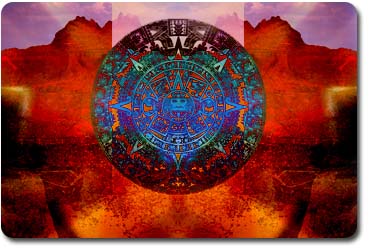
Mayan Calendar Medallion. PHOTO: sacredreconnections.com

A commentary on the recent gathering of indigenous peoples in New Mexico includes some interesting statements on ancient Mayan knowledge of the Sun in the message given at the conference by the Mayan teacher Ac Tah of Yucatan.

< Read the article “Indigenous Gathering in New Mexico” by Mona Delfino online at sacredreconnections.com. >

Link submitted by Dr. Tom Lee


Mar Iazed-buzid, the Great Donor: Part 5A


PART 5: IN THE LIGHT OF THE SETTING SUN

. . . He distributed his rewards and gifts,
laying up nothing in his own house.
He made offering of the crystal granted him by the Emperor;
he dedicated the cloth of gold granted him when he retired and sought rest.
He restored some of the old monasteries to their former condition;
in others he enlarged the worship halls,
elevating and ornamenting their corridors and walls;
roofs and flying eaves with colored tiles
appeared like pheasants on the wing.
He exerted himself beyond measure for the Luminous School;
making benevolence his rule, he dispersed his wealth.
Every year he assembled monks from the monasteries of the four quarters;
the hungry came and were fed;
the cold came and were clothed;
he healed the sick and raised them up;
he buried the dead and laid them to rest. . . .


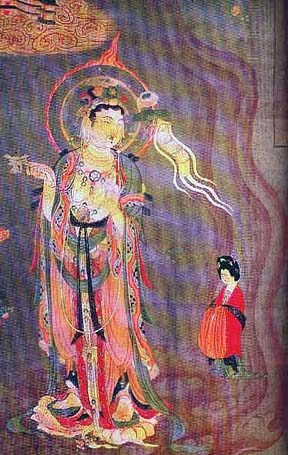
Bodhisattva leading a woman to the Pure Land, incense burner in his right hand, lotus flower in his left hand. Tang era color on silk discovered at Dunhuang in the "100 Buddha Cave."

After the years of rebellion, half the people had vanished, turned to soldiers’ ghosts; the others had risen up and migrated south, leaving whole regions uninhabited. Landed property moved into new hands. Statesmen paid lip service to restoration, but within a few years the government was forced to begin feeling its way toward new institutions. In his deteriorated empire, Emperor Tai-tsung (763–779) now continued, and even embellished, the religious avocation of his ancestral house: He constructed new Buddhist temples and reached new heights in support of Buddhist practice. When the emperor tied Tang government more closely than ever to the affairs of the Buddhist temple, the champions of secular morality began to criticize him for his spiritual leanings. Later, in 781, when a formidable rebellion broke out in Chih-li, after the new emperor, Te-tsung (779–805), wisely refused to be bound by the promises his grandfather, Su-tsung, had made, I-ssu had been retired from military service for many years and did not help to put it down. (See Supplement 1)

In the West, Mar Timothy sat as patriarch in the caliph’s new capital of Baghdad, (See Supplement 2) the head of one of the richest and most influential communities in the Islamic Empire. (See Supplement 3) The office of patriarch had become an important position in the central administration, sometimes through favor with the caliphs themselves, (See Supplement 4) and sometimes through bribery and gifts. (See Supplement 5) In 781, when the Church was reaching its farthest limits of extension into Asia, (See Supplement 6) the patriarch was beginning to look like a civil servant, sometimes sent on diplomatic missions to Constantinople or to Rome, and the Church was growing more ostentatious and worldly from within. (See Supplement 7)


< PART 5B: IN THE LIGHT OF THE SETTING SUN >


SUPPLEMENTS

Supplement 1:
The Selfless Emperor Te-tsung

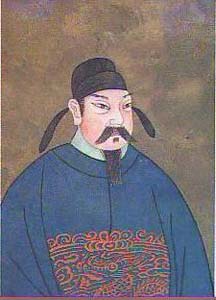
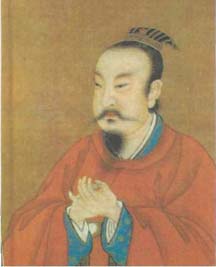
Emperor Te-tsung (Dezong)

Jealousies among the suppressors of the civil war created a new uprising that caused the emperor to flee in terror. Te-tsung, an amiable but weak monarch, in his last acts, showed he had thoughts of ruling well and wisely. Throughout his reign, he had made nothing for himself by his reforms, and when he died, his property consisted of nothing but a few books.


Supplement 2:
The New Patriarchate of Baghdad

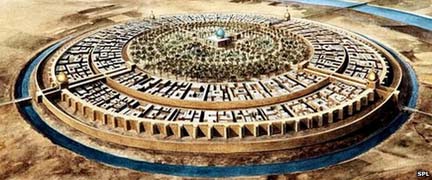
Abbasid Baghdad was a walled, fortified city, set among an extensive network of canals. Artwork: spl

In the time of the patriarch Hanan-Ishu, who preceded Timothy I, the patriarchate had been transferred fifteen miles upriver from Seleucia and Ctesiphon, a metropolis then falling into decay, to Baghdad, the flourishing new capital of the Muslim Commanders of the Faithful.

In 747, Abu’l Abbas as-Saffrah, an uncle of Muhammad, had opened the Abbasid dynasty when he raised the black standard of revolt in eastern Persia and two years later pronounced the traditional homily in the mosque at Kufa to become caliph. It is said that he, though an Arab, revived Persian customs and planted the post of vizier (first minister) in a Persian family descended from a high priest of the Buddhist monastery No Bahar near Balkh.

In 775, after the Abbasid caliphs had discarded the old Sassanid metropolis of Seleucia-Ctesiphon and built their own new capital, Patriarch Hanan-Ishu II (774–779?) considered it expedient to move the patriarchate to that city while still reserving the old patriarchal title of Seleucia-Ctesiphon.


Supplement 3:
The New Church Community

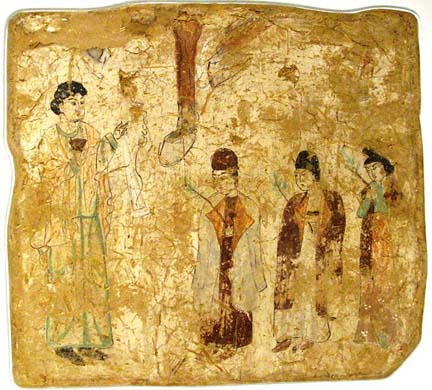
Nestorian priests in procession Detail of 7th- or 8th-century wall painting from the caves of Bezelik

Members of the community were accepted for their wealth and power and praised for their business ability. They were accounted the great teachers of Baghdad, the masters of languages; their physicians found their way to the palaces of the caliphs through efficient and honest medical service; individuals among them gained position, wealth, and fame. At the peak of their church’s history, they were tempted even to claim full rights of equality with their Muslim fellow-citizens.

Although in times of religious toleration the Church flourished, religion, and nationality had always been closely allied. The old pre-Islamic conviction that to be Persian one must be Zoroastrian now came to be replaced by the notion that to be Persian one must be Muslim. The restless energy of the monks, who were prone to wander, directed itself out of the cramping confines of the caliphate into those regions of the East where they felt free and were gladly received.


Supplement 4:
Mar Timothy I and the Caliph of Baghdad

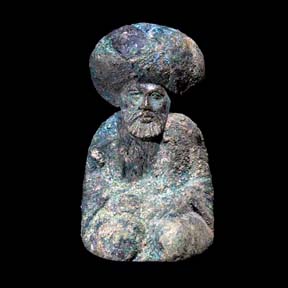
Caliph Harun al-Rashid 8th- or 9th-century Bronze chess piece from Central Asia

By 781 Mar Timothy I, the patriarch of the Church of the East, had become a favored friend of the caliph of Baghdad, Harun al-Rashid, the monarch made fabulous in the Arabian tales of the Thousand Nights and a Night.


Supplement 5:
The Clever Succession of Timothy I

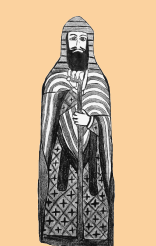
Timothy I of Baghdad Unknown artist

It is reported that Hanan-Ishu died in October or November of 778, 779, or 780, and that Timothy was installed as patriarch eight months later.

At his election, Timothy laid at the disposal of his electors heavy sacks to be opened after his success—presumably full of money; when he succeeded to the patriarchate and his supporters opened the sacks, they found them full of stones. When their understandable displeasure reached his ears, Timothy defended himself by retorting: “The priesthood is not to be purchased for money.” The cleverness and perspicacity of Timothy’s ruse, no doubt designed to humiliate the gross expectation of his perverted electors, has since been interpreted as mere trickery and fraud.

The Book of Governors, a monastic history of the Oriental Church written in 840 by a member of the once-renowned but by then already decaying monastery of Beth Abhe, is one of the earliest documents to suggest that Timothy’s possession of the patriarchate was fraudulent. The author says: “And when Timothy saw the face of every man fixed upon our Mar Isho-yabh, he advised him secretly when they were alone together and said to him, ‘Thou art an old man, and thou art not able to stand up and meet the attacks of the envious, Ephraim of Elam, Joseph the son of Mari, and other opponents; but do thou excuse thyself, and become one of the supporters, and I will make thee Metropolitan of Adiabene’; and to speak briefly, Timothy was appointed catholicos and patriarch, and was proclaimed among the heads of the fathers” (vol. II, p. 383). After a few days, because Mar Maran-’ammeh, metropolitan of Arbela, had died, Timothy appointed and proclaimed Mar Isho-yabh to be bishop of the Church of Adiabene and metropolitan of all his countries.

A fuller account of Timothy’s succession, which further suggests that Timothy made fraudulent bribes, is given by Bar-Hebraeus in his ecclesiastical chronicles. (The account is reproduced in a footnote in the English version of the Book of Governors.) Bar-Hebraeus mentions that Isho bar-Non, Timothy’s own successor, maintained a controversy with him during Timothy’s time in office and played on his name (Timotheos), calling him “Talematheos” or “God-reviler.”

Dr. William Wright, following the line of thought laid out in the Book of Governors, explains in his “A Short History of Syriac Literature” that Timothy got himself appointed catholicos through trickery and against much opposition about eight months after the death of Hanan-Ishu II when a formidable opponent elected by a separate Baghdad synod died suddenly. Even after Mar Timothy’s succession, Wright says, opposition continued; other synods in Baghdad and in cities further east attempted at least twice to excommunicate Timothy.

Only the modern historian Robin Waterfield exonerates Catholicos Timothy, however slightly. He tells us: “Patriarch Timothy can be said to typify a Persian Church leader of his time. He was extremely worldly and not above giving or taking a bribe. Although he showed small signs of spirituality, he was zealous for the well-being and good name of the Church, which he administered very efficiently.”


Supplement 6:
The Outreach of Timothy I

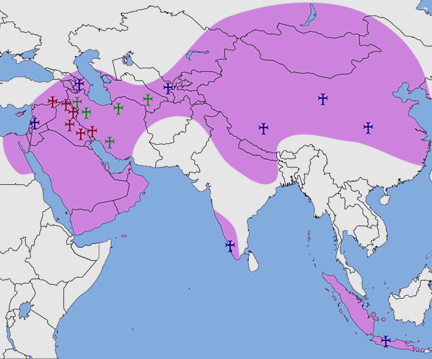
Map of Church of the East metropolitan provinces during the middle ages: red cross indicates Mesopotamia, green cross indicates Persia, blue cross indicates later espansions, violet cross indicates area of missionary activities. Artist: Rafy

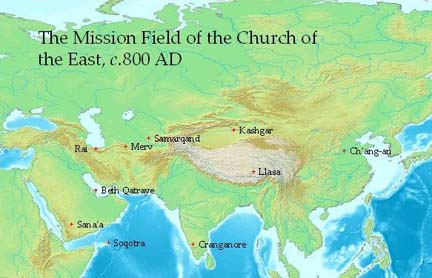
This great outreach was made under Catholicos Timothy I by monks from the monastery at Beth Abhe. In 781, about the same time that the principality of Kashkar became Christian, Timothy wrote that “another Turkish ruler” had become Christian, and he mentions both the consecration of a bishop for Tibet and missionary journeys to India and China.


Supplement 7:
A Note on the Corruption of the Church of the East

Church of the East Exterior Provinces Artist D.J. Wilms

As early as the latter part of the eighth century, there were reports of corruption in church matters; later, in the end, the elements of decay set in with disastrous consequences.


Steamboat Healing Center Welcomes Back Michael Limacher

Michael Limacher (artist unknown)

October 2012: For a very limited time energy/huna healer Michael Limacher will be available for sessions at Steamboat Hot Springs Healing Center.

Michael has studied with many renowned masters and has over thirty years experience in energy healing. His reputation for facilitating spontaneous healing is renowned around the world. His energy work is powerful and result oriented.

Michael has been a regular guest therapist/healer and instructor at Steamboat for over ten years; however, we are limited to only two visits per year so don’t miss this rare and wonderful opportunity.

To learn more about Michael, visit his web site www.threecircle.org.


2012 Interfaith Thanksgiving Eve Service Announced

PHOTO: Roger Weld

THE TWENTY-SEVENTH ANNUAL

INTERFAITH THANKSGIVING EVE SERVICE

“COUNT YOUR BLESSINGS”

 WEDNESDAY NOVEMBER 21, 2012, at 7:00 p.m. 

   A WORSHIP SERVICE OF PRAYERS, READINGS

AND MUSIC FROM A VARIETY OF

FAITH TRADITIONS


 SPONSORED BY

THE NEVADA CLERGY ASSOCIATION

THIS YEAR’S EVENT GRACIOUSLY HOSTED BY

CATHEDRAL OF SAINT THOMAS AQUINAS 

DOWNTOWN RENO AT ARLINGTON AVE & 2ND ST.


MONETARY DONATIONS WILL BE GIVEN TO FAMILY

PROMISE AND FOOD DONATIONS WILL GO TO

THE FOOD BANK OF NORTHERN NEVADA


FOR INFORMATION CALL 775-786-7827

OR E-MAIL gsavoyjr@communityofchrist.org


Services for November 10, 2012


Saturday, November 10, 2012
10:00 AM COMMUNION
Chapel of Holy Child

RR Gene Savoy, Jr
Lector: RM Carol Ann Crabb
Cantor: Rev. Herman Aggenbach
Reader: Rev. Robert Roy
Organist: RC Gary Buchananan


Sunday, November 4, 2012
6:331 AM NEW DIVINE SERVICE*
Church of New Epiphany
Leave: 5:45
Gate: 6:20
Sunrise: 6:48
RR Gene Savoy, Jr
Concelebrant: RR Sean Savoy
Assistants:
RC Roger Weld
Rev. Ted Staver
RM Carol Ann Crabb
Organist: RC Gary Buchanan

OPEN-AIR COMMUNION
Church of New Ephesus                    RC Elizabeth Reece
Church of New Philadelphia                    RC Robert Petrovich
Church of New Smyrna                     Rev. Barbara Whitney


Wednesday, November 14, 2012
 12 N COMMUNION
Chapel of the Holy Child
RM Carol Ann Crabb


Friday, November 16, 2012
9:00 AM PRAYER & FELLOWSHIP
Chapel of the Roses
RC Gary Buchanan


Services for November 3, 2012


Saturday, November 3, 2012
10:00 AM COMMUNION
Chapel of Holy Child

RR Gene Savoy, Jr
Lector: RC Robert Petrovich
Cantor: Rev. Nola Slevin
Reader: Rev. Jim Elliott
Organist: RC Gary Buchananan


Sunday, November 4, 2012
6:21 AM NEW DIVINE SERVICE*
Church of New Epiphany
Leave: 5:30
Gate: 6:15
Sunrise: 6:36
RR Gene Savoy, Jr
Concelebrant: RR Sean Savoy
Assistants:
RC Roger Weld
RC Robert Petrovich
Rev. Barbara Whitney
Organist: RC Gary Buchanan
(Daylight Savings Time ends)

OPEN-AIR COMMUNION
Church of New Mount Tabor                    Rev. Larry Coesens
Church of New Mount Carmel                    Dr. Thomas Lee
Church of New Hebron                     Dea. Stephan Fuelling


Wednesday, November 7, 2012
 12 N COMMUNION
Chapel of the Holy Child
RC Gary Buchanan


Friday, November 9, 2012
9:00 AM PRAYER & FELLOWSHIP
Chapel of the Roses
RC Robert Petrovich


August 1 Confirmation of Divine Law


PHOTO: Stephan Fuelling

August 1 Confirmation of Divine Law
Monday August 1, 2012, was the 30th anniversary of the Appearance of the New Light of God in Sanctuary, confirming the Active Principles of Divine Law. Communion of Fellowship and Sunrise Divine Service were held at the Cathedral Church of the Americas to commemorate this observance.

God’s Confirmation of the Active Principles of Divine Law occurred on August 1, 1982. That event is recorded in Second Advent Scripture in The Book of God’s Revelation with commentary relating the event to the revelation received by the Church on April 18, Easter in the Second Advent Calendar, and the further revelations received on June 6, the Second Advent Day of Pentecost.

Among the revelations received on June 6, 1982, the Church received instruction on the New Act of God, God’s conception of the Newly Created Light, a New Light that renovates the whole of creation. The Church also received instruction on the Four Newly Created Intermediary Lights that manifest through this conception.

Scripture tells us that through the manifestation of these Four Intermediary Lights, God has fixed the Four Newly Created Tables of the Law to be taught to the Ordained in the Holy Institutions of Learning, and so that the unwritten Code of the Law may be codified on earth for the emancipation of the human race, God has decreed Twelve newly created Active Principles of Divine Law of His New Covenant, which are subordinate to the Lights of God and to the Tables of the Law, yet are instruments of the Divine Plan for human redemption.

With the revelation given on June 6, God decreed these Twelve Active Principles to be in force upon confirmation. And on the first day of August 1982, “The New Light of God appeared over the face of the sun, confirming the Active Principles of Divine Law.” Celebrating and recalling that event of confirmation is the purpose of the special commemoration each year on this date.

Pannuches Meal Rite
The Seventy-Second Pannuches Meal Rite was held August 11, 2012, at 6:00 p.m. in the Chapel of the Holy Child. This is a private ceremony for members of the Order. The Jubilee Sunrise Service was held the following morning in Sanctuary. The Jubilee Sunday is a day of fasting. The elderly are exempt from fasting on that day if they choose.

The Seventy-Third Pannuches Meal Rite was held Saturday September 29, 2012, at 6:00 p.m. in the Chapel of the Holy Child. This is a private ceremony for members of the Order. Since this celebration coincided with the annual Convocation, the entire congregation was invited to attend a light repast at the Rectory-Abbey on that evening at 7:30 p.m.

The Jubilee Sunrise was held the following morning in Sanctuary at the Cathedral Church of the Americas. Ordained resident and nonresident congregation members were vested. Vocal performances were provided by the Japanese congregation present, singing a liturgical hymn; Ms. Roya Galata, singing a Persian Baha’i hymn; and Jim Eaglesmith, performing a Zuni sunrise song. A breakfast was served at the Refectory following Divine Service. The Jubilee Service on September 30 was held as part of the 2012 Convocation, with special members of the Northern Nevada interfaith group as participants.


Mar Iazed-buzid, the Great Donor: Part 4D


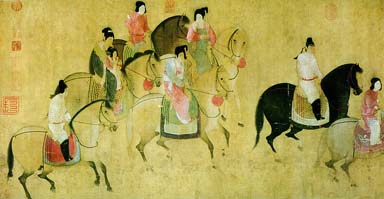
Pleasures of the Tang Court by Zhang Xuan

If we were to approach the life of I-ssu in a more subjunctive mood, is it possible to imagine that his life did not develop a pattern resonant with the court circles that fashioned it, a life like the life of all nobles, charmed with the symmetry of the solar year? Would we not have seen him among the throng, fashionably celebrating new weather on the day of Spring Festival, in the clear brightness after the equinox, when everyone went out walking in their best clothes and picnicked in the open air on some bend of the Crooked River in Chang-an Park, where many of gracious demeanor, men and women, with fine-grained skin and well-proportioned bones and flesh, gathered dazzling at the water’s edge, their garments of embroidered silk gauze reflecting light in the sunset month of spring? When the grain rain fell and evening colored the sweet-scented season of the year, would he not have stood on the river belvedere and looked out on the forest flowers, wet with rain that added to their rouge, and on the golden lotuses, stretching their kingfisher girdles, lengthened by the wind? In summer’s beginning, would he not have walked along the bends of the Serpentine Lake, past jostling scenes of lighthearted extravagance and lovely ladies whose lyres lay in brocade covers at their sides? On Tuan Wu Day, in the increasing heat of summer, when the emperor presented him with a cool grass cloth robe fashioned by palace women and monogrammed by the emperor’s own hand, would he not have celebrated such an afternoon in a pavilion at the river head, sitting with friends and drinking cool wine, far above the Hibiscus Pleasure Grounds that adjoined Prosperous Felicity Palace? In autumn, would he not hunt with crossbow through empty suburbs, or with falcons through vast and grassy parks, rumbling and clattering in a fashionable cushioned carriage, and then come home to a banquet of boiled lamb? And when heat stopped and the equinox turned the dew white with cold, might he not have stopped once upon the city ramparts to watch the setting sun gather on the thick walls around him and seen the ramparts within ramparts catch between them the evening fog? Then, after the frost’s descent became winter’s beginning, after slight snows and the solstice cold, when New Year’s Eve let no one sleep, and candles shone bright in all the pavilions, why would I-ssu have allowed some shadow of trouble to darken the festivities then universal?


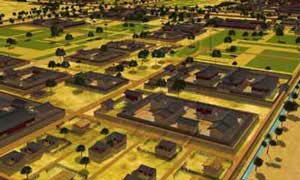
Every primary block of the city of Chang-an was enclosed by walls. Each of the small cities enclosed in these walls held small temples, workshops, and retail establishments. Inside each of these small cities, every residential and official building was also divided by walls. The design imitated the natural system, in which smaller worlds form larger worlds.

In this city, where firewood and food were more dear than pearls and gemstones, I-ssu grew older in public office, serving emperors in a decaying empire. During the time of intrigues at court, the border battles with Khitan rebels in the east, and later, the battles with Tibetans in the west, he waited to retire to monastic life, (See Supplement 8 ) many years before the reign of Te-tsung. (See Supplement 9) In this restless space of time, I-ssu’s life held two moments of rejoicing: the first, his marriage, solemnized by the cup, the ring, the cross, and the coronation in colors; the second, the birth of his son. If, on this occasion, I-ssu had already been ordained, the hands of the priest who washed his son at birth, and the prayers that blessed the water, were his own; and again, on the day of the nearest great feast, he would have baptized his son once more, this time elaborately, with the threefold immersion and, with the child facing east, a total anointing with holy oil.

I-ssu did not fight beside the Duke Kuo Tzu-i at his pale victory in Loyang, when it seemed the rebel forces would gain mastery; (See Supplement 10) nor was he present at the final scene of the rebels’ demoralization. I-ssu did not fight when the Tibetans rose up to take the capital and the emperor fled to Honan; nor did he accompany Kuo Tzu-i on his campaign in 764, when the general emerged from semiretirement to recover Chang-an from the Tibetans after the hui ho joined in the rebellion; (See Supplement 11) nor when the Tibetans retreated and the hui ho left the country; nor later, when the Tibetans resumed their attacks nearly every autumn, and state bureaucracy grew like the trunk of a palm tree.

When I-ssu retired from government service, he received two imperial gifts. The gold-embroidered carpet, according to precedents recorded in official annals, was an award which the empire reserved to military officers upon their retirement from imperial work, somewhat as in our time the United States government rewards the golden years of service of its retiring officers with the Meritorious Service Award or Legion of Merit. The white pearl (po-li) (See Supplement 12) was a ritual gift. (The symbolism of both the crystal and the carpet might have come from Central Asia.) According to the Chinese Book of Rites, the primary authority on ceremonial observances for centuries, an imperial gift conferred symbolic approval or encouragement to action: When bow and arrows were conferred on a prince, he could proceed to execute the royal justice. When the hatchet and battle-axe were conferred, he could proceed to inflict death. When the libation cup was conferred, he could make spirits for himself; when this cup was not conferred, he had to depend for these spirits as a gift from the Son of Heaven (Li Chi, Royal Regulations 2:19) Thus, it seems that, with the crystal that I-ssu received from the emperor, he received also the emperor’s consent to pursue the active principle of virtue.


< PART 5A: IN THE LIGHT OF THE SETTING SUN >


SUPPLEMENTS


Supplement 8:
Administrative Chastity

The Chinese describe inviolate administrative honor as the “great chastity.” It is characteristic of the Tang administrative system that a man who disagreed with some matter of policy that he considered vital would voluntarily retire, often becoming a hermit. Scholars who felt that administrative conditions were such that they could not participate in government and yet preserve their honor would retire and say, “I will not allow my white coat to be splashed with black.” It is possible that I-ssu left government service under such a condition.


Supplement 9:
Te-tsung

Emperor Te-tsung (Dezong)

Te-tsung is the emperor who sat on the Dragon Throne at the time the Monument was raised.


Supplement 10:
The Illness and Death of Su-tsung

Emperor Tai-tsung (Daizong)

Within two years after recalling General Kuo Tzu-i, Emperor Su-tsung fell ill. The emperor’s son, Li Yu, was appointed heir apparent, and the intrepid, jealous, tenacious Lady Chang was appointed empress. To carry out her duties, Lady Chang used the chief eunuch, Li Fu-ku, who overly influenced the ailing emperor. For those two years, the war continued without the guidance of Kuo Tzu-i, until the new emperor, Tai-tsung, returned the duke to his northern command.

Su-tsung died in May, within a fortnight of the death of his father, Hsuan-tsung. Both died tragically: Hsuan-tsung in the virtual imprisonment imposed on him by the Goneril-like behavior of his son; Su-tsung, abandoned on his sickbed while a war to the death was being waged between his hateful empress and his still more hateful chief eunuch, Li Fu-kuo. When the powerful Li Fu-kuo tried to rule over the new emperor, Tai-tsung, as he had over Tai-tsung’s father, Tai-tsung sent a body of soldiers suddenly to his residence to put him to death.


Supplement 11:
The Leader Kuo Tzu-i

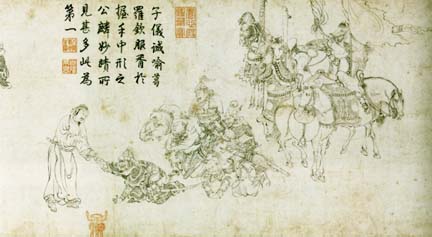
Kuo Tzu-I receiving homage of Uighurs Detail of Song Dynasty painting

The story is told that the Uighur tribes, on the verge of revolt, were pacified when they saw Duke Kuo Tzu-i approach on horseback; they all smiled and lay down heir arms at his feet and went over to him again.


Supplement 12:
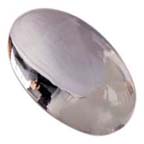
White Pearl

Sample sphatik Shiva lingam

“Crystal,” or as Professor Saeki suggests, “white pearl” or “water crystal,” from the Chinese transcription of the Sanskrit word sphatika.


Earliest Known Human Ancestors Came from Asia

PHOTO: www.discovery.com

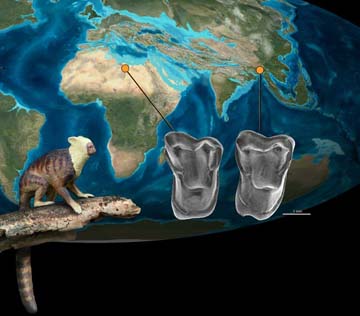
A new fossil found in Myanmar (Burma) may be the earliest ancestor of humans, apes, and monkeys.

Read the article “Earliest Known Human Relatives Came from Asia” online at discovery.com.


Link provided by Frieda Nelson