Services for November 24, 2012


Saturday, November 24, 2012
10:00 AM COMMUNION
Chapel of Holy Child

RR Gene Savoy, Jr
Lector: RC Rebecca Willis
Cantor: Dea. Robert Anderson
Reader: Rev. Michael Spohn
Organist: RC Gary Buchananan


Sunday, November 25, 2012
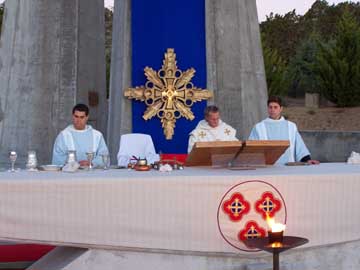
6:48AM NEW DIVINE SERVICE
Church of New Epiphany
Leave: 6:00
Gate: 6:35
Sunrise: 7:03
RR Gene Savoy, Jr
Concelebrant: RR Sean Savoy
Assistants:
RC Roger Weld
Rev. Ted Staver
RM Carol Ann Crabb
Organist: RC Gary Buchanan

OPEN-AIR COMMUNION
Church of the Races of Man                    RR Sean Savoy
Church of the Christian Churches                    RC Robert Petrovich
Church of the Ameriucas                     Dea. Shane Grady


Wednesday, November 28, 2012
 12 N COMMUNION
Chapel of the Holy Child
RC Rebecca Willis


Friday, November 30, 2012
9:00 AM PRAYER & FELLOWSHIP
Chapel of the Roses
Rev. Michael Tamburello


Mar Iazed-buzid, the Great Donor: Part 6


REFERENCES

Florence Ayscough. Tu Fu: The Autobiography of a Chinese Poet. Vol. 1: A.D. 712–759. Boston & New York: Houghton Mifflin, 1928.

Li Ung Bing. Outlines of Chinese History. Shanghai: Commercial Press,, 1914.

C. E. Couling. The Luminous Religion. London: Carey Press,, 1925.

Samuel Couling. The Encyclopaedia Sinica. London: Oxford University Press, 1917.

J. D. Frodsham, trans. The Poems of Li Ho. Oxford: Clarendon Press, 1970.

David Hinton, trans. The Selected Poems of Tu Fu. New York: New Directions Books, 1989.

Frits V. Holm. My Nestorian Adventure in China: A Popular Account of the Holm-Nestorian Expedition to Sian-Fu and Its Results. New York: Fleming H. Revell, 1923.

Frits V. Holm. The Nestorian Monument: An Ancient Record of Christianity in China. Chicago: Open Court, 1909.

Charles O. Hucker. China’s Imperial Past: An Introduction to Chinese History and Culture. Stanford, CA: Stanford University Press, 1975.

Charles O. Hucker. A Dictionary of Official Titles in Imperial China. Stanford, CA: Stanford University Press, 1985.

James Legge, trans. Li Chi: Book of Rites. New York: University Books, 1967.

Howard S. Levy, trans. Biography of An Lu-shan. Chinese Dynastic Histories Translations. Berkeley: University of California Press, 1960.

A. C. Moule. Christians in China Before the Year 1550. New York: Octagon Books, 1977.

Edwin G. Pulleyblank. The Background of the Rebellion of An Lushan. Vol. 4 of the London Oriental Series. London: Oxford University Press, 1955.

P. Y. Saeki. Catalogue of the Nestorian Literature and Relics. Tokyo: Maruzen, 1950.

P. Y. Saeki. The Nestorian Documents and Relics of China. Academy of Oriental Culture, Tokyo Institute. Tokyo: Maruzen, 1951.

P. Y. Saeki. The Nestorian Monument in China. London: Society for Promoting Christian Knowledge, 1916.

Denis Twitchett, ed. The Cambridge History of China. Vol. 3: Sui and Tang China, 589–906, Cambridge: Cambridge University Press, 1979.

Robin E. Waterfield. Christians in Persia: Assyrians, Armenians, Roman Catholics and Protestants. London: George Allen & Unwin, 1973.


Joseph Roy Birth Announced


The Reverend Robert and Noriko Roy proudly announce the birth of their son, Joseph Asahi Roy, born in their home November 3, 2012, at 9:12 AM PDT. He weighed 7 lbs 4 ounces.

Rev. Roy said of the experience of aiding in the birth of his new son, “A most blessed experience, which increases your respect for women and the Gift of Life that they have been given.”


Services for November 17, 2012


Saturday, November 17, 2012
10:00 AM COMMUNION
Chapel of Holy Child

RR Gene Savoy, Jr
Lector: RC Gary Buchanan
Cantor: Rev. Bruce Kanzelmeyer
Reader: Rev. Karen Elliott
Organist: RC Gary Buchananan


Sunday, November 18, 2012
6:40 AM NEW DIVINE SERVICE*
Church of New Epiphany
Leave: 5:45
Gate: 6:25
Sunrise: 6:55
RR Gene Savoy, Jr
Concelebrant: RR Sean Savoy
Assistants:
RC Roger Weld
RC Robert Petrovich
Rev. Barbara Whitney
Organist: RC Gary Buchanan

OPEN-AIR COMMUNION
Church of the Christian Churches                    RC Roger Weld
Church of the End Times                    Rev. Vickie Hewlett
Church of the New Covenant                     Rev. Herman Aggenbach


Wednesday, November 21, 2012
 12 N COMMUNION
Chapel of the Holy Child
RC Robert Petrovich


Friday, November 23, 2012
9:00 AM PRAYER & FELLOWSHIP
Chapel of the Roses
Rev. Amanda Buchanan


Mar Iazed-buzid, the Great Donor: Part 5E


 *

Emperor Wu-tsung (Wuzong)


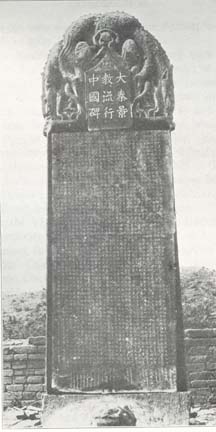
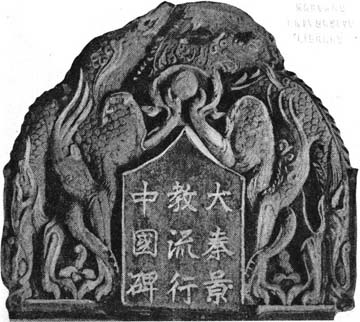
Two dynastic generations after the Monument was raised, a period of time shorter than a single lifetime, the monasteries suffered the humiliation of mortal dissolution, as had the benefactor Mar Iazed-buzid before them. (See Supplement 32) In 845, the monastery buildings were confiscated by imperial decree; the monks were returned to secular life so they might pay taxes; and the Stone was buried in the earth, where it remained for nearly 800 years. (See Supplement 33)

Mar Iazed-buzid, who had striven to restore the visible Church with riches and good works, was perhaps no more presumptuous than I, who have striven to recollect his life from a single short account and a modest audit of history.

____________
____          ____
____________
____          ____
____          ____
____________


Robert Petrovich, 1989


< PART 6: REFERENCES >


SUPPLEMENTS

Supplement 32:
The Ebbing Dynasty of Tang

Emperor Wu-tsung (Wuzong)

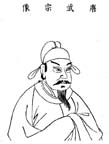
Under Emperor Wu-tsung (reigned 840–847) the dynasty had gone through a period of crisis. After the Uighur Empire fell and internal strife in Tibet destroyed all semblance of central power there, Chinese authority once again spread into the territories of the Northwest. While these foreign affairs were still in the balance, Emperor Wu-tsung faced another internal rebellion, this time in southern Shensi. Now the culminating wave of financial crisis, which had been building during the reign that preceded his, broke. Like Te-tsung and Hsien-tsung before him, Wu-tsung was a deeply committed Taoist, and he decided to solve his problems by suppressing the Buddhist monasteries and sequestering their wealth on a vast scale. (Tai-tsung, the second emperor of Tang, put himself in power in similar fashion before Rabban A-lo-pen’s arrival in 635.) Other foreign religions suffered the same fate. Although Wu-tsung’s successor, Hsuan-tsung, (reigned 874–859) swiftly rescinded these measures – their impact had been profound both on Buddhism and on Chinese society, which had become completely permeated with Buddhist (foreign) influence – it was too late. The power of the dynasty itself was slowly ebbing. The Tang dynasty lingered on for thirty more years, then ended.


Supplement 33:
A Note on the Burial of the Monument

Luminous Teaching Stone of China

During the so-called Ta-chin Rebellion (783–784), it was said that one of the leaders of the rebellion, Chiao Lin, hid in a “saint-visited monastery.” This was perhaps the monastery at Wu-chun. In 784, after the emperor had beheaded the chiefs of the rebellion, he could have ridden back to Chang-an past this same monastery. If the Monument had been erected here, the emperor might have ordered it buried or else the monks might have buried the Stone themselves in order to protect it. The words “Ta-chin” were inscribed on it in large characters. If the Stone was not buried in one of these ways in 784, it was certainly buried in 845 after the imperial edict was decreed.


Mitch Battros on “The Climate Conspiracy (2012)”

“Is it possible that galactic and solar events are exerting an impact on earth’s climate far more than any human activities? And is it possible that these celestial events are affecting us in many more ways than just the climate? Finally, is it possible that ancient cultures, such as the Mayans, anticipated these changes?

“In a far-ranging conversation that travels to the center of our galaxy and back, scientific journalist and psychologist Mitch Battros describes the connection between what happens on the sun and what happens on the earth. He speaks about the impact of solar radiation on the earth – not just climate, but earth’s magnetic field, and, in turn, all life on earth. And he talks about an alignment of our solar system in the galaxy, and a beam of galactic particles that may bring significant change.”

Gaiam TV presents an interview with Mitch Battros and host Lisa Garr. Runtime is 1:24:41.

Watch the video online at Gaiam TV.


Link submitted by Frieda Nelson


Mar Iazed-buzid, the Great Donor: Part 5D


Luminous Teaching Stone of China


In 781 the beneficent Mar Iazed-buzid raised a Monument to commemorate the mission of the Luminous Religion in China, as well as his own part in its restoration. (See Supplement 24) The task of forming the characters of the Inscription and etching them into stone was granted to the young calligrapher Lu Yen. (See Supplement 25) The young Chinese calligrapher, who held a prestigious title but no office, and was quite likely unemployed at the time (he had been engaged formerly as a personnel manager of requisitioned labor on the east coast), yielded to his humble, careful task: to inscribe the characters of his native language onto stone that was paid for by a Turkic benefactor in order to formulate a tract composed by a Persian father. He thereby created a document that would become, a millennium later, the single most valuable testament to the existence of the Luminous Religion in China.

On February 4, 781, (See Supplement 26) a Sunday during the patriarchate of the Great Catholicos Mar Timothy I (See Supplement 27)—five days after New Year in the second year of the Chien-chung period under Emperor Te-tsung and the last day of the Great Cold before Spring’s beginning—the sacristan of the monastery, at the order of the abbot, summoned the congregation out of doors for the raising of the stone. (See Supplement 28) When the boards cracked the icy winter air, human chatter stilled, and churchmen from the monasteries of the four quarters took their places in ceremonial array. The distinguished abbot Ye-li led the elders: the country-bishops Mar Iazed-buzid, from the region northwest of Chang-an, Mar Sergius, from southwest of the capital, Mar Gabriel, head of the church of the two capitals, and the Persian father Ching-ching, who had written the long preface and mediocre verses that commemorate the diffusion of the Luminous Religion in the Middle Kingdom. (See Supplement 29) These and other gray presbyters were followed by the priests Ling-pao, Hsing-tung, and Sabran-Yeshu, who had aided in the raising of the Monument, and by the youths the deacon Adam, Mar Iazed-buzid’s son, and the calligrapher Lu Yen. Perhaps among them also were the seventy other missioners whose names were carved in the Stone: bishops in white turbans holding pastoral staves; priests in black turbans and cassocks; monks in tunics girded in leather and adorned only with a cross, their tonsured crowns covered with black turbans and in their hands the staves of the ascetic. (See Supplement 30)

When we read between the lines of the Syriac that commemorate Mar Iazed-buzid, we come to recognize I-ssu, and the story of the Asian mission that is written in the Inscription is brought to completion for us. We see the distinguished presbyter Mar Iazed-buzid, kind and gracious, provisioning the orphans and the poor at the monastery for fifty days, just as he had provisioned imperial guests daily at the imperial table of the palace as the young and wealthy I-ssu. Each year he laid that table ready at all times with good, substantial food, as much for the stranger who came there as for the brothers who were appointed; the sick were given holy water to drink, and disciples were healed according to monastic custom – by touch and word, without medicines or drugs.

As the courtier I-ssu, Mar Iazed-buzid had been a man of great power and influence in civil and military affairs; (See Supplement 31) here at the monastery, among the white-robed scholars of the Luminous Religion, he wore the purple clerical robe. Mar Iazed-buzid had secured his fate in this transitory and conditional life by cultivating himself and awaiting his allotted time. Now he walked through the doors of the lovely pavilion to keep an appointment within the walled enclosure when the boards were struck at the hour of repast. The meals came from the kitchen cooked and served by the brothers; the wine stores in the pantry were emptied from their skins for the banquet table. Here there were no civil robes, no pendant badges of rank. Only rows of monks and churchmen, assembled silently at long tables on each side of the hall, before their simple meal of bread and vegetables. Novitiate brothers sat and ate together with their prestigious guests and with the ascetics, who had come from their separate cells away in the hills to the commons on this feast day. The abbot, too, sat with them in the assembly on this day. The hearts of the guests were purified. All annoyance was stilled. When the sacristan rose up to beat the board for evening office, black night had already enclosed the courtyard.


< PART 5E: IN THE LIGHT OF THE SETTING SUN >


SUPPLEMENTS

Supplement 24:
The Original Location of the Monument Stone

There are two possibilities for the original location of the Monument Stone:

Position of the monument before its removal in 1907

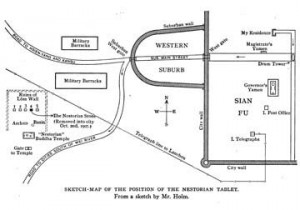
(1) the monastery at I-ning Ward where it stood for 500 years until the Danish explorer Frits Holm found it in 1907. (According to Dr. Kuwabara’s report from the 1930s, which is reprinted in Saeki’s book, the Buddhist monastery where the monument stood from 1625 to 1907 corresponds exactly to the old site of I-ning Ward of Chang-an; that is to say, the Buddhist monastery that Frits Holm visited in 1907 was the site of the 638 Ta-chin monastery at I-ning Ward.)


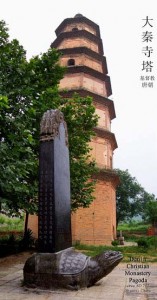
Postcard of Ta-chin (Daqin) Tower and replica of the monument stele

(2) at Wu-chun, the Ta-chin monastery on the slope of South Mountain in Chou-chih, where it is believed that I-ssu retired (The location of Wu-chun is not far from the spot where the Stone was unearthed in 1625 at one of the seven post towns that existed then between Chang-an and Chou-chih).


Supplement 25:
The Calligrapher Lu Yen

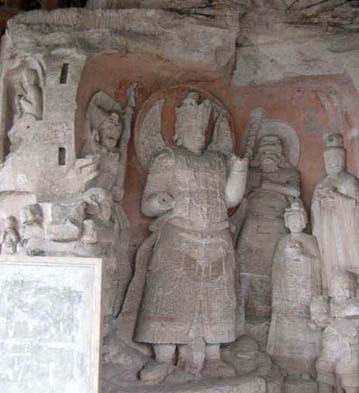
Sculpture of Lu Yen (755-805 CE) as the immortal Lu Dong Bin. By 892 CE his visage was carved into the Caves of Baishan, located in the Dazu region south of Chang-an (presentday Xian). The influence of the Persian Church of the East figures in the angel wings rising from his back and the solar cross on his chest. PHOTO Dale A. Johnson

Although Lu Yen’s beautiful writing, even in the abnormal form of some of its characters, had been quoted as a model of good form in Chinese cursive style since the discovery of the Stone in 1625, the Chinese themselves record the name of Lu Hsiu-yen nowhere else among calligraphers. But if we accept the suggestion of more than one mystic sinologue, this same Lu Yen gained renown as a poet and calligrapher some years after the raising of the Monument and, as the Taoist founder of the Golden Elixir of Immortality Religion (Chin-tan-chiao), received, however partially, the knowledge that the Apostle Thomas is said to have transmitted seven centuries before to the enlightened schools of China.


Supplement 26:
The Founding Date of the Monument

Luminous Teaching Stone of China

February 4, 781, was the date according to the Old Style, or Julian, calendar. The Gregorian date was Sunday, February 8, 781.


Supplement 27:
The Discrepancy of Dating by Patriarchate

James Legge (1815-1897), Congregationalist missionary to China and first professor of Chinese at Oxford University.

The Syriac of the Inscription says: In the days of the Father of Fathers, Mar Hananishu, Catholicus, Patriarch. No two authorities agree on the date of Hanan-Ishu’s death, whether it was 778, 779, or 780. On the other hand, we are told by Dr. Wright and others that eight months elapsed between the death of Hanan-Ishu and the final election of his successor, Mar Timothy. If Hanan-Ishu died sometime in October or November of 780, the closest possible date to the date of the Inscription, the consecration of Mar Timothy could have been as late as May 781. The missionaries in China could not possibly have known of Hanan-Ishu’s death at the end of 780, when the stone was finished and waiting for the day of unveiling.

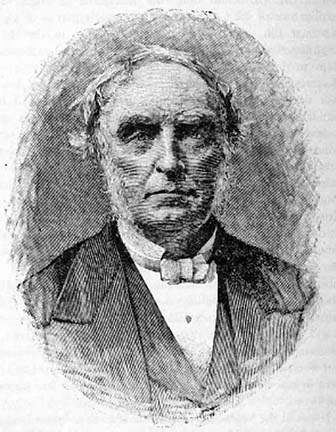
James Legge, the distinguished nineteenth-century professor of Chinese language and literature at the University of Oxford, explained this discrepancy in a footnote to his translation of the Inscription:

This is an important note of time, and occasions some little difficulty. We know from he Bibliotheca Orientalis Celementino Vaticana of J. S. Assemani that this Hanan-Yeshu’ was created Patriarch of the Nestorians at Baghdad in 774, and died in 778; whereas here is this monument erected in 781. But is not this discrepancy rather a proof of its genuineness? The news of the patriarch’s death had not reached them at Chang-an. In fact, according to Assemani (vol. iii I, 347), the canon for communication between the more distant metropolitan sees and the patriarchate required the interchange of messages only once in six years.

Mar Timothy I, whose name has already appeared in our narrative, was elected Patriarch after Hananishu, serving from sometime in 779 or 780 to sometime in 820.


Supplement 28:
The Passing of Ko Tzu-i

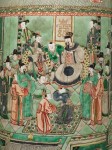
Birthday reception for Duke Kuo Tzu-i Qing Dynasty porcelain vase

In the same year as the unveiling, Ko Tzu-I (himself suspected by historians of being an adherent to the Luminous Religion) retired from office and passed away at the advanced age of 85, still clear-headed and respected. Though many tried to injure his character, none ever dared question his loyalty. His eight sons and seven sons-in-law all held high government offices, and, at the time of his death, three thousand of the family that had grown around him recognized him as their head.


Supplement 29:
The Imperial Office of Abbot Yeh-li

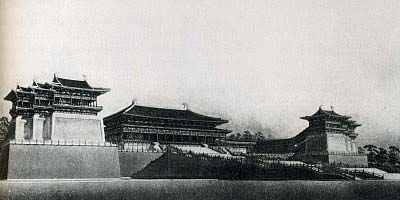
Hypothetical reconstruction of Hanyuan Hall at Daming Palace, where many state ceremonies were conducted.

The Chinese Inscription identifies Abbot Yeh-li as assistant supervisor of the erection of the tablet and “t’ai-ch’ang-ch’ing by examination, granted the purple clerical robe.” This secular title is the common official designation for the office of Chamberlain for Ceremonials. He, a chief minister or chamberlain (ch’ing), passed the government examination to be Minister of the Court of Imperial Sacrifices and was ranked 3a, as I-ssu had been. The agency for which he was ranked, and in which he may have served, was one of the Nine Courts in the central government, and the foremost in prestige. The unofficial title of his office literally evokes his image as standard bearer and the imperial decoration of the sun, the moon, and the dragon.

The court was generally responsible for the conduct of major state sacrificial ceremonies according to the regulations prescribed by the Ministry of Rites. Through its several subordinate agencies, the Court of Imperial Sacrifices was responsible for the rite of ritual slaughter, especially at the Imperial Ancestral Temple and the imperial mausoleums. Through its four minor agencies, all staffed by state slaves, the court maintained the ceremonial implements of imperial sacrifice: hu battle gear captured in battle, treasures of good omen for display, the emperor’s apparel, and all musical instruments, grains, and utensils.

All responsibility for the ritual and for the agents of imperial sacrifice – the provision of imperial fifes and drums and dancing, the provisions of living grains and animals to be sacrificed, the preparations for the imperial rites and their conduct at national altars and at the temples of the dynastic capital, all the forms of sacrificial divination (including the use of tortoise shells and the ancient divination text, the I-Ching) – were under the court. The court was also responsible for suggesting posthumous titles of emperors, such as those that appear in the preface and verses of the Inscription.


Supplement 30:
The Seventy

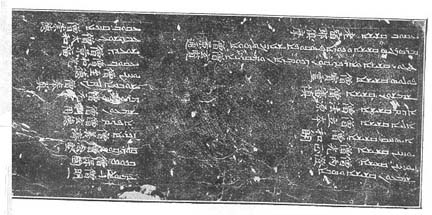
Seventy Syriac names in rows on the narrow sides of the stone with corresponding Chinese characters

Scholars till disagree on the significance of the catalogue of seventy names that cover the edge of the stone, but the East Syrian Bible, the Peshitta, records that Jesus appointed the same number.


Supplement 31:
A Note on the Imperial Office of Monastics

Tang officials Artist unknown

This is not unprecedented in Chinese history, especially during the Tang era; even among the monastic orders there were many instances of priests serving as soldiers or secular officials.


“Heaven Exists”

"'You have nothing to fear. There is nothing you can do wrong.' The message flooded me with a vast and crazy sensation of relief." PHOTO: by Newsweek; Source: Buena Vista Images-Getty Images

“Heaven exists though and it’s now kind of officially recognized by the mainstream media. . . Dr. Eben Alexander has taught at Harvard Medical School and has earned a strong reputation as a neurosurgeon. After a week in a coma during the fall of 2008, during which his neocortex [the conscious part of the brain] ceased to function, Alexander claims he experienced a life-changing visit to the afterlife, specifically heaven. So what exactly does heaven look like? Alexander says he first found himself floating above clouds before witnessing ‘transparent, shimmering beings arced across the sky, leaving long, streamer-like lines behind them.’

“‘You are loved and cherished, dearly, forever. You have nothing to fear. There is nothing you can do wrong,’ are the messages that Alexander heard from beings he encountered in the heavens. ‘There is no scientific explanation for the fact that while my body lay in coma, my mind—my conscious, inner self—was alive and well. While the neurons of my cortex were stunned to complete inactivity by the bacteria that had attacked them, my brain-free consciousness journeyed to another, larger dimension of the universe: a dimension I’d never dreamed existed and which the old, pre-coma me would have been more than happy to explain was a simple impossibility.’”

He’s from Harvard so it must be true—right?

Read the entire article online on Dr. Mark Sircus’ Blog.


Link and comment submitted by Robert Anderson


Mar Iazed-buzid, the Great Donor: Part 5C


Restoration by Robert MacGregor of the original silk painting of a missionary bishop of the Church of the East, discovered at Dunhuang in 1908 by Sir Aurel Stein in a cave sealed since 1036 CE.


When I-ssu put aside his cap of gauze and came to live under new vows, he bowed his head for Rabban to replace his official top knot with the tonsure of “wheel and crown.” Whether it was in middle life or in old age, (See Supplement 14) after the period of probation, he must have served for some time as head priest of a city or large town, with several priests as his assistants, before he became Mar Iazed-buzid and was elevated to the dignity of country bishop, first by election of his future parishioners and then by confirmation with the laying on of hands, and only later could he have received his staff of office to become chorepiscopos of Khumdan (Chang-an).

As chorepiscopos, Mar Iazed-buzid was second only to metropolitan bishops in the rank of church dignitaries. His province at the time of the raising of the Monument extended north of the capital to the city of Ling-wu, the same northwest district of yellow clay and dust where he had once commanded an army. Mar Iazed-buzid employed clerks, readers, and deacons (among them, no doubt, his son) in numbers proportionate to the size of the several parishes in his ecclesiastical pasture and according to his own needs as governor of his province. (See Supplement 15) At that time he, like Mar Sergius, mentioned in the Inscription, had functions identical to those of Mar Gabriel, the archpriest in the capital, and all three exercised episcopal functions in the absence of a regular bishop. Each day Mar Iazed-buzid conducted the morning service, then followed his daily routine of civil duties in bearded state and in the black cloak and turban of his predecessors. With the responsibilities of a regular bishop, his office as chorepiscopos was of extreme importance and delicacy: he had to deal directly with the uneducated and illiterate.

Over a period of more than seven centuries – first in Egypt and Syria, then in Mesopotamia and Persia – countless men before I-ssu had put aside their noble birth or station and laid in their wealth to take on the religious life of service. (See Supplement 16) Not unlike his predecessors, and even superseding them, I-ssu had distributed his riches over the entire region of the Western Capital. (See Supplement 17) The Inscription tells us that the mythic pheasant of five colors spread its wings (See Supplement 18) in flying eaves and roofs of colored tile when this generous patron of the Luminous School enlarged the worship halls and ornamented walls and galleries to restore the old monasteries with the noble adornments of their former condition. (See Supplement 19) In our own time the monasteries are all in ruins or simply erased from the face of the earth, but we may partially remember their images in the images of others preserved for us in ancient journals: the Pearl Tower built by men of Ta-chin in Szechuan province at its capital of Cheng-tu, where, a medieval passage tells us, the ten rooms of the gate tower all had blinds made of strings of pearl and blue jade; (See Supplement 20) the tiles of the temple at Wu-chun, “dazzling in the golden rays of evening”; (See Supplement 21) the splendor of I-ning monastery, whose buildings “shone forth like the light of the sun”; the vermillion tablets that hung high in the air above the monastery gates inscribed with Dragon-writing in kingfisher green; (See Supplement 22) the faithful portraits of the sacred emperors copied on the walls of the monastery at I-ning to “confer great blessing” and “illuminate the church.” (See Supplement 23)
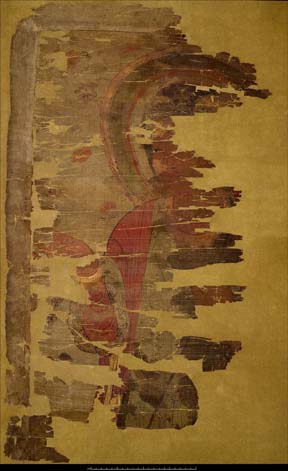
Original silk painting of a missionary bishop of the Church of the East, discovered at Dunhuang in 1908 by Sir Aurel Stein in a cave sealed since 1036 CE.


< PART 5D: IN THE LIGHT OF THE SETTING SUN >


SUPPLEMENTS

Supplement 14:
The Office of the Ascetic
Ascetics could be solitary brethren who lived in a monastery or else bishops and metropolitans.


Supplement 15:
The Religious Provinces
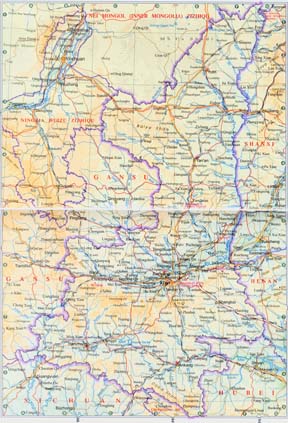
Map of modern province of Shensi (Shaanxi) outlined in purple.

What are called dioceses in the West were called provinces in the Church of the East.

To Professor Saeki it seems that if Mar Iazed-buzid were chorespiscopos of Khumdan (Chang-an), he must have been bishop of the northwestern portion of the modern Chinese province of Shensi. If we accept this determination of Professor Saeki, the size of Mar Iazed-buzid’s province was great.

Mar Sergius, listed among the seventy, must have been chorepiscopos of the southeastern portion, according to Professor Saeki. In the southeast of Shensi, in what was Mar Sergius’s province, is the temple dedicated to the originator of the Golden Elixir of Immortality religion, Lu Yen. This temple is commonly known as the “Monastery of the Purple Door.” In the eighth century, it might have been a temple of the Luminous Religion and Lu Yen its consociate.


Supplement 16:
The Religious Candidate

It was both noteworthy and commonplace for a monk to make large gifts to the monastery upon entering it and to bequeath to the monastery all his inheritance of the house of his fathers.


Supplement 17:
The Ta-chin Monasteries of Tang
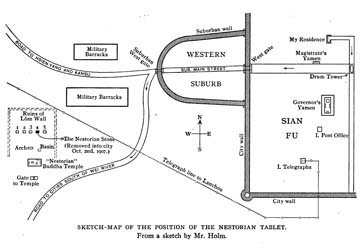
Position of the monument before its removal in 1907

Tang city annals record the locations of several Ta-chin monasteries up to I-ssu’s time. The earliest monastery of the Luminous Religion of Ta-chin in Tang times stood two blocks west of the imperial palace at Chang-an, on the northeast corner of I-ning Ward, not far from the place where the Monument was resurrected in modern times and remained until the beginning of this century. The city wards (fang) were large rectangular blocks of buildings east and west of the Imperial City of Chang-an, divided by cross streets into four parts. The wards themselves were spaces between the streets. I-ning (“Righteousness Repose”) Ward was in the extreme west of the city, two streets down from the imperial palace. The monastery seems to have been in the northeast angle of the cross formed by the two main streets. Moule, in 1930, says: “It ought to be possible to identify the site within a few yards, but I am not aware that this has yet been done.” City records of the time referred to it as a “foreign monastery of Persia.” The founding of another Persian monastery at Chang-an, this one for Manichees or Mazdeans, was recorded in 631. Emperor Tai-tsung built the monastery in I-ning Ward for the sturdy Persian “monk of great virtue” A-lo-pen in 638. At the end of the next century it was also the home of the monk Ching-ching, translator of books and in 781 the author of the monument Inscription that commemorates the emperor, the monk, and the erection of the monastery itself.

According to an old tradition, the monastery at Wu-chun was formed by a company of five brethren who partook of the Immortals’ food and from whom a new brotherhood arose. Another old tradition has it that Emperor Tai-tsung, who welcomed Rabban A-lo-pen in 635, built the White Tower of the Ta-chin temple on the grounds adjacent to Wu-chun. If these traditions are true, the monastery at Wu-chun was connected to the western lands from very early times and must have been built around the same time as the first monastery in I-ning Ward, perhaps earlier than those at Loyang and Ling-wu. In 1444 the Ta-chin monastery near Wu-chun was in a place called the village of Ta-ku in the Yu-hsien section of the district of Chou-chih. According to the epitaph still in existence there in 1932, this same monastery had been called the Ta-chin-ssu ever since the Tang dynasty. There is no longer any trace of the Tang village of Wu-chu. The tower is called Chen-hsien-pao-ta (“Guarding Immortals’ Treasure Tower”).

The tenth paragraph of the Inscription tells us that the decrees of Emperor Kao-tsung (650–683) caused monasteries of the Luminous Religion “to be founded in every prefecture.” In 627 Kao-tsung’s father, Tai-tsung, had divided the whole empire into ten prefectures (shih tao). This imperial favor had already been granted to the Buddhists for many years under Tai-tsung’s reign. In 666, the Taoists received this privilege for the first time under the reign of Kao-tsung. Under Kao-tsung, it says the “True Religion gained the proper elegance and finish” and the Law of the Luminous Religion spread throughout the ten prefectures. Annals also record that in 677 the king of Persia, Pi-lu, made a request to build a Persian monastery in the Li-chuan Ward. (In 708, during the unstable and embarrassingly intriguing period of imperial strife during the Ching-lung years, AD 707–710, the building was moved to Pu-cheng Ward.) There is reference to a Ta-chin monastery being built in the city of Chaun-chou in Min during the sixth year of Hsuan-tsung’s reign, which may indicate either 718 or 747, depending on whether the reference is to the sixth year of the first period if his reign or the second period. (The same monastery was called the Shui-lu monastery in 1638.) Sometime before the An Lu-shan rebellion in 755, a monastery was also built in the northwest at Ling-wu.

Sometime after 638 there was a monastery built in Hsiu-shan Ward of the eastern capital of Loyang (called “Sarag” in the Inscription), one other than the Persian Zoroastrian or Manichean temple already there, and another in Cheng-tu, capital of Szechuan, in the south.


Supplement 18:
The Pheasant Spreads Its Wings
Chinese or golden pheasant

Professor Legge points out that the phrase “till they appeared like pheasants on the wing” is a direct quote from the ancient Shih Ching, a narrative poem on the completion of a palace titled “Sze Kan” (Part II, Book iv, ode v, verse 4).


Supplement 19:
The Restoration of the Monasteries at Ling-wu and Wu-chun
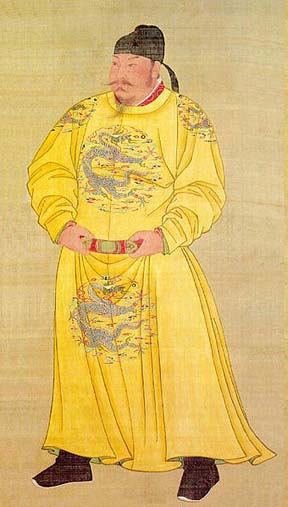
Emperor Tai-tsung (Taizong) Color on silk from hanging scroll

The Inscription also tells us that Emperor Su-tsung (756–762), under whom I-ssu served as a general and palace director, restored the monasteries at Ling-wu and Wu-chun. Su-tsung must have rebuilt the monasteries at Ling-wu and Wu-chun following the rebellion, soon after he entered the capital, because the Inscription says the God of Spirit continued to assist Su-tsung after the two monasteries were rebuilt and his reign began anew. The monastery at Wu-chun, where I-ssu’s influence became strong, seems to have been the center of all the four monasteries located in or near the western capital by I-ssu’s time. Wu-chun literally means “five prefectures” and is the proper name of a place within the district of Chou-chih. During the reign of Emperor Hsuan-tsung, the monastery at Wu-chun was destroyed by an earthquake. It exceeded in grandeur and rank the monastery at Ling-wu and was in fact the model for rebuilding Ling-wu. It was said that the White Tower, and the monastery itself, were originally built in accordance with the imperial order of Tai-tsung (627–649), patron of the first missioner of the Luminous Religion, Rabban A-lo-pen. According to the Inscription, the emperor made the monastery at Ling-wu “equal to” the grand monastery that already existed at Wu-chun. I-ssu might have been the overseer of this imperial work, whether after an early retirement to monastic life or while still in government service.


Supplement 20:
The Stone Bamboo Shoots
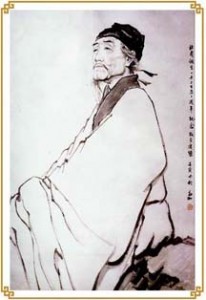
The poet Tu Fu. Anonymous artist's conception.

The poet Tu Fu (712–770) wrote a poem on the stone bamboo-sprouts at Cheng-tu (Poetical Works of Tu Fu, vol. 7). The verses by Tu Fu do not mention the monasteries themselves, but the commentary on the verses does. All the medieval commentaries on Tu Fu’s poem were notes on the single line: “When a heavy rain falls people often find she-she.”

The stone bamboo-sprouts were a pair of stone pillars outside the west gate of Cheng-tu. In 1930 it was reported that the bamboo-sprouts were still there. The north one was 16 feet high and 9 feet around; the south one, 13 feet high and 12 feet around. On the site where the stone bamboo-sprouts stood, the stone that once belonged to the attached pavilion also remained. In Tu Fu’s time, whenever it rained, people picked up pearls, gold, blue jade, and other rare things (she-she). Some of the small pearls there, with the appearance of greenish-yellow millet, had lobes in them through which silk thread might be passed.

The Sung scholar Wu Tseng (960–1127), who recorded and corrected other earlier scholars, tells us that long ago foreigners came to this place and built a monastery named Ta-chin monastery, whose gate tower had ten rooms, every one of which had a blind made of strings of pearls, blue jade, and white gems; later, he said, the tower was broken to pieces and fell to the ground. The scholar explains that what the people called the stone bamboo-sprouts were not the Pearl Tower itself but that the tower was built very close to the site where the stone bamboo-sprouts stood. Wu Tseng’s article concludes: “It is said the Kingdom of Ta-chin produces precious stones like jasper, pearls, and night-shining stones. From this place the water canal-way leads to Yung-chang-chun, I-chou of Shu province, where many rare things are produced; that is why this monastery was built by the people who came from the Kingdom of Ta-chin. But the scholar Tu Tien, quoting from a book called Yu-yang-tsa-tu, said that the city of Shao-cheng in Shu province was beautifully decorated with gold, gems, pearls, and blue jade, and that General Huan Wen got angry at such luxurious decorations and burned down the city so that the people would have nothing more to do with the Ta-chin people. But what Tu Tien said was entirely wrong.”


Supplement 21:
The Tiles of Wu-chun Temple
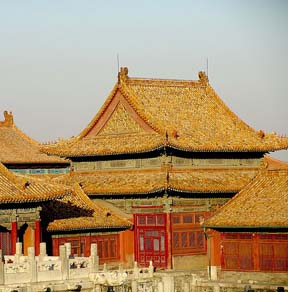
Buildings with traditional imperial yellow roof tiles

General Yang Yung-I, in a poem written in 1200 upon the occasion of his visit to the Wu-chun temple, described the tiles of the temple at Chou-chih in this way.


Supplement 22:
The Dragon Writing on the Monastery Gates
Emperor Hsuan-tsung. Tang Dynasty; source unknown.

The twelfth and thirteenth paragraphs of the Inscription establish the later reign of Hsuan-tsung (745–755) as the time when the Luminous Religion began to become clearly again a state-protected religion. In these paragraphs it is reported that in 744 Emperor Hsuan-tsung himself composed the official monastery names that appeared on the monastery gates, and the front-tablets bore the inscription in the emperor’s own handwriting. The official, or monastery, name of the Ta-chin monastery at I-ning Ward, Ta-chin-ssu, originated in 745, although the monastery had been built in 638. Prior to 745, it had been known simply as the Persian monastery. According to Professor Saeki, nearly every monastery had a “mountain title” (such-and-such shen) and a “monastery name” (such-and-such ssu) as every Buddhist monastery did. Although Saeki was not able to ascertain any of the mountain titles, the fact that the monasteries of the Luminous Religion had a monastery name (-ssu) indicates that the church was a state church under imperial patronage.


Supplement 23:
The Imperial Portraits at the Monastery of I-ning Ward
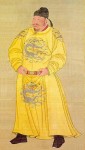
Emperor Tai-tsung (Taizong) Color on silk from hanging scroll

Sometime during the first two years of Hsuan-tsung’s later reign (742–743), he decreed that the likenesses of the five sacred emperors were to be placed in the original monastery of I-ning Ward at the capital as a mark of favor, along with gifts of silk. His wording of the Inscription suggests that the adherents of the Luminous Religion could from this time on expect the protection of the emperor’s bow and sword.

The eighth paragraph of the Inscription records that the monastery at I-ning Ward was adorned with the portrait of the reigning emperor, Tai-tsung. Immediately after the monastery was built in 638, officials were ordered to take a faithful portrait of the emperor and have it copied on the walls of the monastery “in variegated colors” and “with dazzling splendor.” That the monastery was built and supported by the government is indicated by the force of the term “attached to it” and its official name: Ta-chin-ssu.

“Answer the Call”: A Poem

Whence cometh the Source

Of all that is . . . the Driving Force,

The impetus for life here on Earth

Eternal or a time ’til the Self knows its worth?

Sift through the years . . . millenniums of time.

Search and seek and you shall find

The Light that shines . . . the path . . . the way

To Enlightenment . . . and so we pray

For the strength and fortitude . . . eyes open wide.

Look to the Light that emits from inside.

Know the Truth, for it shall bring

The promise of Eternity . . . the coming of Spring.

So open your heart . . . open it wide.

Release all the love secreted inside.

Answer the Call.

Share it with All.

diana carragher
9/12