POSSIBLE BOOKS: “The Possible Book and the Preface”
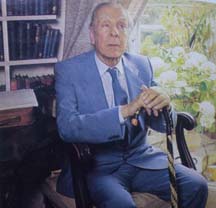
Jorge Luis Borges circa 1976

On November 26, 1974, the Argentine writer Jorge Luis Borges formulated the first theory of the prologue in his own “Prologue of Prologues.” (This title is not to be read as meaning a “superlative” in the manner of the Song of Songs, the Night of Nights, or the King of Kings but is the name of a page that preceded a collection of his own diverse prologues to actual books by actual authors that he wrote between 1923 and 1974, a prologue to his prologues, as it were.) Borges makes these preliminary observations:

The prologue, in the sad majority of cases, borders on after-dinner oratory or on funereal panegyric and abounds in irresponsible hyperboles, which the incredulous reader accepts as conventions of the genre. There are other examples—we recall the memorable study which Wordsworth prefixed to the second edition of his Lyrical Ballads—that state and reason out an aesthetic. The moving and laconic preface to the essays of Montaigne is not a page less admirable than his admirable book. Of many works which time has not wanted to forget, the preface is an inseparable part of the text. In The Thousand and One Nights—or, as [British orientalist Richard] Burton calls it, The Book of the Thousand Nights and a Night—the initial fable of the Sultan who orders his Sultana to be beheaded each morning is no less prodigious than the fables that follow; the procession of pilgrims who narrate, in their pious cavalcade, the heterogeneous Canterbury Tales has been judged by many to be the most lively story of the volume. On the Elizabethan stage, the prologue was the actor who proclaimed the theme of the drama.

He follows this exemplary passage with a proposition:

When the stars are propitious, the preface is not a subaltern form of dinner toast; it is a parallel species of critique.

This proposition introduces his real motive. On the same page that Borges recounts the tradition of the conventional preface, he offers to the world of literature the possibility of a new literary genre: the preface to the possible book. Thomas Carlyle, he notes, had “simulated” the genre more than a century before in Sartor Resartus, when he invoked the authority of a certain German professor who had published a learned volume on the philosophy of appearances: Carlyle invented the professor and presented his own book as a partial translation of the professor’s vast work, then defended the professor’s philosophy in his commentary. The genre envisioned by Borges, which he was able to see only vaguely, would apply an analogous process: an entire work composed of a series of prefaces to books that do not exist but would abound in exemplary citations from those books. He suggests that the plots introduced in those prefaces should be the impalpable substance of “pages which shall never be written” and of a kind that “offer themselves less to laborious writing than to the leisures of imagination or indulgent dialogue.” It would be a good idea, he thought, to avoid parody and satire and to make the texture of those stories the kind that our mind accepts and even craves.

Later on the page, Borges offers the plan for this possible book “to whomever desires to carry it out” because to execute this plan himself would demand “hands more dexterous” than his own and “a tenacity that had already left” him. He was seventy-five years of age when he expressed that thought. Borges, the craftsman, had already dreamed universes free of time and space (“Pascal’s Sphere”); Borges, the master of impeccable syntax, had already conceived of the unlimited rhetorical possibilities of the principle of unity (“Note on Walt Whitman”) and practiced them (“The Flower of Coleridge”); Borges, the artificer, had already written a review of an imaginary book (“The Approach to Al-Mu’tasim) and fictions that were not inventions at all but crafted elaborations upon the scant facts of the lives of real characters (“Story of the Warrior and the Captive,” “The Enigma of Edward FitzGerald,” “The Wall and the Books”). Before he passed out of this world in 1986, Borges lived to author dozens of other works—but not the one he had conceived on that day in 1974.

Borges no doubt expected, as I do, that any author who dares to attempt this genre will imitate the literary procedures that Borges himself had applied to form the series and inlays of his own mosaic works—the quest for symmetries, faceted sentences like cut stones that throw more and more light as they turn before the reader’s eye, themes that interlock and recur in variations, brevity that only seems fragmentary, generalizations that echo the argument and project it onto other planes, succinct catalogs that comprise paragraphs, allusions to a larger whole that is unnameable, harmonic enumeration of diverse parts, the addition of postscripts and afterthoughts (those structures in which literature is able to extend or enclose itself)—these, or other equivalent procedures. To my knowledge, no one has yet taken up his offer.

Reexamining this all-but-forgotten page written about a new form of fiction has suggested to me the plan of another genre, the preface to another kind of possible book, a species of nonfiction that is parallel to the one conceived by Borges: an editor’s preface to a book whose passages have already been written and published but which, strictly speaking, does not exist in a single ordered volume. This genre has no precedent, yet it is possible to imagine the sets of elements it would share with other kinds of writing. As it is now beginning to appear to me, such a work would share with the scholarly review the virtues of evaluation and accuracy; with the investigative essay, the strategies of exposition and scrutiny; with the white paper of science, the clarity of significant figures; with the tally sheet, the satisfaction of a completed inventory of contents that allows one to make projections; and with the detective story, the hidden geometry that becomes clear in stages and prefigures what is finally obvious.

This new genre of nonfiction, in its features and aversions, would resemble its relative conceived by Borges but with two notable exceptions: First, its documentary method and inherently truthful nature would require no “suspension of disbelief” to serve as antidote to the duplicity inherent in fiction; second, perspective, and not plot, would be the substance of its pages—a perspective that perceives and draws together what years and an insignificant number of intervening pages have held apart. The author of such a work, in the persona of “editor,” would assemble, or combine into an essence, a collection of valuable passages in a single new and miniature body of exquisite text and present it to the reader as if in the palm of his hand. It would seem to me beneficial to apply a method that effects Socratic schemes, shared by the author and the reader, that can be continued outside the text for personal transformation.

The work I am imagining would be made of themes and images in the same fashion as a necklace or a ring is made of milled precious metals and polished stones: the materials remember their essence but not the veins of the mountains from which they were extracted. A few examples of this kind of work already come to mind: the preface to an anthology (that does not yet exist in published form) of significant short stories or visionary poems by an author who is due to be “re-discovered” in our time; a preface to the book of literary criticism that the Swiss psychologist Carl Jung has in effect already written but which lies embedded, unnoticed and unformulated, in the twenty formidable black volumes of his Collected Works; a preface to the “Essay on Man” that was unfortunately never written by Alfred Russel Wallace, who codiscovered, with Charles Darwin, the theory of natural selection, but who, unlike Darwin, recognized the spiritual nature of Man. These prefaces, like some other short pieces of prose—the fable, the parable, the note—would be small bright tokens of something else.

Robert Petrovich, 1996/2012


What’s Been Going on at the Sanctuary These Past Few Years?

PHOTO: Roger Weld

What has been going on at the Sanctuary these past few years? This is a question a number of nonresidents have been asking lately.

Below is a list of 25 developments. They appear here in no particular order, just as they popped into the memory of resident caretaker Ted Staver and on to paper:

1. Removed all of the old equipment in front of the maintenance shed

2. Found a new home for the llamas and cleaned up the pasture area

3. Began the foundation for a future park by installing swings and a fountain

4. Built a screened-in garden in the park area

5. Landscaped the front of the Chapter House and removed the old greenhouses

6. Rocked in the parking lot island and areas around the Chapter House with over 25 tons of rock

7. Purchased a recreational vehicle and placed it on the Sanctuary grounds as a guest house with permanent wiring and sewage service

8. Converted one part of the Chapter House into a separate living quarters and thus was able to add one more permanent resident at the Sanctuary

9. Working on completing another living quarters later this year so that one more permanent resident will be living at the Sanctuary, for a total of 4 people

10. Installed a 1-kilowatt wind generator to provide power needed by the added number of people

11. Repaired the Church of New Pentecost and landscaped the area with rocks

12. Repaired the steps at the Cathedral Church of the Americas and stained the table and other key areas

13. Installed transformers to the upper level of the Sanctuary so that the Refectory and Cathedral Church now run on solar power

14. Planted 450 trees at the Church of the Christian Churches and upgraded the irrigation system to accommodate them

15. Removed tons of stone rubble at the parking lot of the Church of New Epiphany

16. Gave the entrance to the Church of New Epiphany a face lift, and it is now the first Church on the Sanctuary grounds to have its name at its entrance

17. Replaced the Communion table at the Church of New Epiphany and repaired the bell choir tables

18. Replaced the 15-foot cross at the Church of the Christian Churches

19. Painted all the crosses in the South Sanctuary (Sanctuary of Prophecy)

20. Repaired the vestment racks at the Churches in the South Sanctuary

21. Painted the Communion tables in the South Sanctuary (Sanctuary of Prophecy)

22. Repaired and permanently fixed in place the cross at the Church of the Americas

23. Completed all but the final phase of the water project (There is way too much to list here. See other Communiqué articles dealing with the Sanctuary water project specifically)

24. Restored the cross and table at the Church of New Philadelphia

25. Placed vestment racks at all the Churches in the Northland (Sanctuary of Revelation)

A lot of lesser projects are not mentioned in this list, but the above twenty-five projects represent the major developments of the past couple of years.


SEASON’S GREETINGS from Rowena Kryder


From Dr. Rowena Kryder (www.creative-harmonics.org) now a resident member of our Reno Community.


The Human Face of Alfred Russel Wallace, Part 3

III

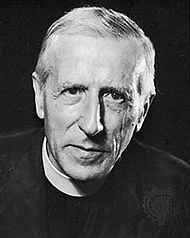
Pierre Teilhard de Chardin

The third version of the idea I shall mention, the most mystical of all, is the invention of a writer much less splendid than Spengler, although he was more gifted with those classical virtues usually called “rational.” I am referring to the author of The Apparition of Man, the distressed but obedient Jesuit priest Pierre Teilhard de Chardin. When he died, he left unpublished (because disallowed by the Roman Church) the manuscript of The Human Phenomenon, a variation or expansion of The Decline of the West. The human which Spengler imagined is, ultimately, no more than an aggregate of parallel subspecies rooted in humus, an accumulation of the humble vassals of the earth, grown over millennia on distinctive soils like varieties of vintage grapes, unequipped to live outside of Time, with no sense of the Immortal and no sense of the Eternal except as a Return. Teilhard’s human is semidivine, a prolonged but terminal creature of mind deployed within the expansive realm of the demiurge, hovering between earth and Heaven—but never reaching the Eternal, the Immortal. Both processes are limited; but Teilhard’s is more centripetal. In The Human Phenomenon the nexus between the historical and the spiritual is not the physical face generated out of the past, as in the previous parables, but a disembodied countenance from the future that mysteriously represents the human.

In biological terms every organism depends upon the process of cephalization, the differentiation of the head as the guiding region of the body, to become first an individual and then a person (a consciously transcendent individual). Before Teilhard passed away in 1955, he announced his discovery that mankind is now converging in such a blossoming complex. The “pessimist” (Teilhard’s term) reduces history, the particular slice of six thousand years or so for which we possess written or dated documents, to a number of civilizations which have fallen into ruins one after the other. Teilhard saw beneath these successive oscillations the great spiral of life following the master-line of its evolution, thrusting up irreversibly in relays toward an ever more highly organized consciousness of the universe. He saw this convergence manifest first on the genetic level, slender and granular as this first membrane may be, when increased interbreeding among all human variants resulted in the type man, and Homo sapiens differentiated into distinct races (subspecies), practically covering the earth with a mosaic of cultures (inter-thinking groups). In the traditions that became organized, and in the collective memory that developed, Teilhard distinguished a common pool of thought beginning to close in on itself and encircle the earth; he also recognized that, however hominized the apparition of political and cultural units may appear, this form of the history of mankind really only prolongs the organic movements of life. Only in the Neolithic Age did he detect the forces of a new kind of coalescence beginning to manifest above the genealogical verticils: a complex of psychical groupings—geographical distribution, economic links, religious beliefs, social institutions—that submerge “the race” and begin to react among themselves. He saw increased numbers and improved communications leading these new units over time into an accelerated process toward the union of the whole human species into a single culture based on a single self-developing framework of thought. It was obvious to him that this great binding of human elements has never stopped; for Teilhard, the periods called “historic” are nothing else than direct prolongations of the Neolithic Age. It was also obvious to him that, during historic time, the principal surviving axis of anthropogenesis has passed through the West (See Footnote 1); Teilhard proposed that a neo-humanity has been germinating round the Mediterranean during the last six thousand years and precisely at this moment has finished absorbing the last vestiges of the neolithic mosaic, thus budding another layer of inter-thinking humanity, the densest of all.

Teilhard imagined the sphericity of man’s environment—the banal fact of the earth’s roundness—to be the cause of this intensification: Man’s thought confined to spreading out over the surface of the earth’s sphere, idea encountering idea where previously race encountered race, has resulted in an organized web of thought. This piece of evolutionary machinery, capable of generating high cultural energy, has become the bounding structure of evolving man, marking him off from the rest of the universe yet facilitating his exchange with it, like the membrane of an animal cell. With his genius for fruitful analogy, Teilhard pointed out that the process of evolution on earth is itself now in the process of being cephalized: The development of humankind into a single inter-thinking unit is providing the evolutionary process with the rudiments of a head. Teilhard’s formulation implies that we should consider inter-thinking humanity to be a new type of organism, whose destiny is to realize new possibilities for evolving life on this planet. He thus makes of the human precisely at this moment an incomparable terminus a quo, a creature who proceeds from the boundary of the present because it is destined to do so; its evolution toward the future a condition for its existence in the present.

Quite possibly Spengler was not acquainted with Wallace’s text; Teilhard perhaps knew and did not admire the text of Spengler. If the doctrine that all people are pale imitations of immortal Spirit is valid, such facts are insignificant. Strictly speaking, it is not necessary to go that far; each of these authors has his precursors, others who recognized the same facts and presented the essential facets of their sciences before they did. Spengler’s precursors are poets: I have found reference to the eye as glance in the verse of Guirat de Bornelh (“The eyes are the scouts of the heart”), to the eye as visage in a sonnet of Dante (“The eyes are the windows of the soul”), to the mouth expressive of understanding in Whitman’s “Song of Myself” (“I carry the plenum of proof and everything else in my face,/ With the hush of my lips I confound the topmost skeptic”), and to the head as the throne of the nonvegetative side of life in Thoreau’s Walden (“My head is hands and feet. I feel my highest faculties concentrated in it”). Spengler contradicts none of these earlier expressions. The writers of scripture who recorded the Fall of the Heavenly Host no doubt inspired Wallace to respond to the significance of that allegory with courage and science. More obtrusive, at first appearance, is Teilhard’s overwhelming image of the universe, in which the survivors of the human phylum he envisioned have persevered in the same way as flowers or trees or animals or individual humans; that is to say, as have “the other thoughts of the Creator of this world.” In the final analysis, Teilhard’s cerebral metaphor is nothing else than the expansion or prolongation of Spengler’s cultural archetype within the monistic limits predetermined by the councils of the Church of Rome.

One last observation. All three authors—Wallace, Spengler, Teilhard—either inadvertently or with conscious intent, have exposed the wrinkles in the human countenance and mankind’s blemish on the Eternal. None of them, through his science, has provided a new solution to the universal problem of the ancients: to discover the way out of the gross fate of physicality. The complex process that Teilhard described involves not only humankind but the entire universe in an organic folding in on itself, which leads in turn to the evolution of a progressively more conscious—more highly organized—Mind. Past the final point of convergence, where self-developing Mind meets itself, Teilhard did not venture. In his optimism, however, he did predict that this convergence—the union of the whole human species—is inevitable, and he left us with the hope that this union may contract for new terms. The cosmos of History of which Spengler conceived is a kind of repertory theater where humans improvise their Destiny in the forms of stock characters and in the outline of a mortal plot which they play out again and again in Time (Immortality is outside of Time and, therefore, outside of History). Within these dramatic limits Spengler was, of course, correct. That he considered these limits satisfactory is another matter. In the Cosmos of the ancients, Destiny is a function of Immortal Life and History merely a counterfeit. Wallace imagined that we may be growing in countenance more and more like the Angels who guide our development; but in the context of ancient doctrine, his hypothesis, carried to its logical conclusion, would lead us (or a portion of us) to resemble the Dark Angels who are our nearest spiritual ancestors. Avowedly ignorant of spiritual cosmology, Wallace made his proposition without any ill intention, of course; he simply could not conceive of the possibility that man is consciously able to form another kind of spiritual body, one that is immortal, a body like that of the Angels of Light, the Heavenly Host.

The problem remains. If it cannot be solved from the dark biological side, perhaps we shall have better luck from the bright spiritual side: As mere mortal creatures, we are the offspring of higher dimensions but not part of them. We require spiritual assistance to hold our own against the Powers of Darkness, and we can free ourselves only as spiritual beings. This is the universal doctrine of Salvation.

Robert G. Petrovich, July 1995

FOOTNOTES
(1) In Book Three, Chapter II of The Human Phenomenon Teilhard compared the progress of hominization in the course of these six thousand years to the whole series of cases, situations, and appearances usually met with in any phylum in a state of active proliferation: a gradual falling away of the oldest splinters; the accentuation and domination of certain other stems, more central and more vigorous, that attempt to monopolize the land and the light, some branches withering, some sleeping, some shooting up and spreading everywhere, here and there disappearances that cause a thinning out, here and there fresh buddings that make the foliage more dense. Later in the same chapter, Teilhard noted that Old China lacked the inclination and the impetus for deep renovation and was still Neolithic well into the nineteenth century; that India allowed itself to be drawn into metaphysics and was lost there; that the old American centers, too isolated, were completely extinguished; that the Polynesian center, too dispersed, continued to radiate in a vacuum. These considerations led Teilhard to the conclusion that, at the present time, all the peoples of the earth, to remain human or to become more so, are inexorably led to formulate the hopes and problems of the modern earth in the same terms that the West has formulated them.


“UPDATE: The Reaction to Karen King’s Gospel Discovery”


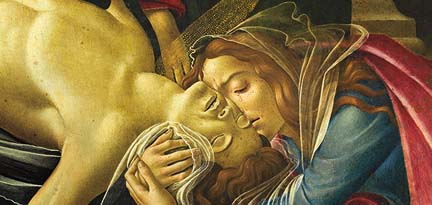
The "Mary" in the controversial text, King says, may be Mary Magdalene, who was present at the Crucifixion. (Sandro Botticelli, The Mourning of Christ, c. 1490. Alte Pinakothek, Bayerische Staatsgemaeldesammlugen, Munich/ BPK, Berlin/Art Resouce, NY)

“When the divinity scholar unveiled the papyrus fragment that she says refers to Jesus’ ‘wife,’ our reporter was there in Rome amidst the firestorm of criticism.”

Read the entire article at smithsonianmag.com by Ariel Sabar, the only reporter on the scene in Rome when the divinity scholar Karen King made the announcement.

This story is an update of < the news broken by Smithsonian magazine on September 18, 2012 >.

Read the original Communique article on the discovery.

Links provided by Robert Petrovich


The Human Face of Alfred Russel Wallace, Part 2


II

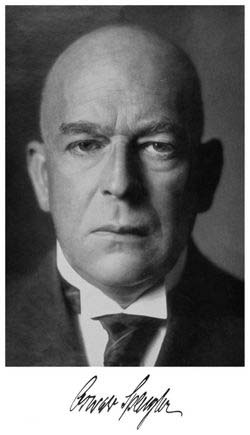
The second text I shall quote is The Decline of the West, the sensational history that brought fame to its author, Oswald Spengler. He wrote his virile pages from 1912 to 1917, six obstinate years spent starving in a gloomy tenement room in Munich. His pages were uncontaminated by the hatred of those years. Around 1915 he finished the revision of the first volume. In the summer of 1918 The Decline of the West appeared in Vienna. Fame began around 1920. With this book Spengler continued and renewed an illustrious Germanic tradition: the creation of a grandiose and perfect System intended to represent, or eventually correspond with, the impure and disorderly universe. In the enormous dialectical structure of the first volume, Spengler invented the human being as a being of history. For Spengler, History is a second Cosmos, different from Nature in structure and complexion; its essence is Destiny—the instinctive, dream-sure logic of Time (a logic as necessary to the organic as the logic of cause and effect is to space). One of the axioms of Spengler’s theory is that Race, like Time and Destiny, is a decisive element in every question of life. He found it impossible to exaggerate the formative power of the living pulse that coins the same living features (“family traits”) over and over again for centuries toward the perfection of a type. It is a corollary of Spengler’s axiom that Race concentrates on the head and face—the flesh, the look, the play of feature. The living flesh carries nine-tenths of the expression, not the bone of the face but its mien. (The race expression of a human head can associate itself with any conceivable skull form.) Preeminent, the organs of the outer sheath gather to themselves more and more race expression: the eye, when it is seen as glance and expressive visage; the mouth, when it expresses understanding through the usages of speech; and the head, with its lineaments formed by the flesh, which has long been the throne of the animal side of life.

Individuals, however, form only one variety of the human. Spengler observed that Cultures, those superlative human organisms in which the History of humankind fulfills itself—like humans—are born of races and live fate-laden for an allotted time through the same cycles, repeating again and again general biographic archetypes. In the same terms we speak of individual persons, he spoke of the mien and speech of Cultures, and with the same meaning. For him the immense history of the Chinese or the Classical Greco-Roman Culture is the exact equivalent of the history of an individual human, animal, tree, or flower. The world history he envisioned is a collection of the biographies of cultures like a set of Rembrandt’s self-portraits, a kind of Goethean autobiography of man. With the transnatural outlook of Dante and Wolfram von Eschenbach, Spengler envisioned great days to come when all sciences would be part of a single, vast physiognomic of all things human, when scientific experience would be equivalent to self-knowledge of the human spirit. Where those who are blind to the world find only a senseless turmoil of events, Spengler saw a Divine Comedy, a drama played for a god.

In Western humankind, or more specifically, in the human of the North, the human of Germanic Europe and America, who changed the face of the current world, Spengler noted a physiognomic abundance. He saw it in the soul of the racial spirit that craves for a style that drives through walls into the limitless universe of space and makes outside and inside the complementary images of one and the same world feeling. He saw it in the painting and sculpture of the artist who transforms every act into a portrait, who even in a landscape develops the background into a definite locale, into a representation of the soul of that locale, and thus endows it too with a face. He saw it in the design of the architect who brings the outer form of a building into relationship with the meaning that governs the arrangement of its interior (a meaning undisclosed by the Arabian mosque and nonexistent in the Classical temple). Such a building has no mere facade, but a head, a visage that greets the beholder and tells him its inner meaning. With its characteristic wealth of windows, the motive of that visage dominates not only the major buildings but the whole aspect of the streets and plazas and towns. This is a second version of Wallace’s image. More sublime than a changing face selected by natural law or the face of an animal is the face refined by a culture, a living face whose features are already assembled and now express the secrets of the race.

< Read Part 3 >


JAPAN REPORT: December 2012

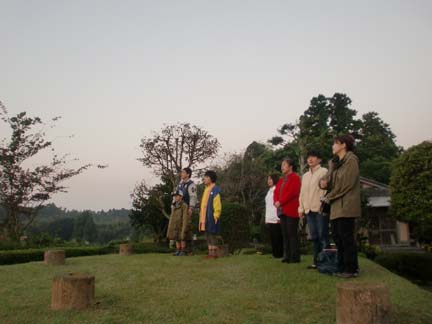
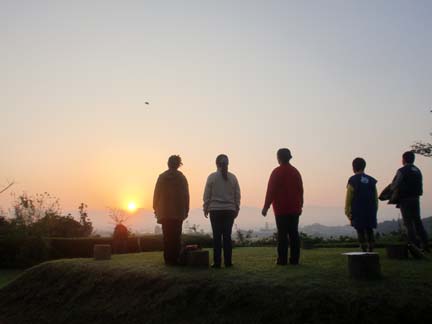
Sunrise in Japan. PHOTO: Miyuki Okayama

Miyakonojo, Miyazaki prefecture
<Visit Miyakonojo, Miyazaki through Wikipedia.>

This report is a brief introduction to the activities of the Community members in Miyazaki.

Community Sunrise in Japan. PHOTO: Miyuki Okayama

The group name of the members in Miyakonojo is “Miyakonojo Nagomi-no-Kai.” Nagomi means “harmony” or “peace.”

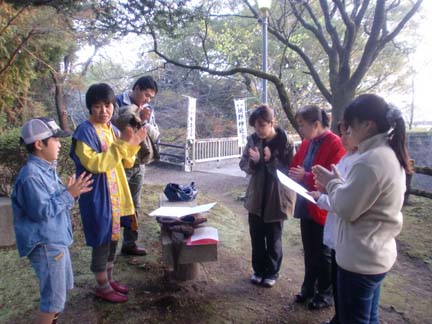
Japanese sunrise service. PHOTO: Miyuki Okayama

In Miyakonojo, Miyazaki prefecture, Cosolargy members hold the ceremony of Sunrise Service on the third Sunday of every month.

After watching the sun rise, the “Sacred Word” is recited all together.

Reciting the Sacred Word. PHOTO: Miyuki Okayama

Then we learn the Tea Ceremony as one of the practices for studying Cosolargy. In Japan, we consider various things as a michi or do (“Way” or “Path”) and do the training of it as a practice that leads to “raising Consciousness.” It is said that the tearoom and the Tea Ceremony express the Cosmos. Thus we think it is useful to raise spiritual Consciousness as taught in Cosolargy through the study of the Tea Ceremony.

Tea ceremony. PHOTO: Miyuki Okayama

When we study the Tea Ceremony, not only Community members but ordinary persons also  participate.

We may sometimes do a special event besides the monthly Sunrise Service. For example, we held a moon-viewing party with 36 people on September 22.

Sincerely,

Miyuki Okayama
Japan Correspondent


The Human Face of Alfred Russel Wallace, Part 1

There are two separate and substantial Creations, one of Light and one of Darkness, and man’s life in this transitory world, and this world itself, is an outgrowth of the Worlds of Darkness; man’s changing material fate is a miscarriage of his spiritual destiny, a counterfeit of another life in the immortal Worlds of Light. This is one of the universal doctrines restored by Zoroaster to the righteous of Persia in the first millennium B.C.E. and recorded nearly a thousand years later in the Gathas of the Zend Avesta. It was not the only time immortal Spirit made such an observation. That doctrine was also restored by Buddha to the righteous of India, by Mani to the righteous of Babylonia, by Jesus and his forerunners to the righteous of Israel, and by other Teachers of Light to the righteous of China, Greece, Northern Europe, Egypt, Arabia, Oceania, the Americas. Oral tradition, and the sacred literature derived from that tradition, abounds in allegories on the spiritual origin and evolution of man.
 
 
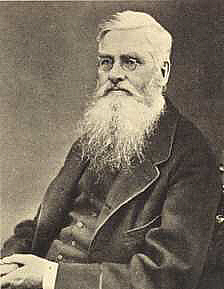
Alfred Russel Wallace (1878)

 I

The cosmology implicit in this universal doctrine gives rise to an endless interpretation of human events. I am invoking it now to assist me in a modest plan: to trace the history of the evolution of an idea through the heterogeneous texts of three authors. The first one is by Alfred Russel Wallace; it is an excerpt from the collection of essays he published one century ago this year (i.e., 1895) titled Natural Selection (pages 167–83):

We know positively that man was contemporaneous with many extinct animals, and has survived changes of the earth’s surface fifty or a hundred times greater than any that have occurred during the historical period. . . . But while these changes had been going on, his mental development had, from some unknown cause, greatly advanced, and reached that condition in which it began powerfully to influence his whole existence, and would therefore become subject to the irresistible action of natural selection. This action would quickly give ascendancy to mind…and from that moment man, as regards the form and structure of most parts of his body, would remain stationary. But from the moment that the form of his body became stationary, his mind would become subject to those very influences from which his body had escaped. . . .

We may trace back the gradually decreasing brain of former races, till we come to a time when the body also begins to materially differ. There we shall have reached the starting-point of the human family. Before that period he had not mind enough to preserve his body from change, and would, therefore, have been subject to the same comparatively rapid modifications of form as the other mammalia. . . . Man may continue to exist through a series of geological periods which shall see all other forms of animal life again and again changed…while he himself remains unchanged, except in two particulars – the head and face, as being immediately connected with the organ of the mind and as being the medium of the most refined emotions of his nature.

I wonder what my reader thinks of that proposition. To me it is nearly perfect. It seems impossible to deny, for it has the integrity of a statement ipso jure, an outgrowth of the law of natural selection itself. And, of course, it is just that. His formula reconfigures clearly an event that is evidently complex: the face expressing a mind developed in a culture that manifests, however imperfectly, an expression of spirit. In chapter 9 of the same collection, Wallace suggests that man is gradually moving or evolving toward participation in the Eternal. He contemplates the possibility that the development of the specifically human portions of man’s structure and intellect have been determined by the directing influence of more highly intelligent beings, perhaps encompassing layers of them, and that some general and fundamental law underlies the law of natural selection “too deep for us to discover it.” Behind Wallace’s idea is the general and ancient idea of the Fall of Man and the generations of humans who long for redemption.

< Read Part 2 >


Christmas-Epiphany Season Events 2012

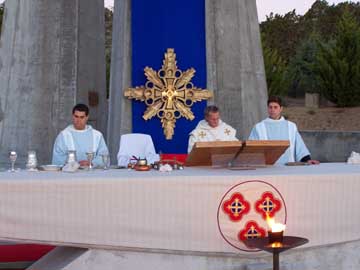
Christmas Choir. PHOTO: Stephan Fuelling

December 25, 2012
Christmas Day is Tuesday December 25. The Vigil begins on this day, and the traditional Christmas Service will be held in the Chapel of the Holy Child at 11:00 a.m. PST.


PHOTO: Stephan Fuelling

December 25, 2012 – January 6, 2013
The Christmas-Epiphany Vigil will be held at the Church of New Epiphany in Sanctuary each morning, weather permitting.


December 29, 2012
The Children’s Tea & Blessing will be held at the Rectory-Abbey on Saturday December 29 at 3:00 p.m. along with other events for the children.


January 5, 2013
Epiphany Eve Dinner will take place at the Rectory-Abbey on Saturday, January 5, 2013, at 6:00 p.m. This is also a Pannuches Saturday. Pannuches elements will be included that evening, but there will be no Pannuches Service in the Chapel. Donations for the dinner remains the same as in previous years: $25/adult and $10/child (14 and under)—but of course, you can always give more!


PHOTO: Stephan Fuelling

January 6, 2013
Epiphany Day. After Sunrise Divine Service, members of the congregation will gather with family and friends.


Services for December 22, 2012


Saturday, December 22, 2012
10:00 AM COMMUNION
Chapel of The Holy Child
RR Gene Savoy, Jr
Lector: RC Elizabeth Reece
Cantor: Rev. Larry Coesens
Reader: Rev. Ted Staver
Organist: RC Gary Buchananan


SUNDAY SERVICES SUSPENDED DUE TO INCLEMENT WEATHER

Sunday, December 23, 2012
7:11 AM NEW DIVINE SERVICE
Church of New Epiphany
Leave: 6:15
Gate: 6:55
Sunrise: 7:26
RR Gene Savoy, Jr
Concelebrant: RR Sean Savoy
Assistants:
RC Roger Weld
Rev. Ted Staver
RM Carol Ann Crabb
Organist: RC Gary Buchanan

OPEN-AIR COMMUNION
Church of New Mount Tabor                    RM Carol Ann Crabb
Church of New Mount Carmel                    Rev. Ted Staver
Church of New Mount Hebron                     Rev. Michael McIntyre


Tuesday, December 25, 2012
7:11 AM NEW DIVINE SERVICE
Church of New Epiphany
Leave: 6:15
Gate: 6:55
Sunrise: 7:26
RR Gene Savoy, Jr
Concelebrant: RR Sean Savoy
Assistants:
RC Roger Weld
RC Robert Petrovich
Rev. Barbara Whitney
Organist: RC Gary Buchanan

11:00 AM CHRISTMAS SERVICE
COMMUNION & CANDLE LIGHTING
Chapel of The Holy Child
RR Gene Savoy, Jr
Lector: RM Carol Ann Crabb
Cantor: RC Roger Weld
Reader: Rev. Karen Elliott
Scriptural Reader: RR Sean Savoy
Organist: RC Gary Buchananan


Wednesday, December 26, 2012
SUNRISE DIVINE SERVICE SUSPENDED DUE TO INCLEMENT WEATHER 
7:11 AM NEW DIVINE SERVICE
Church of New Epiphany
Leave: 6:15
Gate: 6:55
Sunrise: 7:26
RR Gene Savoy, Jr
Concelebrant: RR Sean Savoy
Assistants:
RC Roger Weld
Rev. Ted Staver
RM Carol Ann Crabb
Organist: RC Gary Buchanan
 

 12 N COMMUNION
Chapel of the Holy Child
Rev. Ben Hubbard
Organist: RC Gary Buchanan


Thursday, December 27, 2012
SUNRISE DIVINE SERVICE SUSPENDED DUE TO INCLEMENT WEATHER
7:11 AM NEW DIVINE SERVICE
Church of New Epiphany
Leave: 6:15
Gate: 6:55
Sunrise: 7:26
RR Gene Savoy, Jr
Concelebrant: RR Sean Savoy
Assistants:
RC Roger Weld
RC Robert Petrovich
Rev. Barbara Whitney
Organist: RC Gary Buchanan


Friday, December 28, 2012
7:11 AM NEW DIVINE SERVICE
Church of New Epiphany
Leave: 6:15
Gate: 6:55
Sunrise: 7:26
RR Gene Savoy, Jr
Concelebrant: RR Sean Savoy
Assistants:
RC Roger Weld
Rev. Ted Staver
RM Carol Ann Crabb
Organist: RC Gary Buchanan

9:30 AM PRAYER & FELLOWSHIP
Chapel of the Roses
Rev. Vickie Hewlett