Second Advent Services Announced

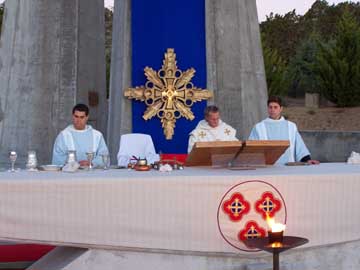
On Tuesday, January 29 at 6:00 PM, in the Chapel of the Holy Child, there will be a special “Remembrance of the Child,” a liturgical service that the Church celebrates every year to begin the Second Advent Vigil. This evening service is a private ceremony for members of the Order. The next morning, on January 30, Sunrise Divine Service will be held at the Red Rock Sanctuary, at the open air Church of New Epiphany.

To commemorate the 51st Anniversary of the Second Advent, Sunrise Divine Services will be held at the open-air Church of New Epiphany from Saturday, February 2 through Wednesday, February 6, 2013.

Due to Divine Service being scheduled for Saturday, February 2, 2013, Communion of Fellowship Service in the Chapel will be held at 11:00 am on that day.


Services for the Week of January 19, 2012


Saturday, January 19, 2013
10:00 AM COMMUNION
Chapel of The Holy Child
RR Gene Savoy Jr.
Lector: RC Rebecca Willis
Cantor: Rev. Ben Hubbard
Reader: Rev. Harold Boulette
Organist: RC Gary Buchanan

 Sunday, January 20, 2013
7:09 AM NEW DIVINE SERVICE
Church of New Epiphany
Leave: 6:00
Gate: 6:50
Sunrise: 7:24
Assistants: RC Roger Weld
RC Robert Petrovich
RM Carol Ann Crabb
Organist: RC Gary Buchanan

 OPEN-AIR COMMUNION
Church of the Christian Churches                    RC Roger Weld
Church of the Golden Age of Light                   RC Elizabeth Reece
Church of the Universal Theocracy                   Rev. Vickie Hewlett

Wednesday, January 23, 2013
12 N COMMUNION
Chapel of the Holy Child
Rev. Michael McIntyre
Organist: RC Gary Buchanan

Friday, January 25, 2013
9:00 AM PRAYER & FELLOWSHIP
Chapel of the Roses
RC Elizabeth Reece


Services for the Week of January 12, 2013


Saturday, January 12, 2013
11:00 AM COMMUNION
Chapel of The Holy Child
RR Sean Savoy
Lector: RM Carol Ann Crabb
Cantor: Dea. Shane Grady
Reader: Rev. Herman Aggenbach
Organist: RC Gary Buchanan


SUNDAY SERVICES SUSPENDED DUE TO INCLEMENT WEATHER
 Sunday, January 13, 2013
7:15 AM NEW DIVINE SERVICE
Church of New Epiphany
Leave: 6:15
Gate: 7:00
Sunrise: 7:24
Assistants: RC Roger Weld
Rev. Ted Staver
RM Carol Ann Crabb
Organist: RC Gary Buchanan


 OPEN-AIR COMMUNION
Church of the Christian Churches                    RC Gary Buchanan
Church of the End Times                   Rev. Amanda Buchanan
Church of the Americas                   Rev. Dorothy Kubiak


Wednesday, January 16, 2013
12 N COMMUNION
Chapel of the Holy Child
Rev. Ted Staver
Organist: RC Gary Buchanan


Friday, January 16, 2013
9:00 AM PRAYER & FELLOWSHIP
Chapel of the Roses
RC Elizabeth Reece


Intercession & Memorial Prayer Services December 2012


DECEMBER 2012

1
Nola Slevin

5
Tricia Haggart Bilick †

8
Tricia Haggart Bilick †

12
Terry Stinson
Nola Slevin
Tom Fee
Guy Pépiu †

15
Terry Stinson
Nola Slevin
Tom Fee
Guy Pépiu †
Joseph Schneider
The 28 victims of an elementary school shooting in Newton, Connecticut †

19
Terry Stinson
Nola Slevin
Joseph Schneider
Genevieve Peterson †

26
Terry Stinson

29
Terry Stinson

 † indicates Memorial Prayer


POSSIBLE BOOKS: Carl Gustav Jung: The Collective Dream, Part 6

CONTENTS

PROLOGUE: “The Work of Art” (from CW 15)

PART I: LITERATURE: THE COLLECTIVE DREAM

THE RELATION OF ANALYTICAL PSYCHOLOGY TO POETRY
Chapter 1: “On the Relation of Analytical Psychology to Poetry” (from CW 15)
Chapter 2: Modes of Creation (from CW 5– 8, 13, 15, 16)
Chapter 3: The Symbol (from CW 3, 5, 6, 8, 9i, 10, 11, 13, 15, 16, 18)
Chapter 4: The Dream (from 3, 4, 7, 8, 9i, 12, 14, 16, 18)

CRITIQUES
Chapter 5: Introduction to a study on the Dream of Poliphilo (from CW 18)

Significant Authors
Chapter 6: Pierre Benoit (from CW 7, 9i, 10, 13, 15–18)
Chapter 7: Arthur Conan Doyle (from CW 10, 15)
Chapter 8: Rider Haggard (from CW 5, 7, 9i, 9ii, 10, 13, 15-18)
Chapter 9: E. T. A. Hoffman (from CW 5, 6, 8, 9i, 14, 15, 18)
Chapter 10: Herman Melville: Moby Dick (from CW 15)
Chapter 11: H. G. Wells (from CW 7, 9i, 10, 13, 18)

Psychological Authors
Chapter 12: Johann Wolfgang von Goethe: Faust, Part I (from CW 4–8, 9i, 10, 11, 13, 14, 16)

Visionary Poets
Chapter 13: William Blake: Painting and Poems (from CW 6, 11, 12, 15)
Chapter 14: The Stammerings of Jacob Boehme (from CW 9i, 9ii, 10–12, 14–16, 18)
Chapter 15: Dante Alighieri: Divine Comedy (from CW 5, 6, 9i, 11–16, 18)
Chapter 16: Johann Wolfgang von Goethe: Faust, Part II (from CW 5–7, 9i, 11–14, 18)
Chapter 17: The Shepherd of Hermas (from CW 6, 9i, 9ii, 14, 15, 18)
Chapter 18: The Dionysian Exuberance of Friedrich Nietzsche (from CW 5, 7, 8, 9i, 11, 12, 15)
Chapter 19: Carl Spitteler: Olympian Spring (from CW 3, 5-7, 9i, 9ii, 12-15)

Analogs of Neurosis
Chapter 20: Lord Byron: “Heaven and Hell” (from CW 5)
Chapter 21: Paul Verlaine: “Mon reve familier” (from CW 5)

Analogs of Schizophrenia
Chapter 22: Friedrich Holderlin (from CW 5, 6, 9i–10, 13–15)
Chapter 23: James Joyce: Ulysses (from CW 15)
Chapter 24: Henry Wadsworth Longfellow: “Hiawatha” (from CW 5, 7, 9i)
Chapter 25: Gerard de Nerval (from CW 5, 7, 18)
Chapter 26: Edgar Allan Poe: “The Raven” (from CW 5)

The Transcendental Function
Chapter 27: Gerard de Nerval’s Aurelia (from CW 18)

THE LITERARY MANDALA AND ITS CENTER
Chapter 28: Implications of the Collective Self (from CW 4–8, 9i, 10, 12–18)
Chapter 29: The Human Self, the Psychic Self, and the Spiritual Self (from CW 6, 9i, 11– 14, 16)

PART II: SOLVING THE PSYCHIC EQUATION

COMMENTARIES ON THE LITERATURE OF ALCHEMY, PHILOSOPHY, AND SCIENCE
Chapter 30: “Foreword to Wickes: The Inner World of Childhood ” (from CW 17)
Chapter 31: “Foreword to Jung: Configurations of the Unconscious” (from CW 18)
Chapter 32: Praise for Rider Haggard (from CW 5, 7, 9i, 9ii, 10, 13, 15–18)
Chapter 33: “Foreword to Brunner: The Anima as a Problem in Man’s Fate” (from CW 18)

REPRESENTATIVE AUTHORS
Chapter 34: Significant and Psychological Authors (See Part I above, chapters 2–8)
Chapter 35: The Vision of Love (See Part I above, chapters 11–13)
Chapter 36: Representatives of Neurosis and Psychosis (See Part I above, chapters 16– 23)
Chapter 37: Authors Appearing in “The Miller Fantasies” (from CW 5, et al.)

PSYCHOLOGICAL TYPES: FORM AND EXPRESSION
Chapter 38: “The Type Problem in Poetry” (from CW 6)
Chapter 39: “Schiller’s Ideas on the Type Problem” (from CW 6)
Chapter 40: Homer (from CW 6, 12, 14, 14, 16, 18)
Chapter 41: Friedrich Schiller (from CW 3, 5, 6, 8, 10, 12, 15, 17, 18)
Chapter 42: Carl Spitteler (from CW 3, 5–7, 9i, 9ii, 12–15)

EPILOGUE: Analysis of the Collective Dream (from CW 5, 7, 10, 18, et al.)


More From the “Ol’ Farmer” in Pumapungo

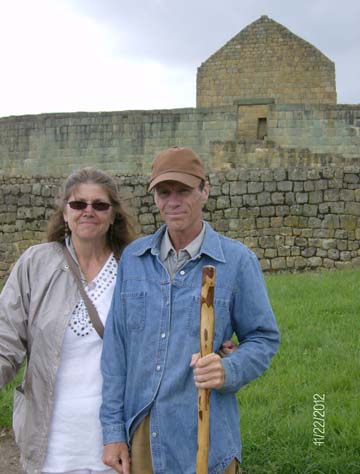
Debra Bloedel and Chris Morriss at Ingapirca. PHOTO: Debra Bloedel

We have just received word from Consociate Chris Morriss (aka “the Ol’ Farmer”) that he and his longtime friend have found a temporary residence in Cuenca, near Pumapungo, Ecuador. Chris plans to set up permanent residence there in the neighborhood in the near future with his wife Debra. They plan to set up a small self-sufficient community and retire there. Chris will continue his participation in the Academy Program and hopes to be of some help with the Andean Explorers Foundation while he is in Ecuador.

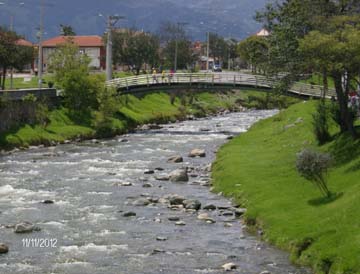
Tomebamba River in Cuenca. PHOTO: Debra Bloedel

Countryside north of Cuenca. PHOTO: Debra Bloedel


POSSIBLE BOOKS: Carl Gustav Jung: The Collective Dream, Part 5

SUPPLEMENTS

Supplement 1
The theory of literature that Jung propounded has been in existence now posthumously for more than thirty years and has inspired the production of a myriad of works of Jungian literary criticism long before the appearance of this published volume by “the master.” Most recently, we note the prominence given to the Trickster figure by Gary Snyder in his “New Nature Poetics” (A Place in Space, 1995, p. 171). By way of Marie-Louise von Franz, one of the theory’s major exponents for decades (through her books Puer Aeternus and Shadow and Evil in Folktales), images of primordial images have reentered literature consciously through the poems of Robert Bly and through his discourses with The Shadow (A Little Book on the Human Shadow, 1988). Directly from the works of Jung have come the pattern of the novels of the Canadian Robertson Davies, who is in line of descent from Jung’s German adherents, Herman Hesse and Thomas Mann, and the last collections of short stories by Jack London (The Red One and On the Makaloa Mat). Acquaintanceship with Jung’s theories lend archetypal significance to the characters of the novels of D. H. Lawrence and Patrick White, and two plays by Eugene O’Neill, The Great God Brown (1925) and The Emperor Jones (1921), bear witness to the author’s reading of Jung.

In the early 1920s, around the time that Jung himself first related archetypes and dream symbols to literature, other literary critics applied his science to literature in tentative essays. After these first beginnings, it took surprisingly long for Jungian criticism to develop. The two pioneering works were published by English women, Maud Bodkin and Elizabeth Drew. Archetypal Patterns in Poetry (1934), Bodkin’s book, rich and sensitive, discusses her own responses, and those of some other well-known critics, to the archetypal patterns of rebirth, heaven, hell, devil, hero, and God in European writers like Homer, Virgil, Dante, Shakespeare, Milton, Goethe, and T. S. Eliot. For many years hers was the only extensive Jungian study of literature.

After the Second World War, when Jungian criticism slowly began to gain ground, more so in America than in England and Europe, the second landmark in Jungian literary criticism appeared: T. S. Eliot: The Design of His Poetry (1949) presents the perceptions of Elizabeth Drew on the major poetic achievements of T. S. Eliot in light of psychoanalytic theory. In the brutal figure of Apeneck Sweeney she sees the projection of T. S. Eliot’s Shadow; in his famous long poem The Wasteland, she sees his archetypal quest for meaning amidst the spiritual aridity of modern society; in the poem “Ash Wednesday,” she sees descriptions of a series of meetings with powerful positive anima figures; in Four Quartets she sees Eliot’s poetic career come to a close with the achievement of psychic wholeness expressed in symbols of quaternities and in the centering of the mandala in the image of the “still point of the turning world.” Her book provides an example of what is possibly the most fruitful way to apply Jung’s psychology to literature: illuminating, sensitive, and sensible interpretation that does not reduce the work of art to something else. In the work of literary critics like Richard Chase, Francis Fergusson, Philip Wheelwright, and the “archetypalist” Northrop Frye ( author of Anatomy of Criticism, 1954), the influence of Jung’s combination of psychology and myth is clear, but their studies apply only to plot patterns, genres, and literary conventions. Jung’s most influential followers—Erich Neumann (The Origins and History of Consciousness, 1949; The Great Mother, 1955), Joseph Campbell (The Hero with a Thousand Faces, 1949; The Masks of God, 4 vols., 1959–1968), and James Hillman (Re-visioning Psychology, 1975; The Dream and the Underworld, 1979; Healing Fiction, 1983)—do not only apply Jung’s idea of the “archetype” to literature as a structuring element, they study the psychological aspects of literary characters and symbols, both in themselves and as expressions of the author’s collective psyche.

The great stimulus for literary application of Jung’s ideas came in the 1960s through the radical questioning of the youth counterculture. In the 1970s we were given a number of Jungian studies of Shakespeare; two or more each of Blake, Melville, and Doris Lessing; a pleasant and witty book on Tolkien; and a brilliant study of H. P. Lovecraft’s horror fiction. There are now Jungian books on Bunyan, Keats, the Brontë sisters, D. H. Lawrence, W. B. Yeats, E. M. Forster, Norman Mailer, Charles Olson, Patrick White, and Robertson Davies, but until the publication of The Collective Dream: The Literary Criticism of C. G. Jung 1912–1961 there is not one by Jung himself!

In more recent years, a number of studies written from a Jungian perspective have contributed to the interpretation of Poe, Emerson, Whitman, Dickinson, and Hawthorne. In 1975 the poet-critic Albert Gelpi published a study of the poems of the American Romantics (The Tenth Muse: The Psyche of the American Poet). His sensitive readings (he sees a poem as the poet’s effort to integrate the conscious and unconscious aspects of his psyche) find fruitful support in archetypal psychology. Martin Bickman’s excellent cumulative study The Unsounded Centre (1980) summarizes and extends some of the work done by critics in the 1970s. One of these critics, Barton Levi St. Armand, relates Poe’s known interest in hermeticism and alchemy to interpretations of some of Poe’s stories, which Armand sees as journeys toward the reconciliation of psychological opposites. Bickman himself uses anima theories to explore the feminine elements in Poe’s work, and he argues that Poe’s theme of psychic dissolution includes a complementary vision of psychic expansion.

Hermann Melville, the most mythical and symbolical of American authors, has been the subject of more than twenty Jungian interpretations, four of them of book length. In the one-hundred-page introduction that established his reputation as a Melville critic, Henry Murray gives an uncommonly thorough and perceptive analysis of Melville’s wildly uneven novel Pierre. In Ishmael (1956), a fine Jungian study named for the narrator of the tale of Moby Dick, James Baird distinguishes six archetypal symbols; the most striking, of course, is the mythic “chaos-dragon,” the white whale.

The entire history of Jungian literary criticism is reported by university lecturer Jos von Meurs in the introductory survey to his book Jungian Literary Criticism, 1920–1980: An Annotated, Critical Bibliography of Works in English. According to that report, there are excellent Jungian critiques written by literary scholars Evelyn Hinz, Lorelei Cederstrom, Nancy Bailey, Annis Pratt, and Stephanie Demetrakopoulos.

Supplement 2
Jung makes a similar statement about the dreams of individuals: “Dreams may sometimes announce certain situations long before they actually happen. This is not necessarily a miracle or a form of precognition. Many crises in our lives have a long unconscious history. We move toward them step by step, unaware of the dangers that are accumulating. But what we consciously fail to see is frequently perceived by our unconscious, which can pass the information on.” (“The Function of Dreams,” CW, Vol. 18)

Supplement 3
For details on this concept, see my note “The Possible Book and the Preface.”


< PART 6 >


POSSIBLE BOOKS: Carl Gustav Jung: The Collective Dream, Part 4


The Central Symbol
At the center of Jung’s theory of literary criticism is his concept of the symbol. The symbol is brought to account for both poetry’s mythic nature and its significance. A symbol is

the intimation of a meaning beyond the level of our present powers of comprehension. . . . When something is “symbolic,” it means that a person divines its hidden, ungraspable nature and is trying desperately to capture in words the secret that eludes him.

The primordial image or archetype, whatever else it may be, is a mythological figure that constantly recurs in the course of history, and wherever creative fantasy is freely expressed, that fantasy appears in order to give form to the countless typical experiences of our ancestors. The recurrence of a mythical situation is always marked by a peculiar emotional intensity. We are stirred by an archetype expressed through the spoken word. Its impact summons up a voice that is stronger than our own. Whoever speaks in primordial images speaks with a thousand voices and transmutes our personal destiny into the destiny of mankind: that is the secret of great art and of its effect upon us.

The concept of the symbol is also brought to account for the rediscovery of authors. When a poet who has gone out of fashion is suddenly rediscovered, it means that our conscious development has reached a level at which the poet can tell us something new. That “something” was always present in the poet’s work but was hidden in a symbol. The eyes of the poet’s time, the eyes of the old society, could see only what they were accustomed to see, but when the spirit of a time is renewed, we are permitted to read the symbol’s meaning anew. In his essay “On the Relation of Analytical Psychology to Poetry,” Jung warns us that experiences of this kind should make us cautious.

Literary Analysis and Dream Analysis
Jung recognized the limits of psychological criticism, and he stated them clearly:

Whatever the psychologist has to say about poetry will be confined to the process of poetic creation and has nothing to do with its innermost essence. He can no more explain this than the intellect can describe or even understand the nature of feeling.

The creative aspect of life that finds its clear expression in a work of art baffles all attempts at rational formulation. And further:

The golden gleam of poetic creation is extinguished as soon as we apply to it the same corrosive method which we use in analyzing the fantasies of hysteria.

And finally:

In order to do justice to a work of art, analytical psychology must rid itself entirely of medical prejudice; for a work of art is not a disease, and consequently requires a different approach from the medical one.

For Jung, literary criticism, like dream analysis, is not so much a technique that can be learned and applied according to rule as it is a dialogical exchange between two personalities. The work of art, he says, “presents us with a finished picture, and this picture is amenable to analysis only to the extent that we can recognize it as a symbol.” To grasp the meaning of the work of art, “we must allow it to shape us as it once shaped him.” Psychology can do nothing toward the elucidation of the visionary imagery of the poet “except bring together materials for comparison and offer a terminology for its discussion.” In Jung’s terminology, that which appears in the vision is the collective unconsciousness.

*

I hope my reader is now thoroughly convinced, if not of the complete viability of Jung’s theory then at least of its great influence and fecundity. My initial claim, which may have sounded pretentious, is a legitimate one. The written material Jung has produced is undeniably substantial. Anyone who imagines that I exaggerate, or believes my claim is extravagant, has only to follow his or her own trail through these pages.

P.S. The volume I have been speaking of in this preface is, unfortunately, imaginary; that is, only a possible book. (See Supplement 3) So far no publisher has accepted the task of constructing such a volume. This situation permits me to propose only the possibility of this possible book. The final arrangement of the book as yet remains to the reader, who may rough it out for him- or herself with the aid of the index entries that appear at the end of each volume of Jung’s Collected Works.

R.G. Petrovich
1996


< PART 5 >


Winter Glow

Longtime Community member Patrick Newman sends us a poem by Carla Desrosiers, who survived a bad car accident that killed her husband – his nephew. She went on through a long recuperation to marry again and have a family. So, although not an especially religious person, she knows about Light and Darkness.

Winter sunrise PHOTO: Stephan Fuelling

WINTER GLOW

Blackness borders shrunken days;
The weakened, chastened sunshine rays
Appear resigned to lose the fight
Against the dark, encroaching night…

Quick! Strike a flame! Let’s help the sun
Hold back the darkness! Everyone –
Raise up a candle, light a spark!
We won’t surrender to the dark…

We’ll BE the light – just watch us glow;
Illuminating smiles show
Where Kindness, Love, and Laughter dance
The Dark and Cold don’t stand a chance!

by Carla Desrosiers


Reno Birth 2012 Event Well Attended

Left to Right: Reverend Ron Arnold, Doyle Brown, Daniel Sanchez, Rabbi ElisaBeth Beyer, Bishop Gene Savoy, Jr., Rajan Zed, Dr. Sherif Elfass, Dan Jacobsen, Reverend Phil Bryan, Sue Kennedy. PHOTO: Andy Hill

The greater Reno community was part of a global gathering to celebrate “the shift in consciousness occurring now.” The 30-hour event from noon Friday, December 21 through 9:00 PM Saturday, December 22 was attended by a number of groups and individuals. Participating from the International Community of Christ were Reverend Gary Buchanan and Bishop Gene Savoy Jr.

Rev. Buchanan spoke on the Community’s perspective of the year 2012, cycles, and changes in the sun. Bishop Savoy participated in a panel of interfaith leaders that included a Protestant, a member of Latter-Days Saints, two rabbis, a Buddhist priest, a Hindu, a Muslim, and an atheist. The group spoke on the topic “How can the religions get along?” Bishop Savoy promoted the fact that “heightened consciousness in the post-2012 world is the only viable way for people and religions to work together and transcend their differences.”

For more information on the Reno Birth 2012 event, read the attached PDF flyer.