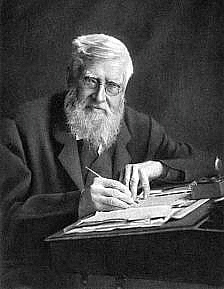
Alfred Russel Wallace (1913) near the end of his life.
First Theory of Natural Selection Applied to the Animal Nature of Man 1
Wallace’s First Theory of Natural Selection 2 is expressed thus:
There is a general tendency in nature which will cause a certain variety to survive the parent species, and to give rise to successive variations departing further and further from that original type, and which also produces, in those varieties induced by the guiding influence of men, the tendency to return to the parent form. (“On the Tendency of Varieties to Depart Indefinitely from the Original Type,” 1858)
In order to discuss the application of the principles of this theory to the nature of Man, the theory itself must be restated in a more general form. Wallace’s First Theory of Natural Selection, as it was originally conceived in 1858, does not account for the genus Homo—Man—but only for the purely animal and plant species. Wallace himself, however, suggests the means by which his original theory may be modified to accommodate Man. In “Limits of Natural Selection as Applied to Man” (1870), Wallace points out the similarity between domestication, the influence of men on certain species of plants and animals, and the influence of spiritual forces on Man, forces of “a superior intelligence” that have “guided the development of man in a definite direction, and for a special purpose, just as man guides the development of many animal and vegetable forms.” He also makes this additional point of clarification: “The essentially human portions of man’s structure and intellect may have been determined by the directing influence of some higher intelligent beings, acting through natural and universal laws.” Thus to arrive at a version of Wallace’s First Theory of Natural Selection that applies as well to plants and animals as it does to humans, we may modify the first theory by simply replacing the term men with the term some higher intelligent beings :
There is a general tendency in nature which will cause a certain variety to survive the parent species, and to give rise to successive variations departing further and further from that original type, and which also produces, in those varieties induced by the guiding influence of some higher intelligent beings, the tendency to return to the parent form.
The statement of the theory of natural selection in this more general form, which presumes only that Wallace considered men to be higher intelligent beings than plants and animals, will allow us to discuss the application of this theory, and the principal statements of the law of natural selection which it contains, to the nature of Man.
The first proposition of this general theory, that nature tends to produce a certain variety of a species that will not only survive its original type but also give rise to a succession of varieties that depart further from the original parent type, when it is applied to the genus Homo, states the principle behind a tendency that has been in operation upon the physical nature of Man over millions of years and through various species—Homo habilis (2.3 to 1.4 million years ago), Homo ergaster (1.9 to 1.4 million years ago), Homo erectus (1.8 to 1.3 million years ago), Homo antecessor (1.2 million to 800,000 years ago), Homo heidelbergensis (600,000 to 400,000 years ago), Homo neanderthalensis (130,000 to 30,000 years ago)—until the present time and up to the development of the present recognizable variations of Homo sapiens sapiens (600,000 years ago to the present). 3 Wallace himself describes this tendency in the history of Man’s physical evolution. An abridgement of his description follows:
We know positively that man was contemporaneous with many extinct animals, and has survived changes of the earth’s surface fifty or a hundred times greater than any that have occurred during the historical period. . . . But while these changes had been going on, his mental development had, from some unknown cause, greatly advanced, and reached that condition in which it began powerfully to influence his whole existence, and would therefore become subject to the irresistible action of natural selection. This action would quickly give ascendancy to mind . . . and from that moment man, as regards the form and structure of most parts of his body, would remain stationary. But from the moment that the form of his body became stationary, his mind would become subject to those very influences from which his body had escaped. . . .
We may trace back the gradually decreasing brain of former races, till we come to a time when the body also begins to materially differ. There we shall have reached the starting-point of the human family. Before that period he had not mind enough to preserve his body from change, and would, therefore, have been subject to the same comparatively rapid modifications of form as the other mammalia. . . . Man may continue to exist through a series of geological periods which shall see all other forms of animal life again and again changed . . . while he himself remains unchanged, except in two particulars—the head and face, as being immediately connected with the organ of the mind and as being the medium of the most refined emotions of his nature. (“The Development of Human Races Under the Law of Natural Selection,” 1864)
I wonder what you think of this proposition. To me, it seems impossible to deny, for it has the integrity of a statement ipso jure, an outgrowth of the law of natural selection itself. And, of course, it is just that. Wallace’s formula reconfigures clearly an event that is evidently complex: the face expressing a mind developed in a culture that manifests, however imperfectly, an expression of spirit. In “The Limits of Natural Selection as Applied to Man” (1870), Wallace suggests that man is gradually moving or evolving toward participation in the Eternal: Wallace contemplates the possibility that the development of the specifically human portions of man’s structure and intellect have been determined by the directing influence of more highly intelligent beings, perhaps encompassing layers of them, and that some more general and fundamental law underlies the law of natural selection. (I see behind Wallace’s idea the general and ancient idea of the Fall of Man and the generations of humans who long for redemption. It may be that the writers of scripture who recorded the Fall of the Heavenly Host inspired Wallace to respond to the significance of that allegory with courage and science.)
With this description, Wallace offers not only support to the first proposition of the General Theory of Natural Selection applied to Man, but also an explanation for many of the physical changes which anthropologists have categorized and catalogued in their taxonomy of the species and types of the genus Homo that have gone extinct thus far. For our own present varieties of the species Homo sapiens sapiens, Wallace’s proposition predicts the possibility of continued existence through coming series of geological periods, with physical changes to occur only in the head and face. These changes, according to Wallace, will occur in response to further developments within Man’s human nature, the higher nature of Man, which Wallace speaks of elsewhere as having its source in Man’s spiritual nature. 4
Wallace’s image of the evolution of Man, as he intended it to be understood, accounts for the refinements of Man’s animal nature, in the flesh and its concomitant unconscious processes, as humans tend towards what Wallace calls “higher existences than ourselves” 5—it goes that far and no further.
Robert G. Petrovich 2000, 2010
FOOTNOTES
1. All the essays of Wallace quoted herein may be found in Natural Selection (1891).
2. For a discussion of this theory, see Part 1: “First Theory of Natural Selection.”
3. The list here provides conventional naming and dating and does not intend to promote one taxonomic subtheory related to Man’s development over another.
4. For discussion, see Part 3: “A Postulate on Man’s Spiritual Origin.”
5. For discussion of this tendency, see Part 3: “A Postulate on Man’s Spiritual Origin.” Wallace is not alone in the recognition of the evolutionary process that he was the first to notice. At least two twentieth-century variations of this same theory may be found: one in the observations of this same tendency by the historian Oswald Spengler, the other in those of the paleontologist Pierre Teilhard de Chardin. They are traced out in my note “The Human Face of A.R. Wallace.”
< PART 5 >