Pentecost 2013 Observed
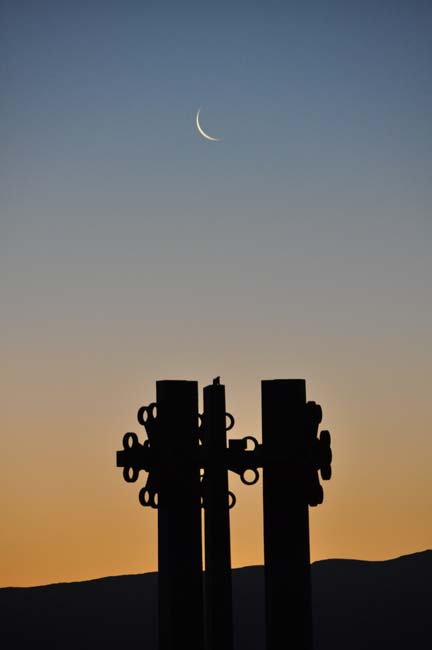
 

PHOTO: Stephan Fuelling

PHOTO: Stephan Fuelling

Pannuches Meal Rite
The 79th Pannuches Meal Rite was held Saturday, June 1, 2013 at 6:00 PM. Jubilee Sunrise Divine Service was held in Sanctuary the following morning.
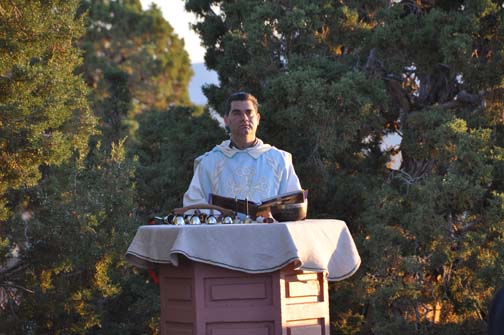
 

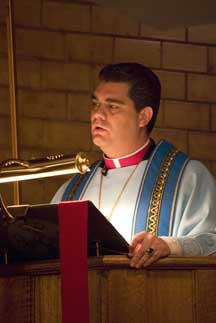
Bishop Gene Savoy Jr at the pulpit of the Church of New Pentecost   PHOTO: Stephan Fuelling

Bishop Gene Savoy Jr. at the pulpit of the Church of New Pentecost during sunrise divine service. PHOTO: Stephan Fuelling

Second Advent Pentecost (June 6, 2013)
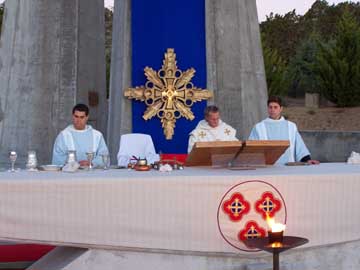
On Thursday, June 6, 2013 Second Advent Pentecost was observed with a celebration of Communion and Sunrise Divine Service at the Church of New Pentecost at Red Rock Consecrated Sanctuary. A light breakfast was served at the outdoor Sanctuary Refectory.

Pentecost in the Second Advent Church means that God has bestowed the Divine Presence upon the Community in Sanctuary, the Image and the Word that nurture the spirit and soul with Life and Wisdom. The old First Dispensation Christian celebration commemorates the descent of the Holy Spirit upon the Disciples seven weeks after Easter. In the old Hebrew calendar, Pentecost — Shavout or the Festival of Weeks — commemorated the giving of the Law on Mount Sinai. In the Second Advent, New Laws have been revealed at the Temple Mount for a new age under God at the Second Coming.

* * *

June 6—forty-nine days after April 18, Second Advent Easter—is a fixed date in the Sacred Calendar of The Church for the observance of Second Advent Pentecost. The sacred date of April 18 and the pentecontad cycle leading to June 6 are discussed in The Book of God’s Revelation. Book II of God’s Revelation, titled “The Seal of God’s New Law,” records the events, meditations, and visions experienced by The Man and The Companions of The Way on the day of Second Advent Pentecost, June 6, 1982.

The following excerpt from The Book of God’s Revelation describes the vision experienced by The Man atop the Temple Mount of the Sanctuary of Prophecy on the day of Pentecost 1982, and suggests the nature of the Revelations received that day:

And The Word of God spoke to his Soul a second time, revealing unto him the Sanctuary was under the special Blessing of God, and that he was to mark those sites where he communed with The Image and The Word.

And The Word of God proclaimed to The Man’s Soul that the Righteous Ministry was ordained to go forth to the whole world, proclaiming God’s Advent and the freedom of the peoples from the tyranny of heretical governments.

And God did reveal to him a Proclamation of Human Spiritual Rights that all governments were to acknowledge and honor. The Righteous Ministers would be God’s Envoys–as a nation in sanctuary–under the protection and sovereignty of God.

And The Word of God revealed that the Temple of uncut stones, made Righteous as was the sun of the earth, was blessed of God. And in the Temple, restored not by human hands but by the Hand of God, God would commune with the Righteous ordained to His Ministry.

And The Man saw a great cloud come over the Sanctuary and the face of the sun. And he felt God’s Presence and Blessings over the Sanctuary. And he looked at the sun grown brilliant by the clouds, its rays burning as fire, and he heard the Word of God say, “Let none but the Righteous in The Way look upon The Image I have made for a blessing over the land.

This day a gift is bestowed upon the Church of My Second Advent. The Light of the Sun in the Eight Appearances shall make wise the Souls of the Righteous who will have understanding and knowledge of God. United they shall be by spirit, bonded together as One in God, and there shall be no diversity amongst them.

“The Spirit of God is poured down upon His People who hear God’s Word. Let the Righteous seek out the Temple and be anointed by God for an earthly mission to make Righteous the people of the world.”

And from out of the cloud the Man saw a Heavenly City formed by shafts of light descending from the sun. And he saw that City hovering over the Sanctuary and the Temple Mount. And the City of Heaven and the Temple of the Sanctuary, with its mounts, were united by those shafts of light. And the shafts of light shone like blue pillars of sapphire reaching upward into the sun.

After a time the invisible City that had appeared returned to Heaven, but the light remained on the seven mounts in the likeness of thrones. And The Man heard The Word speaking to his Soul saying, “The Heavenly City of Light made visible by God shall be hidden to all but the Companions of The Way, anointed.”

And after the City had risen, he felt the presence of The Light. And he saw the sun’s response to the Divine Presence as great flares of light emitted from its surface.

And again The Word spoke saying, “As the Seven Mounts of the Temple have been sanctified by The Presence and bound to Heaven by cords of light beams, consecrate the Mounts of the Temple with holy oils for anointings of the Righteous. Let the faithful ordained to the Ministry of Righteousness be bound to these rocks and to the sun by the anointings, as the Soul and the Spirit are united with God by The Image and The Word in Light.

“God would that earthly Temples be such as this Temple—formed of stones uncut by human hands and joined with God by cords of Light—for the City of God’s Presence will descend upon gathering places such as these here.

“The True Temple of God is the Light of His Image and Word, and the True Temple of man is the Soul wherein dwells The Image and The Word.

“In the final age of the earth, at the threshold of the consummation by Fire, man, as flesh not made in The Image of God, has need of gathering places where the Light is quickened for the good of the Soul. For The Word has revealed that God shall indeed send a Divine redeeming Fire to enlighten Souls and burn up that wickedness first loosed by Satan and the fallen Angels of Darkness, lest the heretical nations ruin the world and the races.

“It is good that humankind restore order on earth in Justice, Love, Peace, Wisdom, and Understanding, thereby limiting the power of evil and of man. The Temple of uncut stones is given for a blessing and for the guidance of the nations and their peoples.”

On that same day, June 6, 1982, The Man marked the lesser mounts of the Temple Mount, the Garden of Oracles, as well as the site to be called God’s Waters.
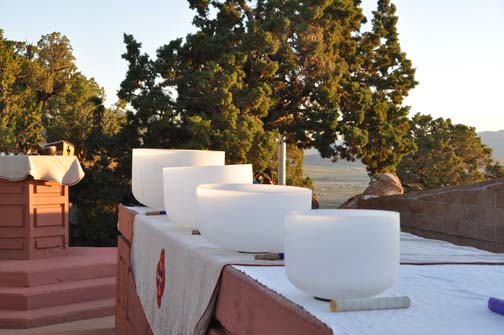
Singing bowls set up on the communion table at the Church of New Pentecost   PHOTO: Stephan Fuelling

Singing bowls set up on the communion table at the Church of New Pentecost PHOTO: Stephan Fuelling


Saturday, June 1, 2013: Chapel Readings

PHOTO: Roger Weld

PHOTO: Roger Weld

Each week of the liturgical year, a reading from Second Advent Scripture is delivered as part of the Saturday Communion of Fellowship Service held in the Chapel of the Holy Child. This reading follows the Sacred Calendar of the Church; that is, Prophecies and Revelations that have been received by The Church on sacred dates are recalled in a liturgical context during the appropriate season each year. This reading is delivered by the Officiant of the Communion Service (that is, Bishop Gene Savoy, or occasionally in his stead, Bishop Sean Savoy) just before the final blessings. Each service also includes a reading from the ancient scriptures, prayers, or wisdom sayings of various world religions past and present and is usually thematically related to the Second Advent Reading. This reading is delivered by the Reader right after the announcements that begin the service and is thus the first reading of the service. An audio recording of the reading from Second Advent Scripture delivered on the date above is provided here below together with a transcript of the first reading of the service that day.

SECOND ADVENT PROPHECY AND REVELATION

A Reading from Book I of the Book of God’s Revelation, “The Opening of the Seven Seals” (pp.95-103):

< Click here to listen to this week’s reading pre-recorded. >

ANCIENT SCRIPTURE AND WISDOM SAYINGS

A Reading from the Gospel of Philip:


Some are afraid lest they be resurrected naked. Because of this they wish to rise in the flesh, and they do not know that it is those who wear the flesh who are naked. It is those who unclothe themselves who are not naked. “Flesh and blood shall not inherit the kingdom of God.” What is it that will not inherit? That which is on us. But, also, what is it that will inherit? He who has received the Word and the Holy Spirit has food and drink and clothing. . . .

It is not possible for anyone to see anything of the things that actually exist unless he becomes like them. This is not the way with man in the world: he sees the sun without being a sun, and he sees the heaven and the earth and all other things, but he is not these things. This is quite in keeping with the truth. But you saw something of that [higher] place, and you became those things. You saw the Spirit, you became spirit. You saw Christ, you became Christ. You saw the Father, you shall become Father. So in this place you see all things but do not see yourself, but in that place you do see yourself—and what you see you shall become.


Services for the Week of June 1, 2013


Saturday, June 1, 2013
10:00 AM COMMUNION
Chapel of The Holy Child
RR Sean Savoy
Lector: RC Gary Buchanan
Cantor: Rev. Vickie Hewlett
Reader: Rev. Michael Spohn
Organist: pre-recorded tape

6:00 PM 79th PANNUCHES MEAL
Chapel of the Holy Child
RR Sean Savoy
Concelebrant: Carol Ann Crabb

Sunday, June 2, 2013
5:27 AM JUBILEE SUNRISE & NEW DIVINE SERVICE
Church of New Pentecost
Leave: 4:30
Gate: 5:10
Sunrise: 5:39
RR Sean Savoy
Concelebrant: RC Robert Petrovich
Assistants:
RC Roger Weld
Rev. Ted Staver
RM Carol Ann Crabb
Organist: RC Gary Buchanan

OPEN-AIR COMMUNION
Church of the Races of Man                  RC Robert Petrovich
Church of the Universal Theocracy                  RC Elizabeth Reece
Church of the Americas                       Rev. Barbara Whitney

Wednesday, June 5, 2013
12 N COMMUNION
Chapel of the Holy Child
Rev. Michael McIntyre

Thursday, June 6, 2013
SECOND ADVENT PENTECOST
5:23 AM  NEW DIVINE SERVICE
Church of New Pentecost
Leave: 4:30
Gate: 5:10
Sunrise: 5:38
RR Gene Savoy Jr.
Concelebrant: RR Sean Savoy
Assistants:
RC Roger Weld
RC Robert Petrovich
RC Rebecca Willis
Organist: RC Gary Buchanan

Friday, June 7, 2013
9:00 AM PRAYER & FELLOWSHIP
Chapel of the Roses
RC Rebecca Willis


JAPAN REPORT: Letter from Japan, March 2013


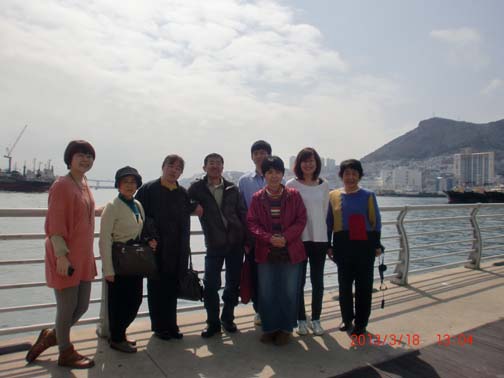
Cosolargy of Japan tour group in Pusan, Korea  PHOTO: Miyuki Okayama

Cosolargy of Japan tour group in Pusan, Korea. PHOTO: Miyuki Okayama

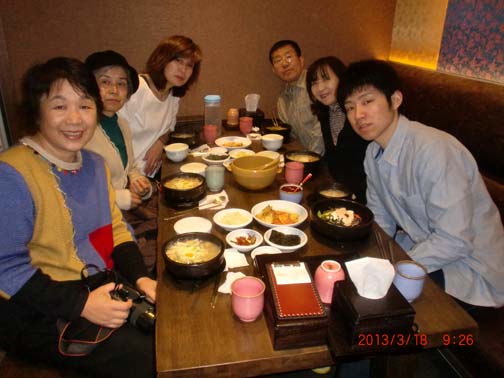
We traveled to Pusan in South Korea from March 17 to the 19.

Bishop Yukinori Matsushita and Mituyo Fukuyama, Kazuno Kawasaki, Saeno Tokunaga and her son Ryota, Nami Aiki, Junko Kodama, Jun Ikeda, and myself, Miyuki Okayama, traveled to Pusan by ferry.

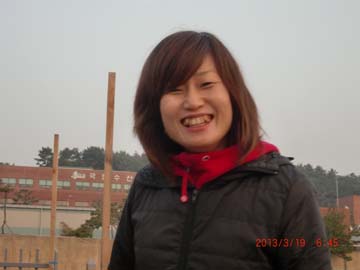
Nami organized the tour, and she was a very good guide.


Nama Aiki, tour guide and Consociate of the Cosolargy Institute of Japan.

Nama Aiki, tour guide and Consociate of the Cosolargy Institute of Japan.


Korean people think that if they have a diet of balanced, healthy food, it will be effective medicine and make good health of body. Following the traditional Korean diet was part of our experience.

We had a great experience of Korean culture and enjoyed this trip.

PHOTO: Miyuki Okayama

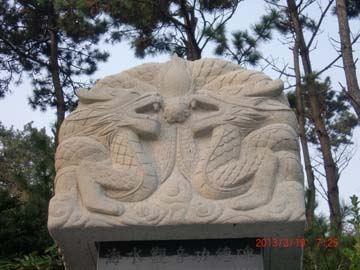
Dragon Palace Temple. PHOTO: Miyuki Okayama


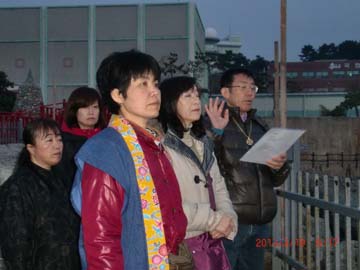
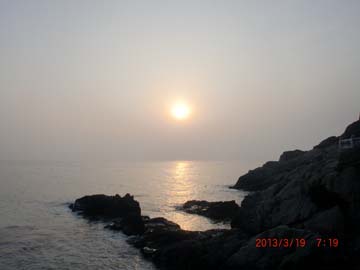
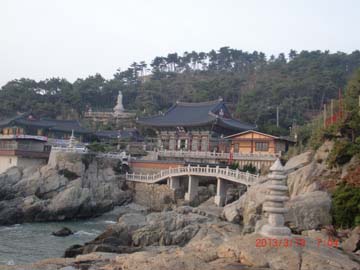
We did the Sunrise Ceremony at Haedong Yeongkoong Temple (Dragon Palace Temple) on the morning of March 19.

Pre-sunrise liturgical reading at Pusan, Korea  PHOTO: Miyuki Okayama

Pre-sunrise liturgical reading at Pusan, Korea.                                        PHOTO: Miyuki Okayama


Sunrise in Pusan, Korea  PHOTO: Miyuki Okayama

Sunrise in Pusan, Korea. PHOTO: Miyuki Okayama


Haedong Yeongkoong Temple (Dragon Palace Temple)   PHOTO: Miyuki Okayama

Haedong Yeongkoong Temple (Dragon Palace Temple).                   PHOTO: Miyuki Okayama

This temple is built on the cliffs of the grand seashore and is harmonized with its natural surroundings.

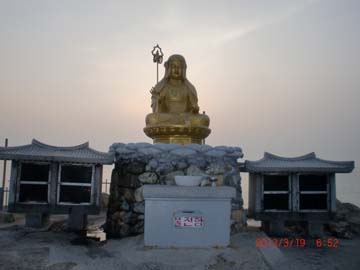
PHOTO: Miyuki Okayama

Dragon Temple shrine. PHOTO: Miyuki Okayama


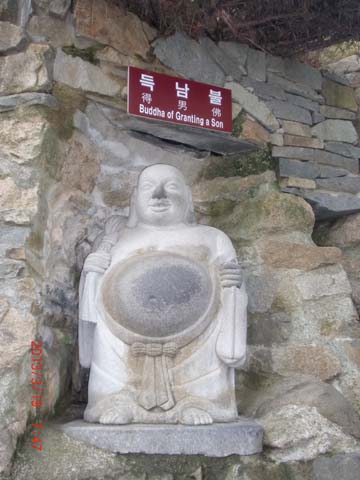
 It is believed that a boy will be conceived if a woman touches her belly while visiting the temple. PHOTO: Miyuki Okayama

It is believed that a boy-child will be conceived if a woman touches her belly while visiting this shrine. PHOTO: Miyuki Okayama


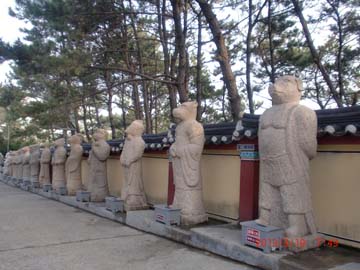
The twelve animal signs of zodiac are displayed at the temple. PHOTO: Miyuki Okayama

The twelve animal signs of of the Chinese zodiac are displayed at the temple. PHOTO: Miyuki Okayama


We had a wonderful time there.

Sincerely,

Miyuki Okayama


Bishop Yukinori Matsushita and Mituyo Fukuyama, Kazuno Kawasaki, Saeno Tokunaga and her son Ryota, Nami Aiki, Junko Kodama, Jun Ikeda, and Miyuki Okayama in Pusan, Korea  PHOTO: Miyuki Okayama

Bishop Yukinori Matsushita and Mituyo Fukuyama, Kazuno Kawasaki, Saeno Tokunaga and her son Ryota, Nami Aiki, Junko Kodama, Jun Ikeda, and Miyuki Okayama in Pusan, Korea PHOTO: Miyuki Okayama


ADVOCATES OF HUMAN SPIRITUAL RIGHTS: Francis of Assisi, Part 1

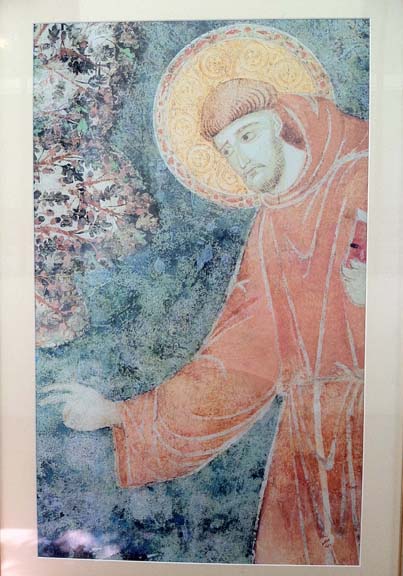
Detail of Francis from the fresco "St. Francis Preaches to the Birds" painted on the west side of the nave of the lower basilica in the Basilica of St. Francis in Assisi.

Detail of Francis from the fresco “St. Francis Preaches to the Birds” painted on the west side of the nave of the lower basilica in the Basilica of St. Francis in Assisi.


All praise be yours, my Lord, through all that you have made,
And first my lord Brother Sun,
Who brings the day; and light you give us through him.
How beautiful is he, how radiant in all his splendor!
Of You, Most High, he bears the likeness.
— “The Canticle of the Sun,” Francis of Assisi


Francesco di Pietro di Bernardone (born 1181/1182, Assisi—died October 3, 1226, Assisi, Italy), known as Francis of Assisi, is the principal patron saint of Italy, the original founder of all Franciscan Orders, and the leader of Roman Catholic reform movements of the early 13th century. His father was a wealthy cloth merchant; his mother, a noble woman from Provence. He was born and grew into adolescence in warring times, when it was customary for nobles of neighboring towns to engage in military skirmishes and while the popes of Christendom called up the Third and Fourth Crusades against the Islamic forces in Palestine. In youth Francis was handsome, gallant, courteous, and witty, a humorous imp and king of frolic who would as soon empty his pockets for a beggar as for himself, popular with everyone in town and the romantic ringleader of the young nobles. He fancied himself a disciple of the Provençal “joyous science,” a troubadour. He early resolved on a military career, and in late 1205 he attempted to join the papal forces against Frederick II, the Holy Roman emperor; Francis’s biographers tells us that a series of dreams or visions urged him back to Assisi where, after a period of uncertainty, he began to seek an answer to his calling in solitary prayer. Not long after, as Dante sings, Francis solemnized his nuptials with Lady Poverty. In 1208, while Pope Innocent III proclaimed a crusade against the “Albigenses” that eradicated the language and culture of Provence, Francis exchanged the remnant of his fashionable clothes for a single tunic in the style of the poorest Umbrian peasant and wandered into the hills behind Assisi, improvising hymns of praise and identifying himself as “herald of the Great King” and “God’s troubadour.” Whatever he did in the name of God he did with the same appearance of great import and seriousness and the same light humor and grace he had used in younger days, mischievous and merrily sly, to undermine the tyrannies that complicate human life.

He evolved into a profound mystic and teacher. He made his life into a drama, at times as an example, at other times as a lesson to be watched and not imitated, in order to awaken and return a half-dead Christendom to God. Thoroughly in touch with his age, he used his life to reflect and evoke what was in the heart of the people, and from him the people learned to live in the hope of immortality. He blended the natural and the supernatural so closely in his life that he clothed his asceticism in romantic charm and impregnated his language with the chivalry and poetry of the chanson de geste. In his concept, Courtesy was the younger sister of Charity and one of the qualities of God himself; the Divine was reflected in all things; there were sermons in stones; and all things were his brothers and sisters. The life he wished to communicate was the life of Christ, “The Mirror of Perfection,” and he took on the persona of Christ as a role he played. He never intended to found an Order (he was ordained a deacon later in life under protest) but a brotherhood that expressed God’s brotherhood, of which all created things were a part. He did not intend to be a reformer: He tried to correct abuses by holding up Images of God. To those who sought “better gifts,” he opened his arms; the others he left alone. His mission was to rekindle the love of God in the world and to reanimate the life of the spirit in the hearts of all.

His example began to attract followers in 1209. When the number of his companions numbered eleven, Francis drew up a rule of life for them to follow, styled his group the Penitents of Assisi, and set out for Rome to seek the approval of the Holy See. Accounts of their reception differ, but it seems Pope Innocent III verbally approved the Rule, and so the members received the ecclesiastical tonsure. (This “first Rule,” as it is now called, has not come down to us in its original form.) After their return to Assisi, the brethren, now called by Francis the Friars Minor— that is, the Lesser Brothers—obtained a permanent foothold near Assisi about 1211 through the generosity of the Benedictines of Monte Subasio, who gave the brethren the little chapel of St. Mary of the Angels, the now-famous Portiuncola. Adjoining this humble sanctuary, a few small huts of straw and mud enclosed by a hedge became their first convent and the central spot in the life of Francis. From here, Francis sent forth the Friars Minor two by two like children “careless of the day,” singing in their joy and calling themselves the Lord’s minstrels. During Lent 1212, Clare, a noble eighteen-year-old heiress of Assisi, sought out Francis to become his spiritual student. In her, Francis found the embodiment of the Lady Poverty whom he had served from afar. Francis gave her a religious habit similar to his own and eventually lodged her in the church of St. Damian with her sister Agnes and a few other female companions who followed her. Thus was founded the sisterhood of Poor Ladies (now known as the Poor Clares).

Francis convoked the first general chapter of the Friars Minor at the Portiuncola in May 1217. At this gathering, Francis apportioned the provinces of the Christian world into so many missions. Francis reserved France for himself, but he was dissuaded from going there by Cardinal Ugolino (soon after made protector of the Friars Minor by Pope Honorius III), who sent Francis to Rome to preach before the pope and cardinals in the pope’s own cathedral of St. John Lateran in order to allay the prejudices that had been growing among the Roman Curia at the methods Francis was using. At the second general chapter of the Order in May 1219, Francis assigned a separate mission to each of his foremost disciples. For himself, he selected the seat of the newly pronounced Fifth Crusade against the Saracens. In June he set sail for Egypt with eleven of his companions. Francis was present at the siege and the taking of the city of Damietta by the Christian crusaders. In the midst of the battle, Francis preached to the crusaders, then passed over to the enemy camp where he was arrested and led to the sultan. It is reported that the sultan received Francis with courtesy and gave him permission to visit the holy places in Palestine. It is also reported that the sultan, charmed by Francis, said: “I would convert to your religion, which is a beautiful one—but both you and I would be murdered.”

< PART 2 >


Saturday, May 25, 2013: Chapel Readings

PHOTO: Roger Weld

PHOTO: Roger Weld

Each week of the liturgical year, a reading from Second Advent Scripture is delivered as part of the Saturday Communion of Fellowship Service held in the Chapel of the Holy Child. This reading follows the Sacred Calendar of the Church; that is, Prophecies and Revelations that have been received by The Church on sacred dates are recalled in a liturgical context during the appropriate season each year. This reading is delivered by the Officiant of the Communion Service (that is, Bishop Gene Savoy, or occasionally in his stead, Bishop Sean Savoy) just before the final blessings. Each service also includes a reading from the ancient scriptures, prayers, or wisdom sayings of various world religions past and present and is usually thematically related to the Second Advent Reading. This reading is delivered by the Reader right after the announcements that begin the service and is thus the first reading of the service. An audio recording of the reading from Second Advent Scripture delivered on the date above is provided here below together with a transcript of the first reading of the service that day.

SECOND ADVENT PROPHECY AND REVELATION

A Reading from Book I of the Book of God’s Revelation, “The Opening of the Seven Seals” (pp.92-94):

< Click here to listen to this week’s reading pre-recorded. >

ANCIENT SCRIPTURE AND WISDOM SAYINGS

The Eleventh Ode of Solomon:

My heart was opened and its flower appeared; and grace sprang up in it; and it brought forth fruit to the Lord,
2 For the Most High opened my hear by His Holy Spirit and searched my affection toward Him: and filled me with His love.
3 And His opening of me became my salvation; and I ran in His way, in His peace, even in the way of truth:
4 From the beginning and even to the end I acquired His knowledge:
5 And I was established upon the rock of truth, where He had set me up:
6 And speaking waters touched my lips from the fountain of the Lord plenteously:
7 And I drank and was inebriated with the living water that does not die;
8 And my inebriation was not one of ignorance, but I forsook vanity and turned to the Most High my God,
9 And I was enriched by His bounty, and I let go the folly which is diffused over the earth; and I stripped it off and cast it from me:
10 And the Lord renewed me in His own garment, and possessed me by His light, and from above He gave me rest in incorruption;
11 And I became like the land which blossoms and rejoices in its fruit:
12 And the Lord was like the sun shining on the face of the land;
13 He lightened my eyes, and my face received the dew; and my nostrils enjoyed the pleasant odor of the Lord;
14 And he carried me to His Paradise; where is the abundance of the pleasure of the Lord;
15 And I worshiped the Lord on account of His glory; and I said, Blessed, O Lord, are they who are planted in thy land! And those who have a place in thy Paradise;
16 And they grow by the fruits of the trees. And they have changed from darkness to light


Services for the Week of May 25, 2013


Saturday, May 25, 2013
10:00 AM COMMUNION
Chapel of The Holy Child
RR Gene Savoy Jr.
Lector: RC Robert Petrovich
Cantor: Rev. Jim Elliott
Reader: Rev. Francine Petrovich
Organist: RC Gary Buchanan

Sunday, May 26, 2013
5:27 AM NEW DIVINE SERVICE
Church of New Pentecost
Leave: 4:30
Gate: 5:15
Sunrise: 5:42
RR Sean Savoy
Concelebrant: RC Robert Petrovich
Assistants:
RC Roger Weld
Rev. Ted Staver
RM Carol Ann Crabb
Organist: RC Gary Buchanan

OPEN-AIR COMMUNION
Church of the Golden Age of Light                    RM Carol Ann Crabb
Church of the Universal Theocracy                  RC Rebecca Willis
Church of the Americas                                     Rev. Michael Spohn

Wednesday, May 29, 2013
12 N COMMUNION
Chapel of the Holy Child
Rev. Ted Staver

Friday, May 31, 2013
9:00 AM PRAYER & FELLOWSHIP
Chapel of the Roses
Rev. Michael Tamburrello


INSIGHT: Dream and Vision Forum: May 2013


This is your forum to share higher-level experiences in Cosolargy through the images of your dreams and visions. All postings are anonymous. Send in verbal descriptions and, if you have them, drawings or paintings.

The primary value in these postings is simply to allow others to see that people do have relevant or meaningful dreams and visions. Another value is to see if others find that the dreams and visions we post are similar or identical to their own. This is why we ask for your comments.

Dreams are communications from the unconscious mind and sometimes the higher self. Some are simply compensation for attention directed elsewhere during the day; some are indications of bodily processes, and some help us work through conflicts. Occasionally, they communicate information from higher realms and thus have more than individual value.

As Cosolargists, we are learning to navigate higher realms. Dreams are part of these higher realms. The Worlds of Light, the realm of spirit, sometimes breaks through to the psyche and gives us information. What breaks through deserves our attention and analysis. In this section of the Community Communique, we offer Community members a forum for sharing their dreams and visions for the edification of the Community and themselves.


Dream No. 7

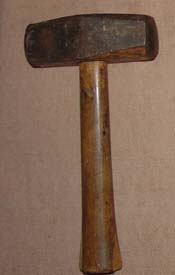
2013-REP-Quarry-Hammer

Normally when I dream, especially if it is a warning of some sort ,the outcome makes itself known within a three day period. In this dream, I found myself in a rock quarry. I was in the pit trying to pry out a rock from the side. I heard a voice yell out to me, “Try this!” I looked up and standing at the edge of the quarry was Reverend Gene Sr. He threw a large hammer down to me. It was early in the morning just before sunrise when I awoke from the dream, and I thought it was strange so I grabbed the Dream Dictionary and looked up “hammer,” which means hard work. Well, I thought, “So what else is new?” It was some years later that I was on a work crew in the Sanctuary in a big pit with a pry bar digging through the decomposed granite that the dream of years ago flashed in my mind and I then understood that the dream was years into the future. Makes me think that some of the other dreams I’ve had that are not quite clear to me have yet to make themselves manifest.


JAPAN REPORT: Letter from Japan, January 27, 2013


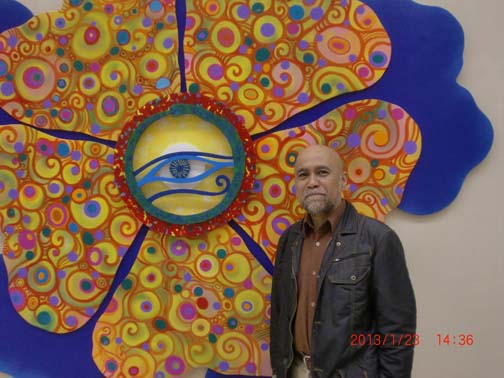
Artist Sadayuki Hagiwara posing before one of his works. PHOTO: Miyuki Okayama

Artist Sadayuki Hagiwara posing before one of his works. PHOTO: Miyuki Okayama

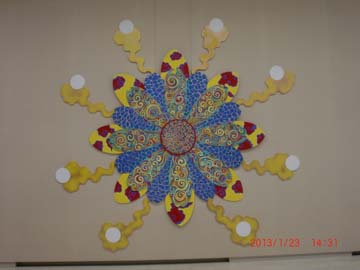
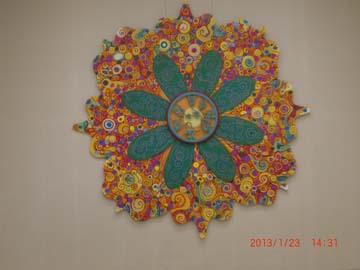
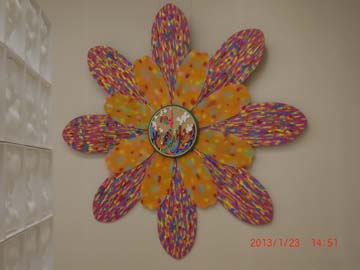
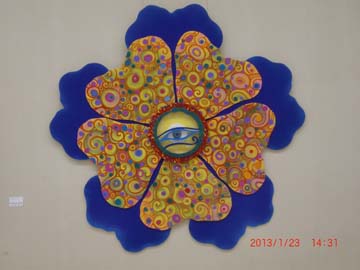
From January 22 – 27, 2013, Japanese Consociate Sadayuki Hagiwara held a private exhibition at Kagoshima Municipal Art Museum titled “Flower of Life.”

Work of artist Sadayuki Hagiwara. PHOTO: Miyuki Okayama

Work of artist Sadayuki Hagiwara. PHOTO: Miyuki Okayama

The round shape had always been a theme of his works of art. However, he thought something was missing. He found that “something” when he began to study Cosolargy. After that his artwork changed.

Work of artist Sadayuki Hagiwara. PHOTO: Miyuki Okayama

Work of artist Sadayuki Hagiwara. PHOTO: Miyuki Okayama


2013-REP-Sadayuki_artwork_CIMG2240-OkayamaM


Work of artist Sadayuki Hagiwara. PHOTO: Miyuki Okayama

Work of artist Sadayuki Hagiwara. PHOTO: Miyuki Okayama


Sincerely,

Miyuki Okayama


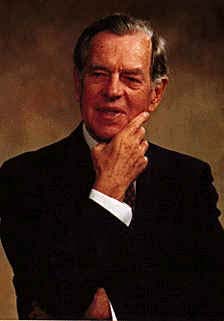
ADVOCATES FOR HUMAN SPIRITUAL RIGHTS: Joseph Campbell

Joseph Campbell

Joseph Campbell


God is a metaphor for a mystery that absolutely transcends all categories of human thought. . . . It’s as simple as that.
—Joseph Campbell, in an interview with Gary Abrams of the Los Angeles Times


Joseph Campbell was born on March 26, 1904, into a staunch Roman Catholic family and enjoyed an upper-class upbringing in New York state. He undertook academic studies at Columbia University and at the University of Munich, where he studied Sanskrit and Indo-European philology. In 1934 he began his teaching career at Sarah Lawrence College and soon after married dancer and choreographer Jean Erdman. Between the years 1949 and 1983, he published his major works on comparative mythology. He died in Honolulu, Hawaii, on October 31, 1987.

Campbell was first drawn to mythology by his interest in Native Americans. After seeing Buffalo Bill’s Wild West Show at Madison Square Garden, he read every book he could find about American Indian tribes and toured the American Museum of Natural History whenever he had time, enthralled by the Indian exhibits there. In prep school he studied the ancient cultures of the South Pacific, and by the time he entered college he had a wide knowledge of folklore and mythology. At Columbia University, Campbell earned degrees in English and medieval literature, and as a member of the university’s track team he traveled to California, Mexico, Guatemala, Nicaragua, Panama, and Cuba. On one of those trips, a meeting with Jiddu Krishnamurti sparked his interest in Hinduism and Buddhism. Campbell dropped out of the doctoral program at Columbia when he was told that mythology was not a fit subject for a dissertation.

For several years after his exodus from Columbia, Campbell studied mythology on his own. In 1927, on an excursion to Paris to study Old French and Provençal, Campbell encountered James Joyce’s labyrinthine novel Ulysses. When he got to chapter 3, “Proteus,” he was puzzled by the opening: Ineluctable modality of the visible: at least that if no more, thought through my eyes. Signatures of all things I am here to read. . . .” He took his enigma to Sylvia Beach, at Shakespeare and Co., 12 Rue de l’Orlean, in a high state of academic indignation, and she gave him the clues he needed to read it. This conversation changed his career. What Campbell discovered became the foundation of his work in comparative mythology and moved him to explore Joyce’s literary creations for sixty years. When he returned to the United States, he spent a year and a half in a cabin in the woods around Woodstock, New York, reading scholarly works on mythology, legends, and folklore. In 1932 he took a teaching position with his old preparatory school. A year later he sold his first short story, “Strictly Platonic.” The next year he moved to Sarah Lawrence College where he taught literature until 1972.

During his years as a teacher, Campbell produced a massive body of work in the fields of comparative mythology, folklore, and religion. He began in the 1940s by editing the unfinished works of the late Heinrich Zimmer, a noted lecturer in Indology at Columbia, who was his friend and mentor. After ten years of work on Indian art and philosophy, Campbell made a long-postponed journey to Asia, which became another turning point in his life. His six months of disillusionment and revelation in India is recorded in his published journals Baksheesh and Brahman.

Campbell’s first book as sole author, The Hero with a Thousand Faces (1949), took him four years to write. In this work, Campbell attempted to unite the world’s mythologies into a “monomyth,” the single underlying story that all myths tell. He found that story to be an outline of the proper way for humans to live. Early reviewers were put off by the volume’s mystical tone. In the four-volume work The Masks of God (1959–1968), Campbell surveyed the world’s mythologies while he argued on behalf of his idea of the monomyth. The first volume begins with the religious ideas of the Bronze Age. The second turns to the East to trace the emergence of the particularly Asian idea of reincarnation and transcendence of the ego. The third begins with the prehistoric belief in a mother-goddess and follows the course of Western religious belief down through the centuries. In the concluding volume, Campbell shifts his attention away from the anonymous myths of the past toward the personal myths of the present created by artists and writers such as Dante, Joyce and T.S. Eliot, and argues the need for a new mythology that speaks to the entire human race in modern terms. With The Mythic Image (1974), Campbell turned to the origins of myth. His argument is that the human unconscious mind, particularly dreams, form the basis of all mythology. Four hundred illustrations collected from all over the world and ranging from prehistoric cave paintings to avant-garde works of the present day are used as evidence of the relationship between myth and dream in humankind’s artistic creations. Swiss psychologist Carl Jung had earlier raised the same point with his theory of the Collective Unconscious. In The Mythic Image, Campbell gave the theory clear and splendid demonstration. In 1983 Campbell published the first of a planned six-volume series titled Historical Atlas of World Mythology. Campbell meant this work to relate the mythological history of the world in a single, all-encompassing narrative. The intended six volumes of the Atlas were never completed.

In addition to writing, Campbell produced a number of video interviews with Bill Moyers for the Public Broadcasting Service (PBS) television special The Power of Myth. These interviews, broadcast together in 1988 as a six-part series, drew an audience of 2.5 million people per episode. A best-selling book based on the televison program was also released. A second PBS program, Transformations of Myth through Time, collected thirteen of Campbell’s lectures on the evolution of myth. In 1989 the series of lectures was released in book form.

Since Campbell’s death in 1987, several volumes of interviews, essays, and other works have been published. An Open Life is the transcription of ten years of interviews on diverse subjects. A more intimate collection of interviews is contained in The Hero’s Journey: Joseph Campbell on His Life and Works. Campbell’s exposure via PBS made him known to more people after his death than while he was alive. This exposure transformed him into the rarest of intellectuals in American life: the serious thinker who is embraced by popular culture. He will be remembered for his efforts to rediscover, for a world deprived of meaning, the fundamental mythological pattern of the human spirit.

Robert Petrovich, 2001