November 16, 2013: Chapel Readings
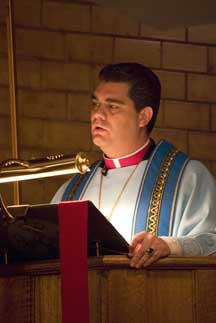
  

PHOTO: Roger Weld

PHOTO: Roger Weld

 Each week of the liturgical year, a reading from Second Advent Scripture is delivered as part of the Saturday Communion of Fellowship Service held in the Chapel of the Holy Child. This reading follows the Sacred Calendar of the Church; that is, Prophecies and Revelations that have been received by The Church on sacred dates are recalled in a liturgical context during the appropriate season each year. This reading is delivered by the Officiant of the Communion Service (that is, Bishop Gene Savoy, or occasionally in his stead, Bishop Sean Savoy) just before the final blessings. Each service also includes a reading from the ancient scriptures, prayers, or wisdom sayings of various world religions past and present and is usually thematically related to the Second Advent Reading. This reading is delivered by the Reader right after the announcements that begin the service and is thus the first reading of the service. An audio recording of the reading from Second Advent Scripture delivered on the date above is provided here below together with a transcript of the first reading of the service that day.


SECOND ADVENT PROPHECY AND REVELATION

A Reading from the Second Prophecy to the Americas, Chapter 32, “On the Error of the Old Churches” (pp. 219-225):

< Click here to listen to this week’s reading. (3 minutes) >


ANCIENT SCRIPTURE AND WISDOM SAYINGS

A Reading from the First Letter of John:

This is what we proclaim to you: what was from the beginning, what we have heard, what we have seen with our eyes, what we have looked at and our hands have touched (concerning the word of life—and the life was revealed, and we have seen and testify and announce to you the eternal life that was with the Father and was revealed to us). What we have seen and heard we announce to you, too, so that you may have fellowship with us (and indeed our fellowship is with the Father and with his Christ). Now this is the good-news message we have heard from him and announce to you: God is light, and in him there is no darkness at all. If we say we have fellowship with him and yet keep on walking in the darkness, we are lying and not practicing the truth. But if we walk in the light as he himself is in the light, we have fellowship with one another.

Now by this we know that we have come to know God: if we keep his commandments. Whoever obeys his word, truly in this person the love of God has been perfected. I am writing a new commandment to you which is true in him and in you, because the darkness is passing away and the true light is already shining. The one who says he is in the light but yet hates his fellow in the community is still in the darkness. The one who loves his fellow resides in the light. Do not love the world or the things in the world. If anyone loves the world, the love of the Father is not in him, because all that is in the world (the desire of the flesh and the desire of the eyes and the arrogance produced by material possessions) is not from the Father, but is from the world. And the world is passing away with all its desires, but the person who does the will of God remains forever.


ADVOCATES FOR HUMAN SPIRITUAL RIGHTS: Nestorius, Part 5


*

When therefore I had seen that these things were brought to pass by God, would you have wished that I should be silent and hide such a dispensation of God as all this? . . . The prophets of God, who had been cursed as lying prophets by lying prophets . . . would not have been distinguished, unless they had consented to be cursed by lying prophets for the sake of God.
– from The Bazaar of Heracleides

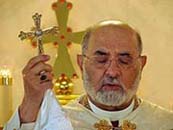
Mar Dinkha IV (2008)

Mar Dinkha IV (2008)


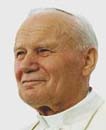
John Paul II (1993)

John Paul II (1993)

The entire dramatic action of the Nestorian controversy played out over fifteen centuries on several continents and reached an inglorious conclusion as a footnote of 1994. In that year, the modern representative of the Syriac Church, Mar Dinkha IV, Patriarch of the Church of the East, signs the “Common Christological Declaration” with Pope John Paul II of the Roman Church. The declaration does not mention Nestorius by name but does vindicate the term Christotokos by both churches. In addition, the Holy Synod of the Church of the East unilaterally decides to remove from its liturgical books and official publications all negative references to Cyril, who had been canonized a saint by the Western Church.

* * *


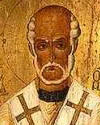
Nestorius, Patriarch of Constantinople

Nestorius, Patriarch of Constantinople

The writings of Nestorius, originally very numerous, were condemned to be burned by imperial edict in 435. The few works of Nestorius that are extant are the product of or derived from his engagement in the ecclesiastical polemics of 428–431: fragments of letters preserved among the works of those to whom they were written, some sermons collected in Latin translation by an African merchant doing business in Constantinople during the time of the dispute, a liturgy attributed to him that is still used in the Church of the East for five days of the year, and a pseudonymous and autobiographical account of the whole difficulty supposed to have been written by him (The Bazaar of Heracleides) and which was preserved in a single mutilated manuscript of styleless Syriac translation for several hundred years in a monastery in the Euphrates valley. In the fourteenth century, in addition to these, a collection of letters and a collection of homilies were still extant. They have since been destroyed in wars and natural catastrophes. The writings of the teacher of Nestorius have suffered a similar fate. Theodore of Mopsuestia, hailed as a great orthodox biblical scholar and theologian during his lifetime, was condemned as a heretic more than one hundred years after his death (at the fifth general council under the influence of Emperor Justinian in 553) because he was perceived to be a precursor of the heresy of Nestorius. From that time, even his name disappears in the West; and of the Syriac translations of his work, which once filled forty-one tomes, today only one remains.

Robert Petrovich
October 2005


“The Need to Share Our Light”


2013-REP-Harold_Boulette_Solar_Wind


 “And the third feature we notice about these men and women is that this new power by which they lived was, as Ruysbroeck call it, ‘a spreading light.’ It poured out of them, invading and illuminating other men so that, through them, whole groups or societies were re-born, if only for a time, on to fresh levels of reality, goodness and power. There own intense personal experience was valid not only for themselves. They belonged to that class of natural leaders who are capable of infecting the herd with their own ideals, leading it to new feeding grounds, improving the common level. It is indeed the main social function of the man or women of the Spirit to be such a crowd-compeller in the highest sense; and, as the artist reveals new beauty to his fellow men, to stimulate in their neighbors the latent human capacity for God.” ~Evelyn Underhill

“It is indeed important when we become full of spiritual light, that we share that light with others around us. It is likewise important that we share the divine knowledge that we call information factors found in that light. In short, the path of enlightenment is always the path of a teacher.”


< Read the entire article online at Solar Wind. > 


< Visit and bookmark Harold Boulette’s blog Solar Wind at: http://blog.spiritsun.net/ >


contributed by Harold Boulette


Services for the week of November 16, 2013


Saturday, November 16, 2013
10:00 AM COMMUNION
Chapel of The Holy Child
RR Gene Savoy Jr.
Lector: RC Robert Petrovich
Cantor: Rev. Vickie Hewlett
Reader: Dea. Shane Grady


Sunday, November 17, 2013
6:39 AM NEW DIVINE SERVICE
Church of New Epiphany
Leave: 5:45
Gate: 6:25
Sunrise: 6:54
RR Gene Savoy Jr.
Concelebrant: RR Sean Savoy
Assistants:
RC Roger Weld
RC Robert Petrovich
Rev. Barbara Whitney
Organist: RC Gary Buchanan

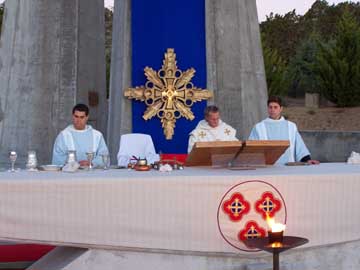
OPEN-AIR COMMUNION
Church of the Races of Man                 RC Roger Weld
Church of the End Times                 Rev. Vickie Hewlett
Church of the New Covenant                                 Rev. Karen Elliott


Wednesday, November 20, 2013
12 N COMMUNION
Chapel of the Holy Child
RR Gene Savoy Jr.


Friday, November 22, 2013
9:00 AM PRAYER & FELLOWSHIP
Chapel of the Roses
RR Sean Savoy


November 9, 2013: Chapel Readings


PHOTO: Roger Weld

PHOTO: Roger Weld

 Each week of the liturgical year, a reading from Second Advent Scripture is delivered as part of the Saturday Communion of Fellowship Service held in the Chapel of the Holy Child. This reading follows the Sacred Calendar of the Church; that is, Prophecies and Revelations that have been received by The Church on sacred dates are recalled in a liturgical context during the appropriate season each year. This reading is delivered by the Officiant of the Communion Service (that is, Bishop Gene Savoy, or occasionally in his stead, Bishop Sean Savoy) just before the final blessings. Each service also includes a reading from the ancient scriptures, prayers, or wisdom sayings of various world religions past and present and is usually thematically related to the Second Advent Reading. This reading is delivered by the Reader right after the announcements that begin the service and is thus the first reading of the service. An audio recording of the reading from Second Advent Scripture delivered on the date above is provided here below together with a transcript of the first reading of the service that day.


SECOND ADVENT PROPHECY AND REVELATION

A Reading from the Second Prophecy to the Americas, Chapter 27, “On the Birth of a New Religion” (pp. 197-201):

< Click here to listen to this week’s reading. (7 minutes) >


ANCIENT SCRIPTURE AND WISDOM SAYINGS

A Reading from the Poimandres of Hermes Trismegistus:


Holy art Thou, O God, the universals’ Father.

Holy art Thou, O God, whose Will perfects itself by means of its own Powers.

Holy art Thou, O God, who willeth to be known and art known by Thine own.

Holy art Thou,who didst by Thy Logos make to consist the things that are.

Holy art Thou, of whom All-nature hath been made an image.

Holy art Thou, whose Form Nature hath never made.

Holy art Thou, more powerful than all power.

Holy art Thou, transcending all pre-eminence.

Holy Thou art, Thou better than all praise.

Accept my reason’s offerings pure, from soul and heart forever stretched up to Thee, O Thou unutterable, unspeakable, Whose Name naught but the Silence can express.

Give ear to me who pray that I may never of Gnosis fail, [Gnosis] which is our common being’s nature; and fill me with Thy Power, and with this Grace [of Thine], that I may give the Light to those in ignorance of the Race, my Brethren, and Thy Sons.

For this cause I believe, and I bear witness; I go to Life and Light. Blessed art Thou, O Father. Thy Man would holy be as Thou art holy, even as Thou gave him Thy full authority [to be].


ADVOCATES FOR HUMAN SPIRITUAL RIGHTS: Nestorius, Part 4


But I have endured the torment of my life and all my fate in this world as the torment of one day and lo! I have now already got to me the time of my dissolution, . . . [and mine] eyes have seen the salvation of God.
– from The Bazaar of Heracleides

Exile

Schenoute I

Schenoute I

 In August 435 an imperial edict proscribes the writings of Nestorius and any meetings of his followers; Nestorius himself is dragged from retirement and banished to Petra in Arabia; a second decree sends him to the Great Oasis in the Libyan desert, known now as the Oasis of Kharijah. How Nestorius spends the remainder of his days is somewhat uncertain, but we know that at some point he is carried off in a raid by either Nubians or the Blemmyes and set free again circa 450 in the Egyptian Thebaid, with his hand and one rib broken. Nestorius gives himself up to the governor at Panopolis in order not to be accused of having fled, and then, there in the desert inhabited by thousands of orthodox monks and nuns in a city of monasteries, his persecution continues at the hand of Schenute (Shenoudi), the hero of the Egyptian monks, appointed by Cyril in 431 to act as archimandrite at the council that condemned Nestorius. In Panopolis Nestorius dies, still defending his doctrinal position. It is there in Egypt, probably during the final year of his life, that Nestorius writes The Book of Heracleides of Damascus (mistakenly translated into Syriac as The Bazaar of Heracleides), a pseudonymous defense of his teaching and a history of his public life.

Council of Chalcedon (October 8–25, 451)
After the death of Nestorius’s principal antagonist, Cyril, in 444, the ecclesiastical balance of the Imperial Church suffers another turn of events. At the so-called Robber Council of Ephesus (449), Cyril’s successor in Alexandria deposes the Bishop of Tyre, who was once a friend of Nestorius, and the Bishop of Edessa, who is known in his city as a great teacher, together with the Bishop of Cyprus and the new Bishop of Antioch, the nephew of John. Two years later, the new empress, the older sister of Theodosius II, succeeds her brother after his early death in a horse-riding accident and summons a council to meet at Nicaea. When the Hunnic invasion of Rome that year prevents the imperial representative from reaching Nicaea for fear of the Huns in Illyricum, he orders the bishops to move the council to Chalcedon. This council endorses a letter written by Leo, the new Bishop of Rome, in which he uses the term “Mother of the Lord”— somewhat as Nestorius had originally wished. At this council, the Bishops of Edessa and Cyprus both take the view that Leo’s Roman perspective helps rehabilitate Antiochene theology, and both bishops are restored to their sees. If we may believe the final pages of The Bazaar of Heracleides, Nestorius too rejoices at this reversal of Roman policy from the perspective of his exile during the last days of his life.

Missions East

Theodore of Mopsuestia

Theodore of Mopsuestia

 In the Syriac-speaking world of the fifth century, Theodore of Mopsuestia was held in high esteem, and the condemnation of his pupil was not well received. After the deposition of Nestorius, whose doctrines had been theirs since the first century, a Great Syriac Church built up, and the Sassanid Persian kings, then at war with Byzantium, used the opportunity to assure the loyalty of their Syrian Christian subjects by supporting the division between the churches of the East and West: They granted protection to the adherents of Nestorius (462); they executed the pro-Byzantine Catholicos and replaced him with the bishop of the Persian city of Nisibis, Bar Sauma (484); and when the Byzantine emperor closed the school of Edessa for its heretical tendencies (489), they allowed the transfer of the school to Nisibis. After 489, the Church in Persia, which then called itself Chaldean, practiced an autonomy like that of the old eastern patriarchates. They did not accept the Councils of Ephesus and Chalcedon, and the great doctor of their school was Theodore of Mopsuestia. From the monastery of Beth ‘Âbh in Mesopotamia under the Sassanids, many missionaries traveled east into Asia from the sixth through the eighth centuries, even reaching China in 635.

Monastery Beth 'Abhe

Monastery Beth ‘Abhe


JAPAN REPORT: Letter from Japan, May 2013


The 2013 Japan Seminar Tour was held May 25-26.

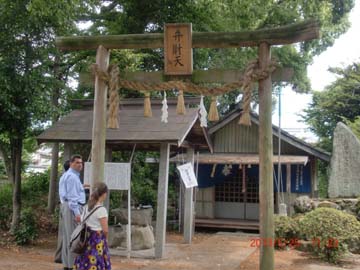
On May 25, we visited the Kinryu shrine.


Gene Savoy Jr. and daughter Sabrina entering Kinryu Shrine PHOTO: Miyuki Okayama

Gene Savoy Jr. and daughter Sabrina entering Kinryu Shrine PHOTO: Miyuki Okayama


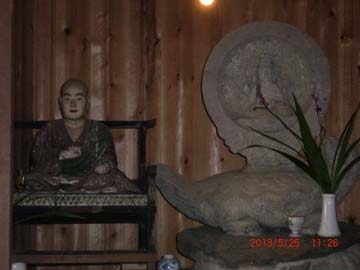
Shrine interior showing Kobo Daishi (Kukai) and Benzaiten, the goddess of eloquence, music, and wisdom PHOTO: Miyuki Okayama

Shrine interior showing Kobo Daishi (Kukai) and Benzaiten, the goddess of eloquence, music, and wisdom PHOTO: Miyuki Okayama


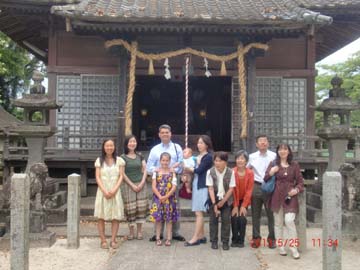
Members of 2013 Japan tour group gather outside the shrine  PHOTO: Miyuki Okayama

Members of 2013 Japan tour group gather outside the shrine PHOTO: Miyuki Okayama


After that, we admired dedication dancing by Mizuho Asano. 

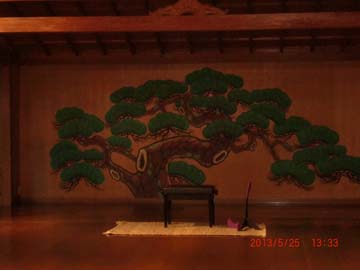
Performance stage for traditional dancer Mizuho Asano PHOTO: Miyuki Okayama

Performance stage for traditional dancer Mizuho Asano PHOTO: Miyuki Okayama


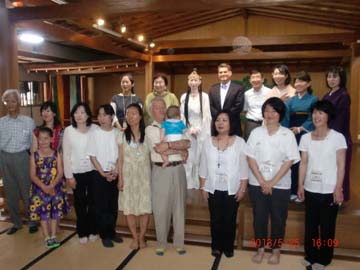
Members of 2013 Japan tour with dancer Mizuho Asano (second row center) PHOTO: Miyuki Okayama

Members of 2013 Japan tour with dancer Mizuho Asano (second row center) PHOTO: Miyuki Okayama

 Then Bishop Gene Savoy Jr. announced the publication of the Japanese version of the book Project “X”: The Search for the Secrets of Immortality, titled in Japanese Project Sun.


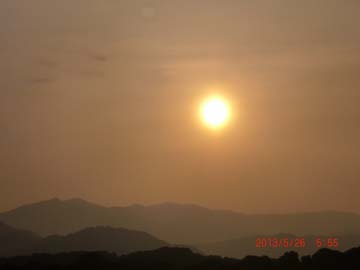
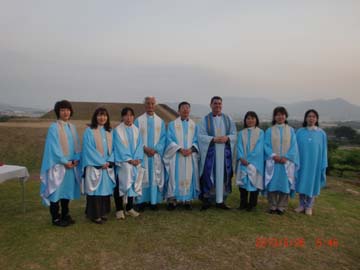
On May 26, we performed the ceremony of the Sunrise Service at the ancient solar site of Yaki-no-Touge.

Sunrise view at ancient solar site of Yaki-no-Touge PHOTO: Miyuki Okayama

Sunrise view at ancient solar site of Yaki-no-Touge PHOTO: Miyuki Okayama


Officiants at sunrise service May 26, 2013 at  Yaki-no-Touge PHOTO: Miyuki Okayama

Officiants at sunrise service May 26, 2013 at Yaki-no-Touge PHOTO: Miyuki Okayama


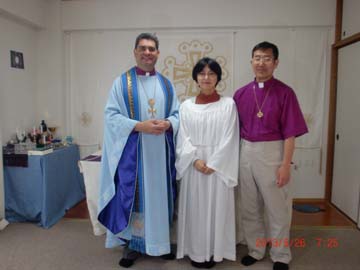
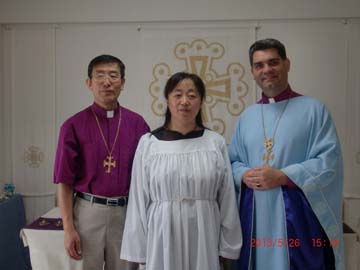
Later an Ordination service was performed at the headquarters of Cosolargy Institute in Japan for Akiko Takahashi and Junko Kodama.

Akiko Takahashi between Bishop Gene Savoy Jr and Bishop Yukimori Matsushita PHOTO: Miyuki Okayama

Akiko Takahashi between Bishop Gene Savoy Jr and Bishop Yukimori Matsushita PHOTO: Miyuki Okayama


Junko Kodama between Bishop Yukinori Matsushita and Bisho Gene Savoy Jr PHOTO: Miyuki Okayama

Junko Kodama between Bishop Yukinori Matsushita and Bisho Gene Savoy Jr PHOTO: Miyuki Okayama


The service was followed by a social gathering at the headquarters.

Sincerely,

Miyuki Okayama


“The Importance of Symbols and Understanding Them”


2013-REP-Harold_Boulette_Solar_Wind


“In a sense one has to pass beyond the ‘symbols’ used in religion to the reality that it represents. The symbols contain and convey something of the reality that they signify. The symbols are therefore to be integrated into one’s spirituality as one moves toward greater realization of the truth, since they are not a ‘false’ reality, merely and attempt t representing the true reality. The symbols of a religion are not to be regarded as the religion itself, but to be transcended in order to discover why the religion exists.” ~Dion A Forster

“Symbols are important in religion and spiritual schools because anyone can understand them. No matter what language people speak, no matter if they are illiterate, they can understand symbols.”


 < Read the entire article online at Solar Wind. >


< Visit and bookmark Harold Boulette’s blog Solar Wind at: http://blog.spiritsun.net/ >


contributed by Harold Boulette


Amitabha Mandala Completion Ceremony Attended


Completed sand painting of Amitahba Buddha mandala  PHOTO: Gene Savoy Jr.

Completed sand painting of Amitahba Buddha mandala PHOTO: Gene Savoy Jr.

The completion of the sand painting of the Mandala of Buddha Amitahba at the Buddhist Center in Reno was celebrated on October 24, 2014.

Reno Buddhist Center hosted the Venerable Lama Losang Samten to create the Mandala of Buddha Amitahba from October 6-24, 2013. The Tibetan art form of sand painting practiced by Losang Samten is intended to uplift and benefit every person who sees it and to bless the environment in which it is made.

Monk Losang worked his calm and deliberate art over three weeks to complete the painting of the Pure Land of the Light or Solar Buddha Amitahba. It will be dissolved on December 8, 2014, Bodhi Day, the day of Buddha’s enlightenment. The ceremony on October 24th was a celebration of the painting’s completion.

Bishop Gene Savoy Jr. was asked to attend the ceremony and to speak on “Light.” During his talk, Rev. Savoy made comparisons between the Buddha and Christ Jesus, emphasizing that they were both able to access the source of life by the same means, that is, through the gateway of the sun, and thereby both become living Light Beings or “Lights” on Earth. He explained that their mission was to exemplify the Light and teach men and women how they too could commune with the Sun and themselves become living Lights and, in this way, all become Amita Buddhas or Christ Beings. Bishop Savoy encouraged those in attendance to chant their Buddhist mantras at sunrise.

During the three weeks of its creation, several members of the Second Advent congregation attended the making of the sand painting at various times.

Ven. Losang has been sharing teachings of loving-kindness, joy, and compassion, as well as the path to enlightenment for almost 30 years. Losang lived and studied over 20 years in the Namgyal Monastery, the monastery of the Dalai Lama, earning the highest degree attainable at the monastery. He also became a master of ritual dance and sand mandalas and was the personal attendant to the XIV Dalai Lama prior to moving to the United States in 1988. Ven. Losang is one of the mandala masters who created the first public sand mandalas in the West in 1988. He is the director of several Buddhist centers in North America. His home base is in Philadelphia, Pennsylvania.

Venerable Lama Losang Samten overlooking the mandala of Buddha Amitahba  PHOTO: Gene Savoy Jr.

Venerable Lama Losang Samten overlooking the mandala of Buddha Amitahba PHOTO: Gene Savoy Jr.


Services for the week of November 9, 2013


Saturday, November 9, 2013
10:00 AM COMMUNION
Chapel of The Holy Child
RR Gene Savoy Jr.
Lector: RC Gary Buchanan
Cantor: Rev. Robert Anderson
Reader: Rev. Francine Petrovich


Sunday, November 10, 2013
6:32 AM NEW DIVINE SERVICE
Church of New Epiphany
Leave: 5:45
Gate: 6:15
Sunrise: 6:47
RR Gene Savoy Jr.
Concelebrant: RR Sean Savoy
Assistants:
RC Roger Weld
RC Ted Staver
Rev. Barbara Whitney
Organist: RC Gary Buchanan

OPEN-AIR COMMUNION
Church of New Philadelphia                 RC Elizabeth Reece
Church of New Qumran                 Rev. Greg Klinedinst
Church of New Bethany                                 Rev. Michael Tamburello


Wednesday, November 13, 2013
12 N COMMUNION
Chapel of the Holy Child
Rev. Dorothy Kubiak


Friday, November 15, 2013
9:00 AM PRAYER & FELLOWSHIP
Chapel of the Roses
RC Robert Petrovich