5/24 Friday
Gene Savoy, Yukinori Matsushita, other American guests and some Japanese members left the hotel at 9:00 am and traveled to Saga for a guided tour in Saga. We arrived at Niyama Shrine in Kanzaki, Saga at 10:00 am.
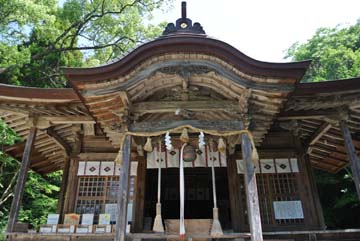
Niyama Shrine PHOTO: Stephan Fuelling
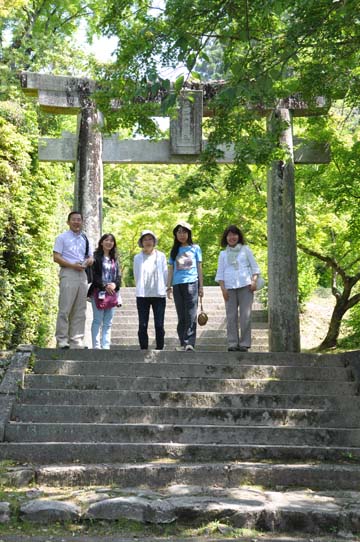
At torii of Niyama Shrine (from left to right) Yukinori Matsushita, Miyuki Okayama, Chieko Nakayama , Shinobu Uwataki, Keiko Inoue PHOTO: Stephan Fuelling
We visited the ruins at *Yoshinogari Historical Park at 11:00 am. This visit was planned and coordinated by Saga Members Hiroko Soejima, Keiko Inoue, Shinobu Uwataki, Yoko Taniguchi, Chieko Higashi, Yoko Nishimura, Yasuko Nishimura, Terumi Kuroda, Kahori Sano, and Naoko Tokushima.
*The Yoshinogari hills were originally slated for one of Saga Prefecture’s industrial areas, but the project was suspended upon discovery of ruins and relics, until further research into the area could be carried out. In 1986, the site was meticulously studied to understand whether it was a truly important cultural site. The concluding result was that this area was one of Japan’s largest moat encircled villages dating from the Yayoi period (c. 3 BCE – c. 3 CE). The location and layout of the village captured the imagination of Japan as it closely resembled the long disputed ancient country of Yamatai mentioned in early Chinese chronicles. The Yoshinogari ruins are of extremely high academic value and are an important cultural asset.
In 1992, the Yoshinogari ruins were designated a NationalHistoricalPark with the surrounding area made into a SagaPrefecturalPark. In April 2001, the initial phase of the Park was opened to the public. The Park, as of April 1, 2009, measures 73.7 hectares (38.3 hectares of national land, 35.4 hectares of prefectural land).
< Visit the Yoshinogari web site. >
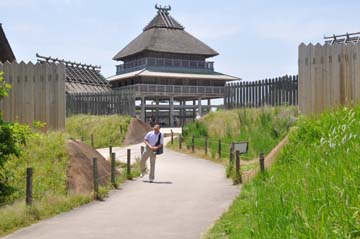
Reconstructed buildings PHOTO: Stephan Fuelling
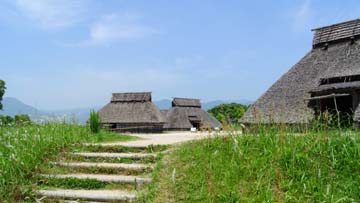
Reconstructed buildings PHOTO: Stephan Fuelling
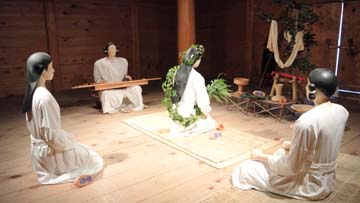
Exhibition of a ritual with a shaman PHOTO: Stephan Fuel
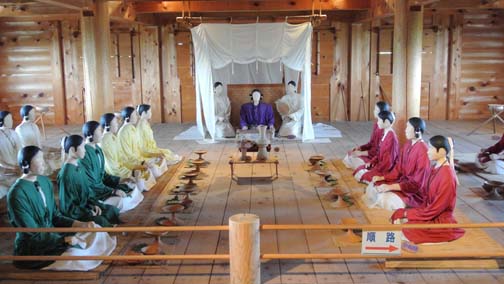
Exhibition of ceremonial dinner. The color of the peoples’s clothes are different based on their official rankings. PHOTO: Stephan Fue
We had a lunch at Saga Retrokan at 1:30pm. This event was planned and coordinated by Saga Members Hiroko Soejima, Keiko Inoue, Shinobu Uwataki, Yoko Taniguchi, Chieko Higashi, Yoko Nishimura, Yasuko Nishimura, Terumi Kuroda, Kahori Sano, and Naoko Tokushima.
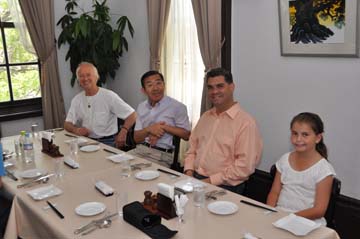
(from left to right) Robert Roy, Yukinori Matsushita, Gene Savoy, Sabrina Savoy PHOTO: Stephan Fuelling
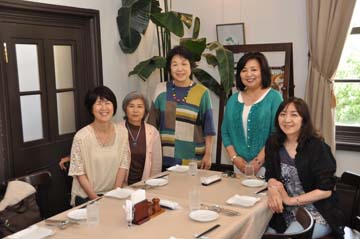
(from left to right) Chieko Higashi, Ms. Kawasahi, Hichiyo Hukuyama, Yoko Nishimura, Miyuki Okayama PHOTO: Stephan Fuelling
We visited *SagaCastleHistoryMuseum with a volunteer interpreter guide at 2:30pm.
This event was planned and coordinated by Saga Members Hiroko Soejima, Keiko Inoue, Shinobu Uwataki, Yoko Taniguchi, Chieko Higashi, Yoko Nishimura, Yasuko Nishimura, Terumi Kuroda, Kahori Sano, and Naoko Tokushima.
*Saga Castle History Museum is a reconstruction of the main keep (honmaru) of SagaCastle built in 1838, during the last years of the Edo Period. It is one of the largest wooden reconstructions in Japan. Over 700 rush mats (tatami) are laid in the building, providing ample space for a wide variety of exhibits including data, images, and models that depict Saga during the fall of the Tokugawa Shogunate and the Meiji Restoration.
< Visit the Saga Castle History Museum web site. >
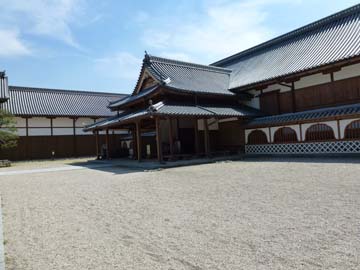
Outside view of the Saga Castle History Museum PHOTO: Stephan Fuelling
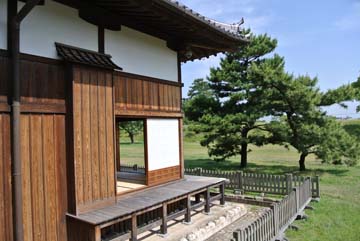
Outside view of the Saga Castle History Museum PHOTO: Stephan Fuelling
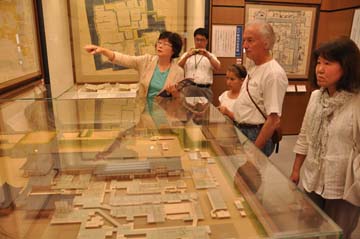
Visiting group inside the Museum PHOTO: Stephan Fuelling
We visited the *Jofuku Long Life Center in Saga City at 4:30pm, and then the Kannon of the Well. This event was planned and coordinated by Saga Members Hiroko Soejima, Keiko Inoue, Shinobu Uwataki, Yoko Taniguchi, Chieko Higashi, Yoko Nishimura, Yasuko Nishimura, Terumi Kuroda, Kahori Sano, and Naoko Tokushima.
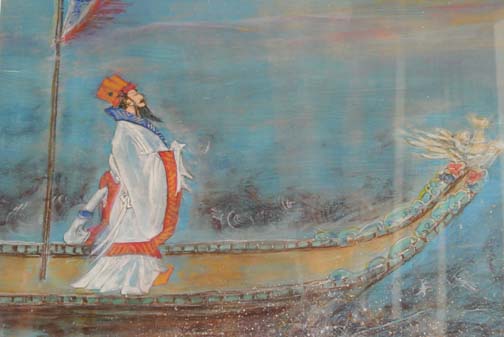
Painting of Joguku PHOTO: Stephan Fuelling
*Jofuku, pronounced Xifu in Chinese, came to Japan during the Jomon Era in the 3rd century B.C. It is said that he landed near Shingu and brought with him much Chinese culture and technology.
Jofuku was at the time serving as a Taoist shaman to the Emperor Shikoutei of the Xin Dynasty in China about 2200 years ago. He was ordered by the emperor to set out in order to “find the elixir of eternal life which is said to be on the mountain of Horai on the sea to the east.” He eventually arrived in Kumano and with him he brought about 3000 people, men, women, and children. Unfortunately for the emperor, he never returned to China.
Jofuku (known aa Xu Fu in Chinese) was a Taoist monk who sailed from China to Japan in search of the fabled elixir of immortality. He is said to be responsible for the spread of Chinese culture in Japan, including farming methods for irrigated paddy rice cultivation, and many different areas in Japan have local legends which claim Jofuku landed there. Saga, which is said to be the cradle of early mass rice cultivation in Japan, also boasts a great number of Jofuku legends—Jofuku is even enshrined as a god of the harvest at Saga’s Kinryu Shrine.
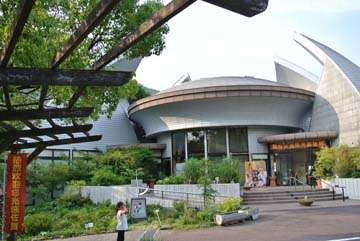
Outside view of the Center PHOTO: Stephan Fuelling
The JofukuLongLifeCenter rests at the foot of Mt.Kinryu, and in addition to introducing the legends of Jofuku to visitors also serves to spread the latest developments in research on Jofuku and his voyages.
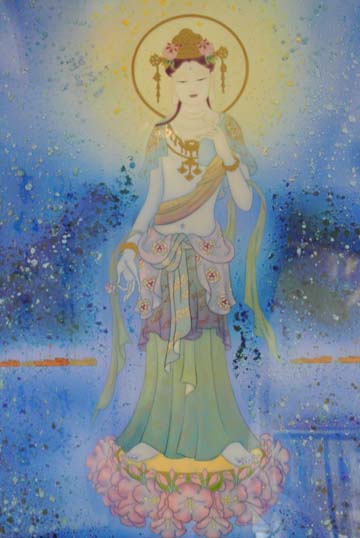
Painting of Deity of Mercy created by Kusaba Kazuhisa, using the same technique used to make Arita ware.
< Visit Kusaba Kazuhisa’s web site. >
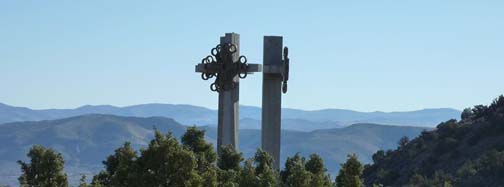
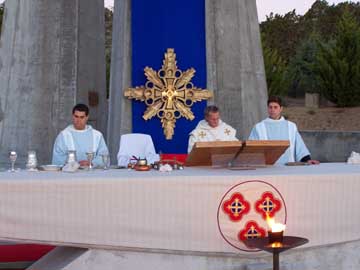
We had a casual Sunset Service meeting at MegalithPark at 6:00pm. This event was planned and coordinated by Saga Members Hiroko Soejima, Keiko Inoue, Shinobu Uwataki, Yoko Taniguchi, Chieko Higashi, Yoko Nishimura, Yasuko Nishimura, Terumi Kuroda, Kahori Sano, and Naoko Tokushima.
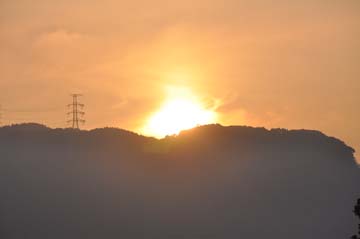
Sunset at Megalith Park PHOTO: Stephan Fuelling
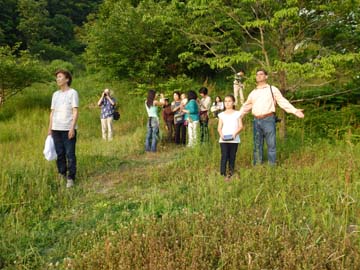
Gathering for sunset at Megalith Park PHOTO: Stephan Fuelling
We all had dinner at Umenohana Tofu Restaurant at 7:00pm.
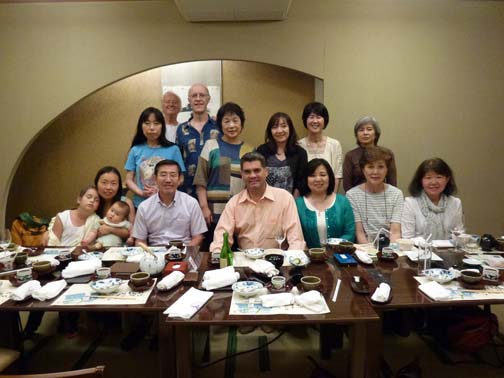
After dinner (front row, from left to right) Sabrina Savoy, Noriko and Joseph Roy, Yukinori Matsushita, Gene Savoy, Yoko Nishimura, Chieko Nakayama, Keiko Inoue. (back row, left to right) Shinobu Uwataki, Robert Roy, Stephan Fuellig, Michiyo Fukuyama, Miyuki Okayama, Kazuno Kawasaki PHOTO: Stephan Fuelling
Travel notes by Noriko Roy
< DAY 1 >
< DAY 3 >