Spiritual Architecture and Art in Ancient Lands
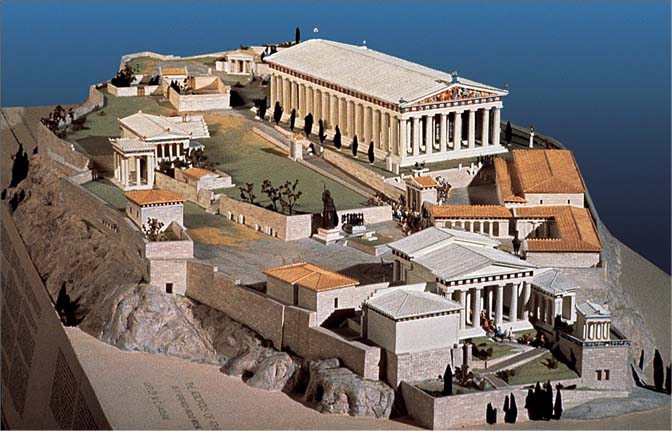
“Great art is, among other things, a result of this impulse. It is only necessary to gaze with the eye of the spirit upon a Greek Temple, in order to see that in this marvel of art, material substance is so worked upon by man that it appears in every detail as the expression of spirit. The Greek temple is the ‘House of the Spirit.’ One sees in its form what otherwise only the Spiritual eye of the seer perceives. The temple of Zeus (or Jupiter) is so constructed as to present to the physical year a fitting shrine for what the guardian of the Zeus (or Jupiter) Initiation saw with spiritual vision. And it is the same with all Greek art. The wisdom of the Initiates flowed in mysterious ways into poets, artists, and thinkers. The mysteries of the Initiates are found again, in the form of conceptions and ideas, in the system of thought by which ancient Greek philosophers interpreted the universe. The influences of the Spiritual life, the Mysteries of the Asiatic and African sanctuaries of Initiation, flowed into these nations and into their leaders.” ~Rudolf Steiner
Greek Temples
The ancient Greek temples, as well as other buildings, were designed in a way that did make them spiritual, in a sense. They were designed and constructed according to the Law of Divine Proportion. Their main entrance always faced East, toward the rising sun, and the secondary entrance, or exit, was on the west side facing the setting sun. This was not just for the Temple of Zeus, but is also true of the Parthenon, the Temple of Hera, The Temple of Artemis, the Temple of Apollo at Delphi, and others. And it wasn’t limited to temples. The Great Theater of Epidaurus has been called the most perfect theater of all time because of its appearance and acoustics.
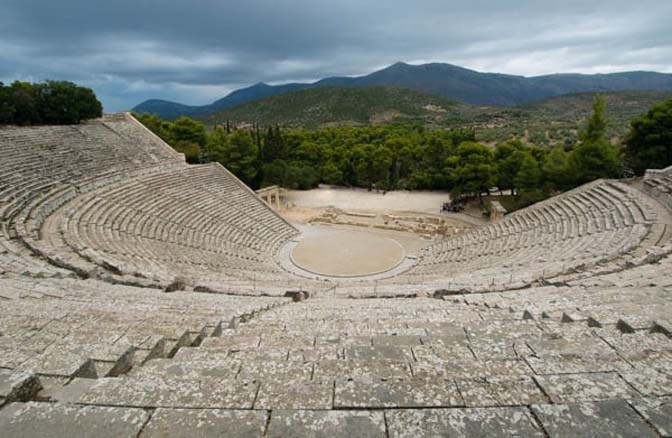
One can stand in the speakers spot and speak in a normal voice and be heard by those seated anywhere in the great theater.
Greek Arts
Steiner says that other arts in Ancient Greece were also done with spiritual vision. That is true in many cases, but not all. Not all painters, writers, sculptors, or philosophers were knowledgeable in the spiritual teachings of the mystery schools. Even fewer were actually students of such schools. But some followed the established conventions of beauty, harmony, and grace that were followed by those who were students of the mysteries. Much of that art has not survived to the present time, but some has, particularly the sculptures and philosophies. We all know of some of the great philosophers of Greece, including Plato and Socrates. We are not familiar with the great sculptors for a simple reason: their works are generally not signed. You can go to museums in Athens and elsewhere and see many examples of great sculptures that follow the rules of Divine Proportion, harmony, and grace, but you find no signature on them. Despite that fact, some of the sculptors were famous in their time. They include Myron of Eleutherae who was said to have sculpted a heifer that was so realistic, it could be mistaken for a real cow, and Phidias of Athens who’s most famous work was a 40-foot statue of Athena.
Roman and Egyptian Architecture and Art
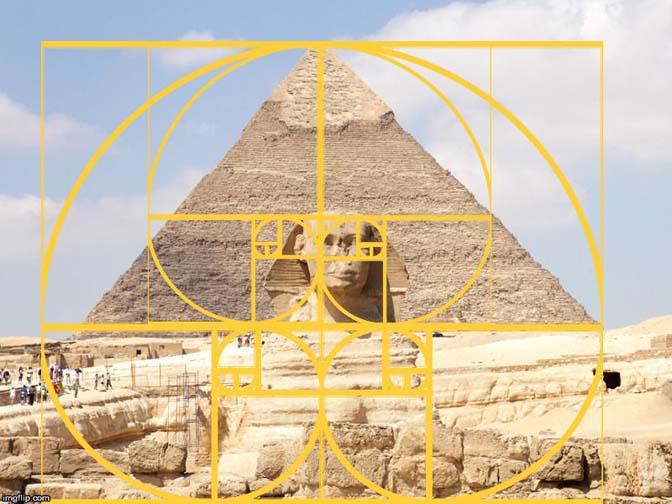
The ancient Greeks were not the only ones who used Divine Proportion and other spiritual concepts in their architecture and other arts. The Egyptians did it before the Greeks, and much of the knowledge the Greeks had on the subject came from Egypt. And the Romans copied the classic art of the Greeks, so much of their art had it as well. Of course there were spiritual schools around Rome, just as their were in Greece and Egypt, so some of the Roman art may have been inspired by their own initiates and not simply copied from the Greeks. As for the Egyptians, they also used Divine Proportion, also known as the Golden Ratio. The image below of the Pyramid and Sphinx illustrates the use of the Golden Ratio at that sight.
From the SOLAR WIND collection by Harold Boulette