Cosolargy Newsletter June 2022 Issue 6
Subscribers to the Cosolargy.org web site receive this monthly newsletter.
Click here to read or download this issue.
Subscribers to the Cosolargy.org web site receive this monthly newsletter.
Click here to read or download this issue.
Saturday, June 11, 2022
10:00 AM COMMUNION
Chapel of The Holy Child
RC Robert Petrovich
Lector: RC Ted Staver
Cantor: Rev. Dorothy Kubiak
Reader: Dea. Gary Huss Jr.
Sunday, June 12, 2022
5:21 AM SUNRISE DIVINE SERVICE
Church of New Pentecost
Leave: 4:30
Gate: 5:10
Sunrise: 5:36
RC Ted Staver
Concelebrants:
RC Robert Petrovich
Rev. Bruce Kanzelmeyer
Assistant: Rev. Barbara Whitney
OPEN-AIR COMMUNION
Church of the Golden Age RC Amanda Buchanan
Church of the Universal Theocracy Rev. Robert Roy
Church of New Qumran Claudia Grady
Wednesday, June 15, 2022
12:00 NOON COMMUNION
Chapel of The Holy Child
Dea. Radheka Savoy
Friday, June 17, 2022
9:00 AM PRAYER & FELLOWSHIP
Chapel of the Roses
Rev. Noriko Roy
“TRUTH IS THE MOUTH OF THE FATHER. Each one loves truth because truth is the mouth of the father. His tongue is the holy spirit. Whoever touches truth touches the mouth of the father by his tongue at the time when one will receive the holy spirit. This is the manifestation of the father and his revelation to his eternal beings. He revealed what is hidden in him and explained it. For who is it who exists if it is not the father himself? All the spaces are his emanations. They knew that they stem from him as children from a perfect man. They knew that they had not yet received form, nor had they yet received a name, every one of which the father produces. If they at that time receive the form of his knowledge, though they are truly in him, they do not know him. But the father is perfect. He knows every space that is within him. If he pleases, he reveals anyone whom he desires by giving him a form and by giving him a name; and he does give a name and cause to come into being. Those who do not yet exist are ignorant of him who created them. I do not say, then, that those who do not yet exist are nothing. But they are in him who will desire that they exist when he pleases, like an event that is going to happen. On the one hand, he knows, before anything is revealed, what he will produce. On the other hand, the fruit that has not yet been revealed does not know anything nor is anything either. Thus each space that, on its part, is in the father comes from the existent one, who, on his part, has established it from the nonexistent. For whoever has no root has no fruit, but although thinking, “I have come into being,” that one will perish. For this reason, whoever does not exist at all will never exist.” ~Gospel of Truth
It is an interesting way that the writer of this gospel chose to word this. He doesn’t say that only truth comes from the mouth of the Father, or that what God speaks is truth and nothing but truth, but that truth is the mouth of the Father. In this way, he is stating emphatically that everything that comes out of the “mouth” of the Father is truth, and always truth. Of course, God doesn’t have a mouth in the physical sense, yet He does have a voice, and that voice is the voice of Truth and Wisdom, always and forever.
One might ask at this point, “Why then are there so many contradictions in the Bible, especially between the Old and New Testament, and also in the scripture of other religions?” The answer is complex. First, much of what is written in those books is the interpretation of humans of what God showed them in visions, or otherwise. This may result in different interpretations of what is the same truth. Another reason is that some of what many believe to be the Word of God is actually the Word of the Demiurge, the Lesser God, or False God that created matter, but not spirit. That is why matter is defective (death, disease, destruction, etc.) while spirit is not.
This is true in one sense, and not true in another. Everything spiritual is from God, but matter is not. At least not directly. Matter is the creation of the Demiurge, the false god, but it is not true creation. Because the Demiurge created matter by changing spirit, some spirit remains in matter, and therefore some of the essence of God remains in matter. It is that spirit within matter that has God in it. And the matter that is not from God is beginning to undergo the changes that will turn it into spirit once again. That is God’s Great Plan: to restore everything to spirit.
I don’t know about the idea that within God’s mind there are beings that do not yet have a form or a name, so they don’t really exist and are not conscious until God gives them a form and a name. This may be an allegory, but its significance escapes me. Since God’s Consciousness is all that truly exists, anything that is held in that consciousness must be real. At least it seems that way to me. God thinks of a being and it comes into existence. But I could be wrong.
From the SUN TALK collection by Harold Boulette

APRIL 2022
2
Kaylea Dowling
Junko Yamamori
Treasure Okon Umoh
The People of Ukraine
Reverend Nola Irene Slevin
6
Reverend Nola Irene Slevin †
Keith Schaffer
The People of Ukraine
Kaylea Dowling
Junko Yamamori
9
Reverend Nola Irene Slevin †
Keith Schaffer
The People of Ukraine
Kaylea Dowling
Junko Yamamori
Francisco Guzman
13
The People of Ukraine
Robert Vierra
Rev. Harold Boulette
16
The People of Ukraine
Robert Vierra
Reverend Masayoshi (Koshu) Kawahara
20
Uwe Kaufmann †
The People of Ukraine
Reverend Masayoshi (Koshu) Kawahara
Kaylea Dowling
23
Uwe Kaufmann †
Andreas Fuelling †
The People of Ukraine
Reverend Masayoshi (Koshu) Kawahara
Kaylea Dowling
27
The People of Ukraine
Reverend Masayoshi (Koshu) Kawahara
Kaylea Dowling
Keith Schaffer †
30
The People of Ukraine
Reverend Masayoshi (Koshu) Kawahara
Kaylea Dowling
Keith Schaffer †
Anne Ferrentino
Rev. Keiko Inoue
† indicates Memorial Prayer
Saturday, June 4, 2022
10:00 AM COMMUNION
Chapel of The Holy Child
RR Gene Savoy Jr.
Lector: RM Rebecca Willis
Cantor: Rev. Robert Roy
Reader: Rev. Francine Petrovich
Sunday, June 5, 2022
5:22 AM SUNRISE DIVINE SERVICE
Church of New Pentecost
Leave: 4:30
Gate: 5:10
Sunrise: 5:37
RR Gene Savoy Jr.
Concelebrants:
RC Robert Petrovich
Rev. Bruce Kanzelmeyer
Assistant: Rev. Barbara Whitney
OPEN-AIR COMMUNION
Church of New Ephesus RR Yukinori Matsushita
Church of New Philadelphia Rev. Robert Roy
Church of New Qumran Rev. Noriko Roy
5:00-7:00 PM Pentecost Vigil Meal
Bishopstead
Monday, June 6, 2022
5:22 AM SUNRISE DIVINE SERVICE
SECOND ADVENT PENTECOST
Church of New Pentecost
Leave: 4:30
Gate: 5:10
Sunrise: 5:37
RR Gene Savoy Jr.
Concelebrants:
RC Robert Petrovich
Rev. Bruce Kanzelmeyer
Assistant: Rev. Barbara Whitney
Wednesday, June 8, 2022
12:00 NOON COMMUNION
Chapel of The Holy Child
Rev. Francine Petrovich
Friday, June 10, 2022
9:00 AM PRAYER & FELLOWSHIP
Chapel of the Roses
RM Rebecca Willis

HEAD OVERSEER’S WEEKLY MESSAGE

June 2, 2022
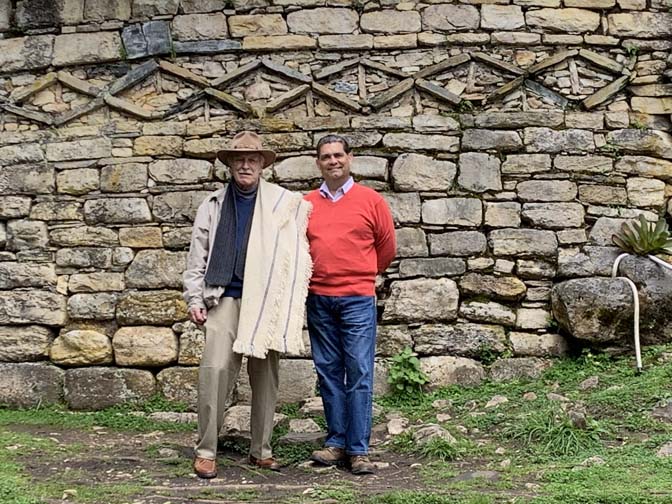
Gary Buchanan and Gene Savoy Jr at Fortaleza Kuelap, March 3, 2020
The Community is getting involved again in Peru after a lapse of several years. Following extensive legal entanglements over the nature of the Andean Explorers Foundation, The Community regained control over the unique research and valuable archives in 2019. Then COVID hit. Three years ago, the editor of the Community Communique sat down with Bishop Gene Savoy Jr. to discuss his recent visits to Peru in January and November 2018 to explore possibilities for the future work of The Community there and his vision for the future.
The interview was recorded February 11, 2019. The ending commentary was written May 24, 2022.
ED: Let’s start our discussion with an explanation of the name “Gene Savoy Xplorations.”
GSJr: In June 2018 we formed a DBA [fictitious firm name] of the Church, which is “Gene Savoy Xplorations” with an “X.” This will be the beginning of recreating our work in Peru, as the Andean Explorers Foundation as an entity is no longer part of the Church. The formation of “Gene Savoy Xplorations” as a part of The Community will also ensure that we never have the kind of problem again that we have had with incorporating the Andean Explorers Foundation, because this entity will be part of the Church and not a separate corporation subject to outside manipulation, as the Andean Explorers Foundation proved to be.
ED: And you went down to Peru a few months ago?
GSJr: I went in January of 2018 and November of 2018.
ED: And you had a plan at that time?
GSJr: Yes. The plan in January was to see what the climate was for us getting involved, and what the interest was, and, also, to see how Chachapoyas had changed. We had heard that it has changed quite significantly. And I had gotten reports that the government is spending a lot of money in Amazonas because they are very concerned with the number of people visiting Machu Picchu, and so they want to limit the number of tourists there and expand into other areas.
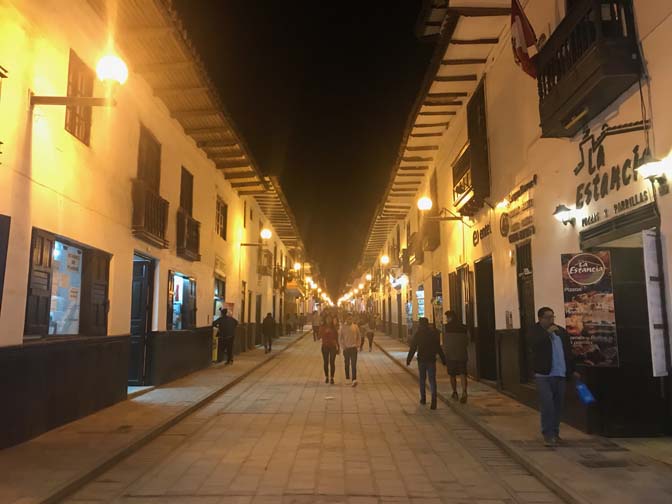
Pedestrian walkway in Chachapoyas, Amazonas, Peru
That means they have to open up additional archaeological sites, which makes sense.
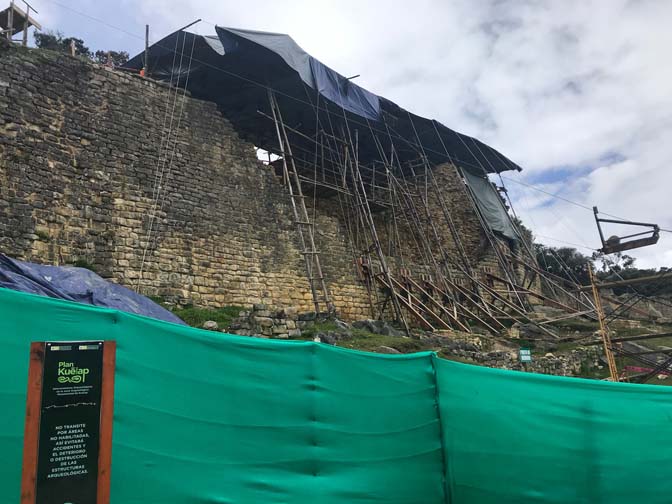
Restoration work underway at Kuelap Fortress
The next major site is Kuelap, and that’s why a magnificent cable car system going up there has been built.
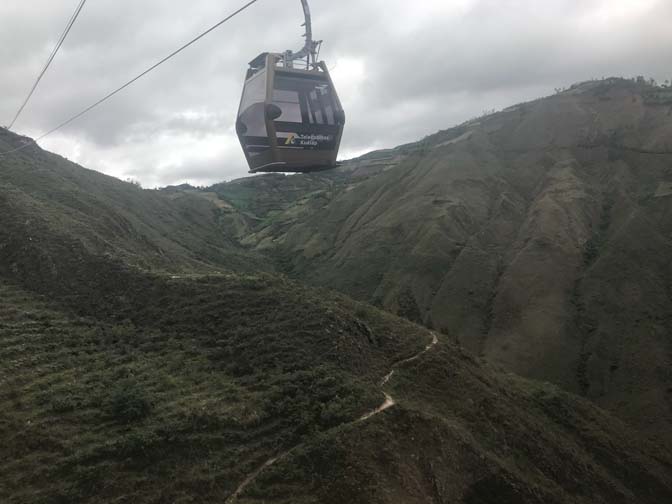
New cable car tramway with old mule trail below
This is the area where we spent many, many decades working. The government is spending a great deal of money there, as I said, which interested me because we had thoughts back in the old days, in the 1990s, of how we could take advantage of the archaeological sites that my father had discovered, and how we could capitalize on that. We were letting the whole world know about these places – these archaeological sites – and where they were, but then other people were coming in and reaping the benefits of what we had discovered. And that’s fine, but we should also be a part of that. Maybe thirty years ago wasn’t the right time. But now definitely is. In the last twenty years, the Peruvian government has built national road systems that didn’t exist before. There are daily flights from Lima to Chachapoyas, which you didn’t have before. The townspeople have spent a lot of money in Chachapoyas itself, beautifying their city. It really is quite different from what it used to be when I was first there.
ED: Can you describe the way it was in the early 1990s, and the way it is now?
GSJr: Well, it was kind of like being in the old west in a way. There were horses and mules and the occasional pickup truck. People were coming in from the countryside, the campesinos [peasant farmers]. And in the best hotel in town, for example, you didn’t have private bathrooms. There was a communal bathroom. You didn’t have hot water. You showered in cold water. There was one TV in the whole town. That was a big deal. It belonged to a guy who owned a restaurant on the plaza. And everyone in town would come and watch through the doors and the windows what was on the TV because that was very novel. It’s totally different now. You have internet service. You have hotels that have private bathrooms. You have hot water. They’ve renovated a lot of the old homes with courtyards for restaurants, coffee shops and wine bars.
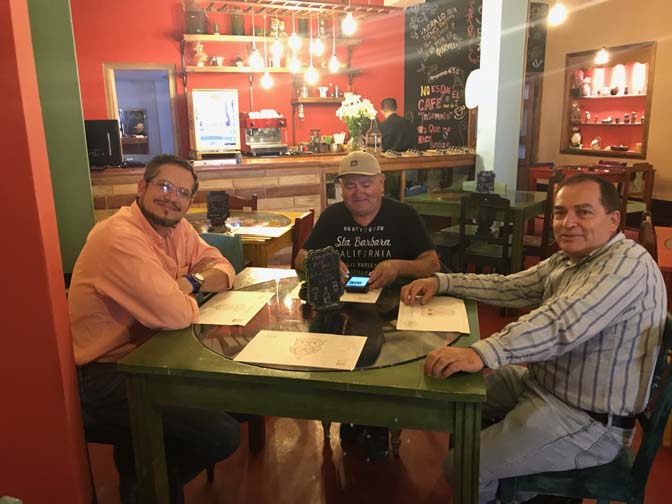
Ismael Seoane, Martin Chumbe and Eduardo Morocho at a coffee shop in Chachapyas, Amazonas, Peru
It’s just a totally different scenario. They actually have a fleet of taxis. It’s changed quite a bit. That cable car system is really phenomenal. I recommend it to anybody, if they are there. You have to take the cable car system up to Kuelap.
ED: What was it like to get from Chachapoyas to Kuelap before?
GSJr: From Chachapoyas you would take a truck to the town of Tingo, which was about an hour or an hour-and-a-half drive back in those days because they didn’t have paved roads. All of the roads are paved now.
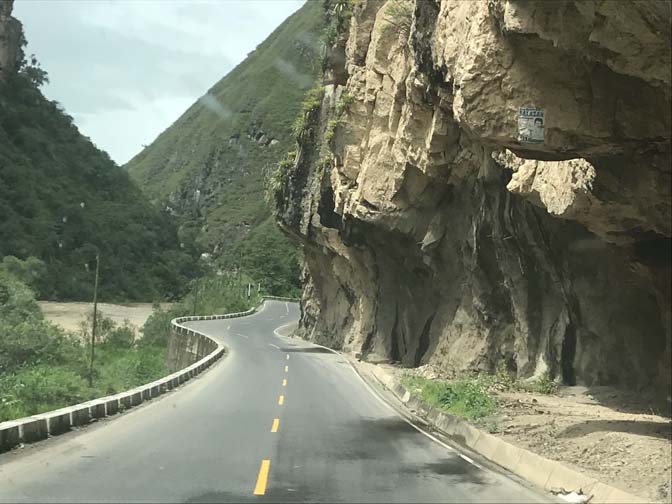
New national road, Amazonas, Peru
Now it’s about forty-five minutes to get to Tingo by car. And then, in the old days, you would have to take mules up the mountain, which would take you half a day to get up to the fortress. Now you do the whole trip up the mountain in twenty minutes via the cable cars.
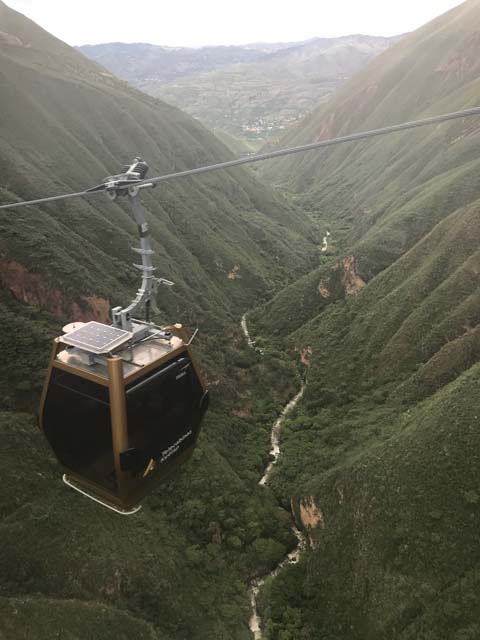
New cable car crossing the mountain valley below
ED: Where did the idea come from to do explorations in the corporate sense rather than going in to do archaeological work?
GSJr: We are not limiting ourselves with what we can do with Gene Savoy Xplorations. Really, the first thing in January 2018 was to just feel things out. I was able to go to Chachapoyas. I was very, very impressed with what I saw. There is a lot of opportunity there, and the tourism is increasing. It has been doubling every year, for pretty much the last few years. According to government projections and other projections, that is only going to increase . For the most part, though, people are still not going into Gran Vilaya. The importance of Kuelap is that it was the fortress of the cities that lie beyond.
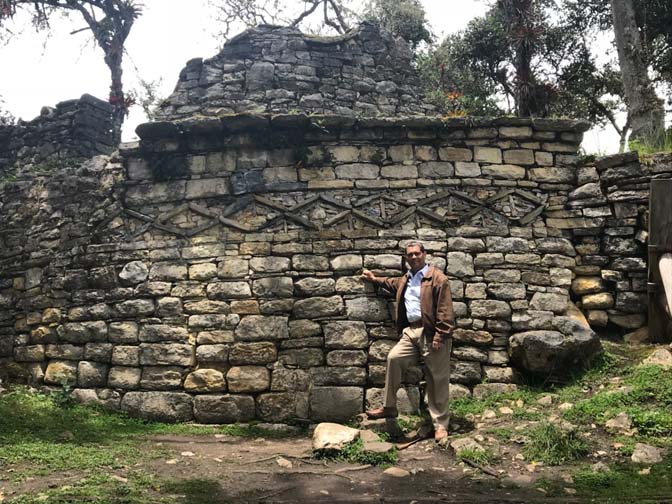
Gene Savoy Jr. at Kuelap examining Chachapoyan frieze
Kuelap basically protected what we now know as Gran Vilaya and Gran Sapasoa, which my father discovered. These were all Chachapoyan civilizations. They were conquered by the Incas. Nobody is really going beyond Kuelap. But now it is very easy to get to, for instance, Gran Vilaya. But the tourist agencies are not taking people in there yet. We believe that we can start taking people into Gran Vilaya. And that is the basis for us to establish our own tourist agency in Chachapoyas.
ED: And who is helping to put this all together?
GSJr: Right now , the main person that I work with in Peru is Ismael Seoane.
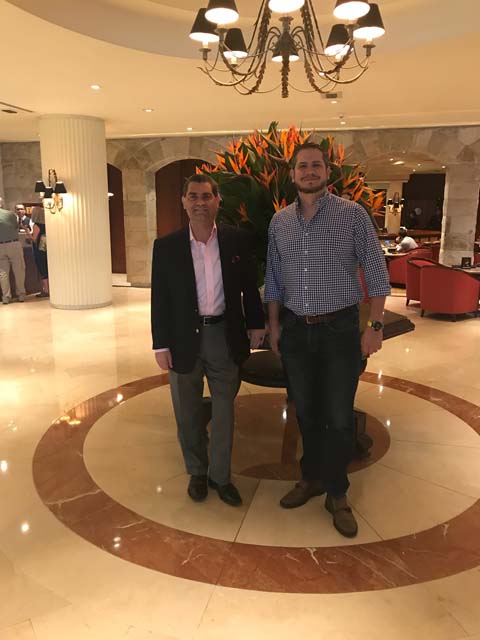
Gene Savoy Jr. and Ismael Seoane in the Swiss Hotel Lobby, Lima, Peru
He’s the third son of Pancho Seaone. [Francisco “Pancho” Seoane was the logistics officer for the Andean Explorers Foundation and worked with Gene Savoy, Sr. on his expeditions from 1984 until Pancho’s death in 1997.] Ismael is also the brother of Francisco and Alfonso Seoane. Ismael has connections. He’s the one who has connections with attorneys. These attorneys have connections with high profile people in the government, with the media and public relations firms and things like that. We are starting out with something very small. Also, his eldest brother, Francisco, is also helping in various ways. Francisco is now our archaeologist. He teaches at the University of Trujillo. He had been on a few of the expeditions when we were first there with my father. Francisco has agreed to be our official map maker and the liaison between us and the Institute of Culture. If we do anything in the future, we have to go through the Institute of Culture. So it’s very important for us to have an archaeologist that is our “archaeologist in-residence,” so to speak.
ED: Is there anyone else you have been working with in Peru?
GSJr: The other person who is helping a great deal is Martin Chumbe.
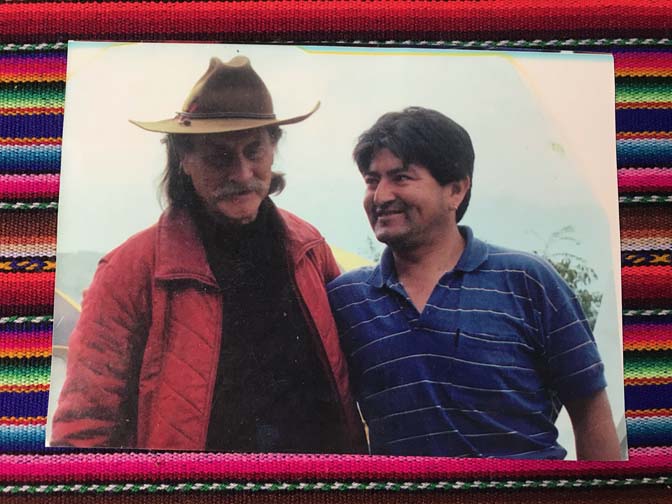
Gene Savoy Sr. and Martin Chumbe at Gran Vilaya, c. 1989
He was on expeditions when we were there in 1989 and the early 1990s. He is familiar with Gran Vilaya. He has also become very familiar with Gran Saposoa. He has connections in Chachapoyas. He is really the key to our connections in Chachapoyas. Ismael and Francisco have connections in Lima and Trujillo, but Martin is equally important because he knows everybody in Chachapoyas.
ED: And he now makes his living as a guide?
GSJr: Martin always had made his living as a guide, and he has become very prominent as a guide. Everybody knows him. Tourists seek him out to be their guide.
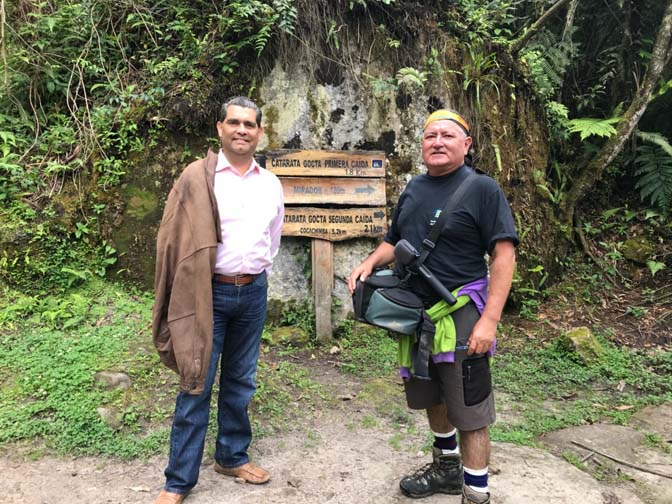
Gene Savoy Jr. with Martin Chumbe in expedition gear at the entrance to Gocta Falls, Amazonas, Peru
He’s very good, and he wants to work with us. He reveres my father and has pictures of him, and his relatives have copies of magazines going all the way back. They are very excited that this is now happening.
ED: You put all of this together last January?
GSJr: The initial trip was in January 2018. Other things were taking place between January and November, when I went again. By that time, we actually had a few more things in place. We were able to meet with the law firm of GLB Abogados.
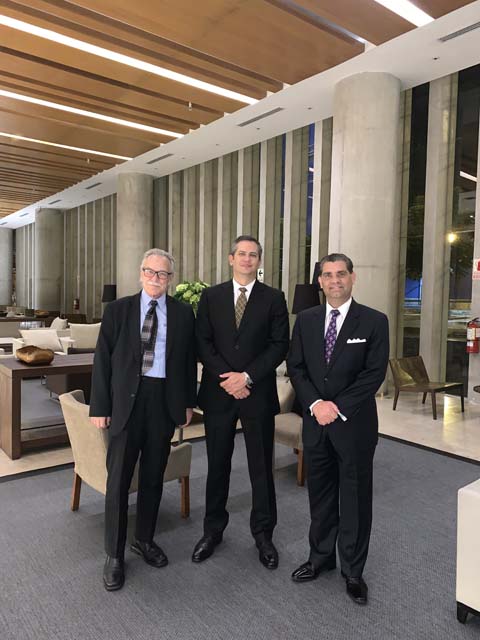
Gary Buchanan, Ismael Seoane Peyon, and Gene Savoy Jr in Lima, Peru , March 7, 2020
The law firm is two brothers, and they are helping us right now putting together the legal structure for what we are going to do in Peru. At this point, the idea is to have two corporations, one for-profit and one non-profit. The reality is that people will help us get things started, but they eventually will want to be compensated for their efforts; and quite honestly, I think, so do we. If we were to start the tourist agency, which we would like to do, the plan for 2019 is to do three things: First of all, and as we speak, Martin is in the field for 75 days. What he is doing is mapping, further mapping. We have maps that Gary Buchanan did back in the old days. Martin has his own set of maps, which he has shared with us. What he is doing now is going to these sites, and, with a GPS, taking the elevations and the distances from one point to another along the trails. The idea is to approach the Peruvian government to designate a specific official route, which will be called the “Route of Savoy” or “The Savoy Route” or, in Spanish, “La Ruta de Savoy,” similar to the Inca Trail in concept. The Inca Trail is down in Cusco and Machu Picchu. If you want to backpack you can take a few days going on the Inca Trail, and you can walk to Machu Picchu. This would be the same kind of concept. La Ruta de Savoy is going to be based on all or most of the sites that my father discovered in the 1960’s. So basically, everything that was talked about in his book Antisuyo is going to be part of “La Ruta de Savoy.”
ED: Including Gran Vilaya?
GSJr: Gran Vilaya and Gran Sapasoa are going to be two other separate things. So we have some big ideas. For right now, Martin is in the field for 75 days, mapping, getting coordinates, distances, elevations. The idea is that ,with the travel agency, we’ll be able to take backpackers and campers and people like that. He needs to know, for instance, how long it takes to get from Point A to Point B, and from Point B to Point C, and so on. It takes so many days to do the whole route, but you need to set up designated places for people to camp, and this is where we need the government’s assistance to help us with investments. The government has set up some very interesting investment programs so that they can start developing these sites and then recoup their expenses with, obviously, the tourist dollars. That’s the first thing that is happening. Second, we will have an expedition. It will be kind of a scouting expedition in the summer, probably in July or August [of 2019], where we will go into Gran Saposoa with Francisco and start mapping Gran Sapasoa. It’s the place that hasn’t really been mapped. Gran Vilaya has been mapped many times. Martin will also verify certain distances and things so we can update our main map.
ED: So you are actually talking about doing three different routes?
GSJr: Yes, we are talking about three things: The Savoy Route, Gran Vilaya, and Gran Sapasoa. That’s what we’re concentrating on.
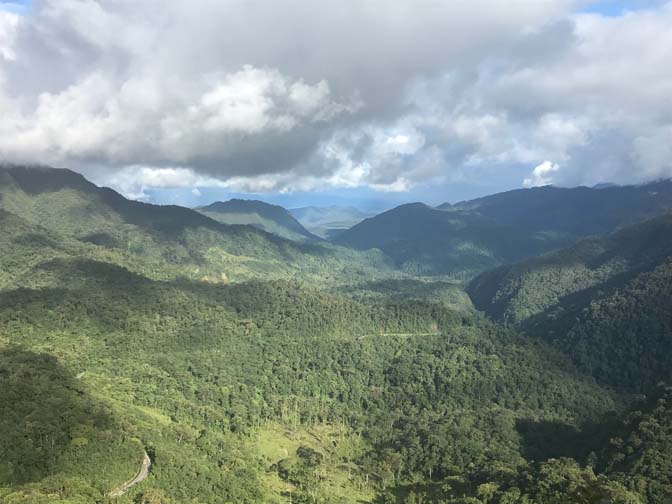
Scenic overlook, Amazonas, Peru
After the scouting expedition this year, when we have better information about places and distances and where to visit, then the idea is in 2020 to have a true expedition where we actually have some media exposure, and we will announce Gene Savoy Xplorations as being active in Peru. We’ll have the travel agency set up. And we already have people who have donated space right off the main square for the offices and all of that. So I think this is actually quite exciting. The way that I look at it is, if The Community is going to expand its ministry and at some point and some day have a presence in Peru, which I believe it should, it again has to have some basis for financial survival. So we have to set up some things that are going to bring in revenue. And, obviously, the work that we have done at the ruins can be the revenue stream that initially supports The Community’s establishment there. You have to do the one thing before the other. Otherwise, it doesn’t make any sense, in my mind.
ED: And as far as the expedition in 2020, do you want to say anything more?
GSJr: Not this point. The only people who know about it at this time are Ismael, Francisco, Martin, and I, and also Alfonso [Alfonso Seoane, also the brother of Ismael] who is helping us in Reno. The idea is that all of this will be kept quiet until we actually do something, because we want to make a big splash. But working with Ismael is easy for me because he is a businessman, so he understands that you have to take things slowly, and you have to plan things and do things properly, and make sure that everything at the back end is set up before you do anything on the front end. We don’t want to rush into things, and then have everything fall apart or be unorganized and sloppy. Then people get upset.
ED: Anything else you would like to add?
GSJr: That’s basically the whole idea, and I think that is all we really need to say right now, except that this isn’t a new idea for me. I had been talking about these ideas years ago, but certain people involved in the Andean Explorers Foundation didn’t see things my way and went off on their own doing their own thing which didn’t have anything to do with the mission of the Church. Gene Savoy Xplorations is already a legal entity here in Nevada. The attorneys have already reserved the name “Gene Savoy” in Peru on our behalf, so the whole idea is that once this comes out, who knows what’s going to happen? That’s why we are doing everything very meticulously on the back end before we make our next move. The Community has its roots in Peru and Mexico. Those places are significant to us. We shouldn’t forget that.
* * *
During the three years since the February 2019 interview with Bishop Gene, much has transpired in the world. Covid-19 was a major factor everywhere, including Peru, and The Community’s plans had to be put on hold. The planned 2020 expedition never happened. However, Gene was able to make one final trip with Gary Buchanan in February/March 2020 before Peru was locked down due to Covid and before Gary’s passing in October of that year.
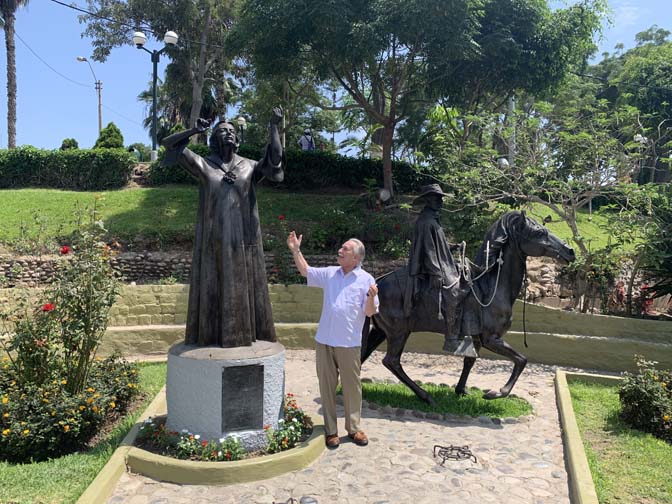
Gary Buchanan with statue of Chabuca Granda, Barranco, Lima, March 7, 2020. PHOTO: Gene Savoy Jr.
Since that time, Gene Savoy Xplorations (GSX) has developed and trademarked an official logo.
Newly trademarked logo for Gene Savoy Xplorations
The logo emphasizes the importance of the feathered, or plumed, serpent and its representation of Quetzalcoatl in Mexico, Kukulkan in Mesoamerica, and Viracocha in Peru. Readers will remember that Gene Savoy, Sr. named the three vessels he sailed Feathered Serpent I, Feathered Serpent II, and Feathered Serpent III. The first craft, which was the totora reed raft he sailed in 1969 from Peru to Panama, was also referred to as the Kuviqu, for Kukulkan, Viracocha, Quetzalcoatl.
Another positive development has been the collaboration of Gene, Jr. with Mr. Gabriel Urza. Mr. Urza, originally from Reno, Nevada, is a Fulbright Scholar and currently on the faculty of Portland State University in Portland, Oregon. (For a profile of Gabriel Urza click here.)
Mr. Urza contacted Gene in early 2021 about the possibility of writing a full biography of Gene Savoy, Sr. from his childhood and youth, to his service in the United States Navy during World War II and thereafter entering Catholic seminary to become a priest, to his explorations and life in Peru, including with The Child Jamil, the System of Cosolargy, the founding of The Community and its relocation to Reno, as well as its activities from 1957 to the present. Gene has been working with Gabriel on the project over the past year-and-a-half.
An exciting development of their working together is the opportunity for Gene to travel next month, June 2022, to the legendary site of Vilcabamba, which Gene’s father discovered in 1964. The discovery catapulted Gene Sr. on to the world stage. Gabriel invited Gene to accompany him to the famed ruins of the Inca resistance to the Spanish conquest, which Gene gladly accepted. The son of the guide who accompanied the elder Savoy in 1964 will guide the younger Savoy and Gabriel Urza on their trek next month. It is anticipated to be an exciting meeting spanning two generations of explorers!
Saturday, May 28, 2022
10:00 AM COMMUNION
Chapel of The Holy Child
RR Gene Savoy Jr.
Lector: RC Peter Foust
Cantor: Rev. Michael McIntyre
Reader: Marilyn Taylor
6:00 PM 146TH PANNUCHES MEAL RITE
Chapel of The Holy Child
RR Gene Savoy Jr.
Concelebrant:
RM Elizabeth Reece
Sunday, May 29, 2022
5:25 AM SUNRISE DIVINE SERVICE
Church of New Pentecost
Leave: 4:30
Gate: 5:10
Sunrise: 5:40
RR Gene Savoy Jr.
Concelebrants:
RC Robert Petrovich
Rev. Bruce Kanzelmeyer
Assistant: Rev. Barbara Whitney
OPEN-AIR COMMUNION
Church of New Ephesus RM Elizabeth Reece
Church of New Smyrna Rev. Barbara Whitney
Wednesday, June 1, 2022
12:00 NOON COMMUNION
Chapel of The Holy Child
Rev. Dorothy Kubiak
Friday, June 3, 2022
9:00 AM PRAYER & FELLOWSHIP
Chapel of the Roses
Rev. Noriko Roy
HEAD OVERSEER’S WEEKLY MESSAGE
Wednesday, May 25, 2022
The Twenty-second Saying (Part 15)
“When The Man had thus spoken, a Companion of The Way said, ‘Since earth is material and we are partly material, and since we are engaged in this struggle for the Light, then through our efforts matter can be transformed into higher forms of energy which could manifest and assist us in our quest for the enlightenment of not only ourselves but of the world.’
“And The Man responded to him by giving an illustration. ‘Just as the physical, material sun is used by God to reveal Knowledge of Himself to the human race, then the bodies of humankind must also be used to teach The Way to the race. Once man and woman are put in contact with their heritage – their spirit – they become Instruments of God’s Will on earth, which is to teach the human race the Judgements and the Statutes that will be coming out in the future and to establish a whole new concept of government. Once they begin to teach, then other people will follow in growing numbers. These Teachings will create a Community of followers and then the material sun, acting upon the mind and upon the material body through the atomic structure, will begin to change the thinking habits of humankind. The material sun is used by the spiritual Sun as the spiritual Sun is used by God and His Image. Thus we see a chain of events, an inner relationship of spirit to matter.
“The Image and The Word is the sea of rebirth. It is the seminal force – the spermatikos – that creates and generates life in the spirit. The spirit gives birth to the Soul and the Soul then becomes an Instrument of God’s Image and Word. That Soul is nurtured by the Image and The Word for the Soul needs nourishment – Food. The greatest motivating force of living things in the world of nature is the need to eat for survival. The second greatest motivating force is that of procreation. More than anything else, these two great forces are the driving forces of nature. Similarly, the spirit needs to be reborn and needs to eat in order to live. And that is why there are so many religions in the world, so many religious books, and the urge for man and woman to be religious. It is within them. The spirit craves nourishment and life.’
“Then said a disciple, ‘Do you suspect that other suns in the universe having planets around them serve a purpose similar to our sun?’ The Man said, ‘The manifestation of the Sun of Righteousness is a cosmic, universal event.’ And the disciple replied, ‘Then it would affect more than one physical sun, would it not?’
“‘Yes,’ answered the Teacher. ‘However, we have here an enigma, just like the enigma in the allegorical Garden of Eden. Where did God come from? Where did the Devil come from? Why was there a power of Darkness, a Dark angel? Why did they Fall? And the problem is this: If the spirit is not reborn, it cannot see God; it cannot hear His Word. And yet, how is the spirit reborn if it cannot see the Sun of Righteousness? This is one of the most fundamental teachings, not only in this religion, but in the great world religions of antiquity that taught the Way of Light.
“‘In order to have knowledge of The Image and The Word, humankind must be instructed or told. Therefore, God sends a Messenger who proclaims the existence of The Image and The Word. That is what Jamil did. He proclaimed the existence of the Sun of Righteousness in our own era. He laid the foundation for this Church. While God is the True Founder of the Church, Jamil is the Messenger – the Proclaimer – who had been sent by God to speak to humankind. Thus, we see that we must trace our authority to more than a spiritual force, not only for the world to accept it, but in order for the awakening and the rebirth to take place. Jamil came into the world, revealed the message of the existence of The Image and The Word and prepared his disciple – his successor – by ordaining him and quickening his spirit so that it could receive The Image and The Word of God. There has to be a beginning.
“‘Members of this Church have been brought into the Church because of Jamil and because of his successor – in this case, The Man – who is able to awaken in the disciples of The Child and the members of the Church a memory of their spiritual nature and a reason for their being here. This indicates that these people are pre-ordained to be here. They are old wise souls, if I may say so, and once they contact the Church and are drawn into the presence of Jamil’s successor, they are awakened and able to see The Image and The Word. And their rebirth is instantaneous. They are nurtured by The Image and The Word, but there was a beginning – this contact – which is vital.
“‘Again, we see that the physical sun is used. A child was used. Jesus was used. A man or a woman – disciples, humans – are used as the material sun is used to reach the human race. Such are the means available to The Creator.’
“And this was the commentary on the Twenty-Second Saying.”
Again, if I may be of any personal service to you, please do not hesitate to contact me.
Very truly yours in Light+,
Gene

“I am first thought, the thought that is in light. I am movement that is in all, she in whom the realm of all takes its stand, the firstborn among those who came into being, she who exists before all. She is called by three names, although she exists alone, since she is perfect. I am invisible within the thought of the invisible one. I am revealed in the immeasurable, ineffable things. I am intangible, dwelling in the intangible. I move in every creature. I am the life of my afterthought that is within every power and every eternal movement, and in invisible lights, and within the powers and angels and demons and every soul in Tartaros, and in every material soul. I live in those who came into being. I move in everyone and I enter them. I walk upright, and those who sleep I awaken. And I am the sight of those who dwell in sleep. I am the invisible one in all. I counsel those who are hidden, since I know the whole realm of all that exists in it. I am numberless beyond everyone. I am immeasurable, ineffable, yet whenever I wish, I shall reveal myself. I am the head of all. I am before all, and I am all, since I am in everyone. I am a voice speaking softly. I am from the beginning. I am in the silence that surrounds every one of them. And the hidden voice is in me, in intangible, immeasurable thought, in the immeasurable silence. I descended into the underworld and shone down on the darkness. I poured water. I am hidden in radiant waters. I gradually dawn on all by my thought. I am weighed down with the voice. Through me knowledge comes. I am in the ineffable and unknowable. I am perception and knowledge, uttering a voice by means of thought. I am the real voice. I cry out in everyone, and they recognize it, since a seed lives in them. I am the father’s thought, and through me came the voice: the knowledge of everlasting things. I am as thought for all. I am joined to unknowable and intangible thought.” ~Three Forms of First Thought
The First Thought is God’s Thought. We can’t really say that it is God’s first thought, but it is God’s first thought that began the true creation, the creation of spirit. It is the first thought that is significant to us. The quote from the Gnostic text known as “Three Forms of First Thought,” has God using the feminine “She” as a self-reference. This is rather unusual, but it should be noted that it is not incorrect. God is as much female as male, Mother as well as Father. The quote also says that this first thought is “the movement that is in all.” Today, of course, we all know that light moves, and moves fast, so if the first thought took the form of Light, then the first thought moves and moves fast. Yet it doesn’t seem to move so fast down here on earth. That is because the material realm that we live in is so far away from God that everything here moves much more slowly.
God is intangible but also dwells in the tangible. Even matter has spirit in it, and where there is spirit, there is God. Therefore, the First Thought that came from God is also in the intangible places of spirit as well as the tangible ones of matter.
This doesn’t mean that First Thought awakens us from physical sleep, although it may sometimes affect our physical sleep through dreams. What it means is that those who are spiritually asleep are awakened by First Thought, which is also God’s Light. But then, why are most people still asleep, including most of those who claim to be awake? It is because a spiritual awakening rarely happens by accident. It must be sought and sought in the proper place. Seeking a spiritual awakening in dark, cave-like churches doesn’t work. Seeking an awakening by staring at the moon at night doesn’t work. It is the Sun that is the messenger of God, not the moon. It is the Light of the Spiritual Sun that awakens those who are ready to be awakened, and that means more than just those who wish to be awakened. They must want it for the right reasons, those reasons being to help people including themselves develop spiritually, and to aid God in the Divine Plan to save the world. Seeking it for selfish reasons doesn’t work.
Real Knowledge, the kind that the Gnostics called Gnosis, isn’t found in books or in sermons. It is found in connecting with higher levels of consciousness. As we develop and raise our own consciousness, we are able to connect with higher and higher levels until we reach the highest level where we connect with God and First Thought. Then we will have Gnosis.
From the SUN TALK collection by Harold Boulette
