


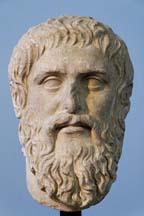
Plato sculpted by Silanion circa 370 BCE
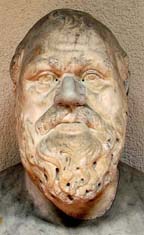
Socrates portrait by Palermo copied from the 4th-century original
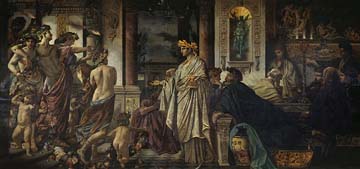
Plato’s Symposium by the German artist Anselm Feuerbach (1873)
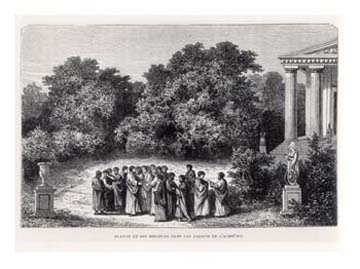
Plato and His Disciples in the Garden of the Academy by Alexandre de Baer (circa 1874), from La Vie Des Savants Illustrés
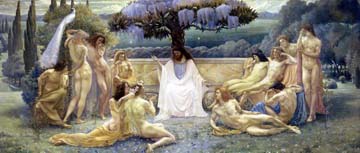
Plato’s Academy depicted by Jean Delville (1867–1953) PHOTO: theontologicalboy.blogspot.com
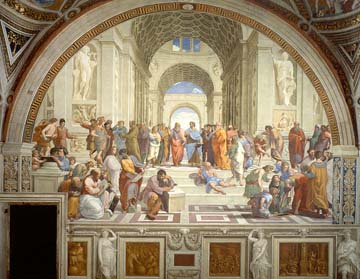
Whatever image we personally hold of Plato’s Academy could only be derived from one of these, until recently. Arts and sciences of all kinds no doubt had their place in Plato’s Academy, in all imaginable fields of study, as they do in the present global collective community of practitioners and transmitters of education and research that goes under the name of academia or Acad me or Academy. Yet the fact is that Plato’s Academy resembles nothing in modern society so much as it resembles a 501(c)3 religious association; that is to say, a church. This may come as a surprise you. It was a surprise to me when I first found the hint of this fact in the writings of Purdue University classicist Christopher Planeaux. A personal conversation with him later confirmed it. (See Supplement 1) In the next few hundred words, I would like to share with you the image of Plato’s Academy I have found.
SUPPLEMENTS
Supplement 1:

Christopher Planeaux PHOTO My Space
Plato Scholar Christopher Planeaux
I should mention that Dr. Planeaux has made it his life’s work to determine the social and historical setting of each of Plato’s Dialogues and that he shares my enthusiasm for his work but not for my search for the mystic underpinnings of Plato’s teachings.
To him I owe the references “Plato: A Family History,” “Plato: A Biography,” and “Plato’s Academy” on the website Christopher’s Athens (http:/php.iupui.edu/~cplaneaux/Plato) copyright © 1999, 2001 by Christopher Planeaux.