


PHOTO: Roger Weld
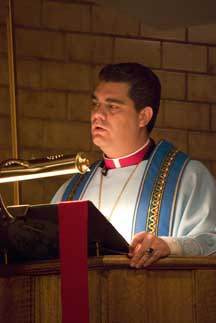
Each week of the liturgical year, a reading from Second Advent Scripture is delivered as part of the Saturday Communion of Fellowship Service held in the Chapel of the Holy Child. This reading follows the Sacred Calendar of the Church; that is, Prophecies and Revelations that have been received by The Church on sacred dates are recalled in a liturgical context during the appropriate season each year. This reading is delivered by the Officiant of the Communion Service (that is, Bishop Gene Savoy, or occasionally in his stead, Bishop Sean Savoy) just before the final blessings. Each service also includes a reading from the ancient scriptures, prayers, or wisdom sayings of various world religions past and present and is usually thematically related to the Second Advent Reading. This reading is delivered by the Reader right after the announcements that begin the service and is thus the first reading of the service. An audio recording of the reading from Second Advent Scripture delivered on the date above is provided here below together with a transcript of the first reading of the service that day.
SECOND ADVENT PROPHECY AND REVELATION
A Reading from Second Prophecy to the Americas, chapter 35, “On the Existence of Divine Reason” (pp.232-238):
< Click here to listen to this week’s reading on YouTube. (8 minutes) >
ANCIENT SCRIPTURE AND WISDOM SAYINGS
A Reading from the Teachings of Fourth-century Mystic Gregory of Nyssa:
< Click here to listen to this week’s reading on YouTube. (3 minutes) >
God has Logos: else He would be without reason. And this Logos cannot be merely an attribute of God. We are led to a more exalted conception of the Logos by the consideration that in the measure in which God is greater than we, all His predicates must also be higher than those which belong to us. Our logos is limited and transient; but the subsistence of the Divine Logos must be indestructible; and at the same time living, since the rational cannot be lifeless. . . . It follows, that, together with the Word, He Who speaks it, which is the father of the Word, must be recognized as existing. . . . We affirm that we find in the Logos, whose existence is derived from the father, all the attributes of the Father’s nature.
God created by His reason and wisdom; for He cannot have proceeded irrationally in that work; but His reason and wisdom are . . . not to be conceived as a spoken word, or as the mere possession of knowledge, but as a personal and self-willed potency. If the entire cosmos were created by this second Divine hypostasis, then certainly was man also thus created; yet not because of any necessity, but from superabounding love, that there might exist a being who could participate in the Divine perfections. If man were to be receptive of these [perfections], it is necessary that his nature should contain an element akin to God; and, in particular, that he should be immortal. This, then, man was created in the Image of God. He could not therefore be without the gifts of freedom, independence, [and] self-determination; and his participation in the Divine gifts was consequently made dependent on his virtue. Owing to this freedom he could decide in favor of evil, which cannot have its origin in the Divine will, but only in our inner selves.